

Asia's Leading Countries by Ultra-Rich Population in 2026
China has the most ultra-rich individuals in all of Asia in 2026 with 121,677.

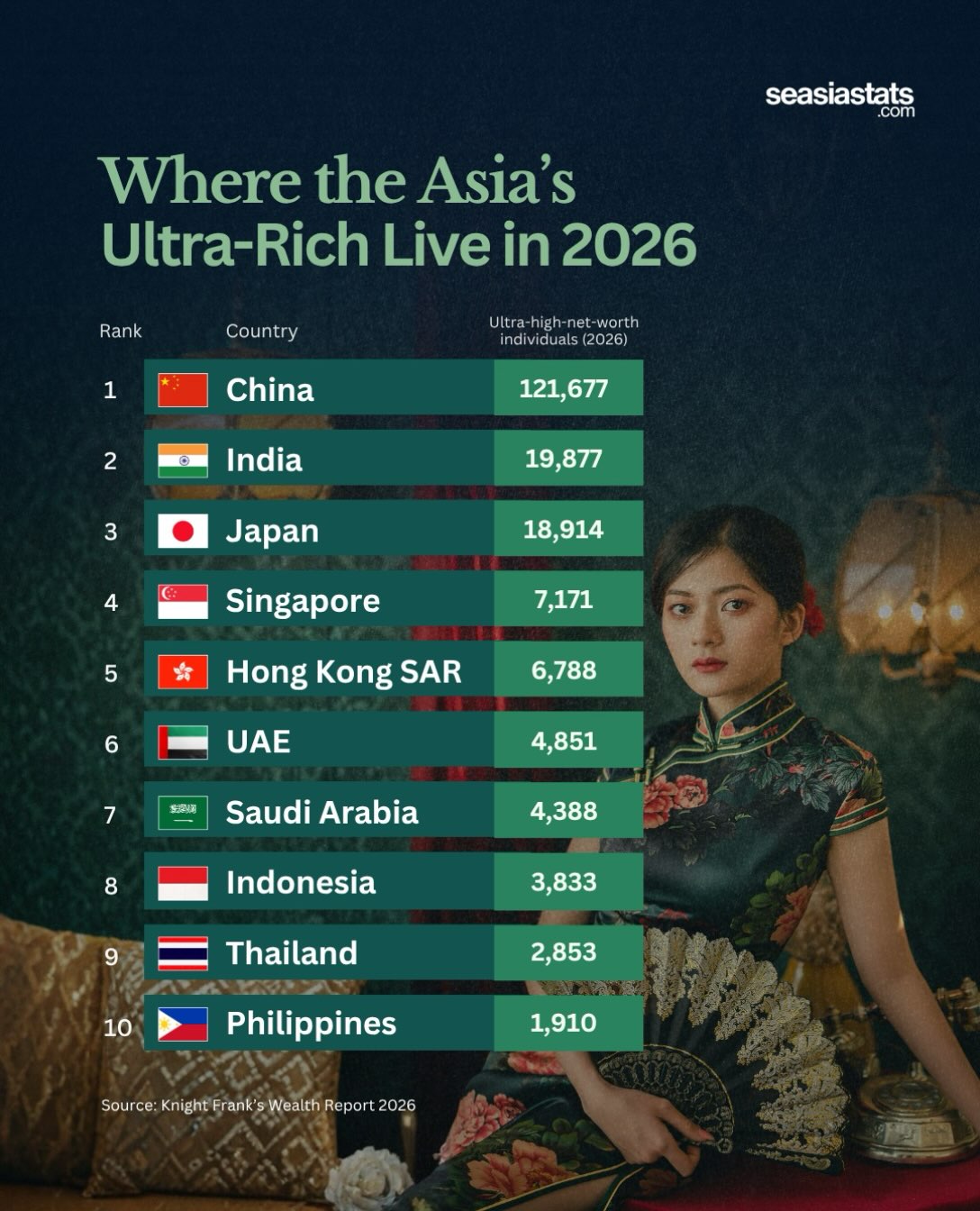
Asia is home to some of the world's largest concentrations of private wealth, with thousands of ultra-high-net-worth individuals living across its major economic and financial centers. In 2026, China leads the region by a significant margin in the number of ultra-rich residents, while India and Japan occupy the second and third positions.
The concentration of wealth across Asia is shaped by several important factors, including the size of national economies, the development of financial markets, entrepreneurial opportunities, and the influence of major business, investment, and commercial hubs.
China ranks first, with a total of 121,677 ultra-rich individuals. Its enormous economy and population, supported by strong technology, manufacturing, property, and investment industries, have helped create one of the world's largest wealthy populations.
Major cities such as Shanghai, Beijing, Shenzhen, and Hong Kong are central to the country's wealth generation and financial management. China also remains one of the leading nations globally in terms of its billionaire population.
India takes second place, recording 19,877 ultra-rich individuals. The country's growing technology, financial services, pharmaceutical, manufacturing, and consumer industries have played an important role in expanding private wealth.
Mumbai, New Delhi, and Bengaluru stand out as some of India's most significant centers for wealthy individuals and business activity.
Japan ranks third, with 18,914 ultra-rich residents. As one of Asia's most developed economies, Japan has a well-established base of affluent entrepreneurs, investors, and business owners. Tokyo continues to serve as the country's leading center for financial services, commercial operations, and corporate activity.
Beyond these three major economies, several smaller yet highly prosperous countries and financial hubs also account for considerable numbers of ultra-rich individuals.
Singapore has approximately 7,171, while Hong Kong records 6,788. Both destinations have established themselves as prominent international financial centers, attracting significant global investment, private capital, and wealth-management businesses.
In the Middle East, the United Arab Emirates (UAE) ranks among the region's leading wealth destinations, with 4,851 ultra-rich individuals. Saudi Arabia follows closely, recording 4,388. Cities such as Dubai and Abu Dhabi have become increasingly important centers for luxury real estate, financial services, international trade, and investment activities.
Saudi Arabia's affluent population, meanwhile, is strongly supported by the country's substantial economic resources and the continued development and diversification of its private business sector.
Elsewhere in Southeast Asia, Indonesia leads with 3,833 ultra-rich individuals, followed by Thailand with 2,853 and the Philippines with 1,910. Indonesia's large domestic market, growing consumer demand, and expanding corporate landscape have contributed significantly to private wealth creation, particularly in Jakarta and its surrounding areas.
Overall, the figures demonstrate that Asia's ultra-rich population is concentrated across two main types of destinations: large, powerful national economies and strategically important international financial centers.
China maintains a considerable lead over every other country and territory, while India and Japan form the next two major centers of private wealth in the region.
Meanwhile, Singapore, Hong Kong, the UAE, Saudi Arabia, Indonesia, Thailand, and the Philippines illustrate the growing importance of Asia's financial markets and business communities in the global distribution of wealth.
Together, these countries reflect the region's expanding influence on international investment, entrepreneurship, and private wealth management.