

Asia's Most Connected Airports in 2026
UAE's Dubai International Airport is the most connected airport in all of Asia.

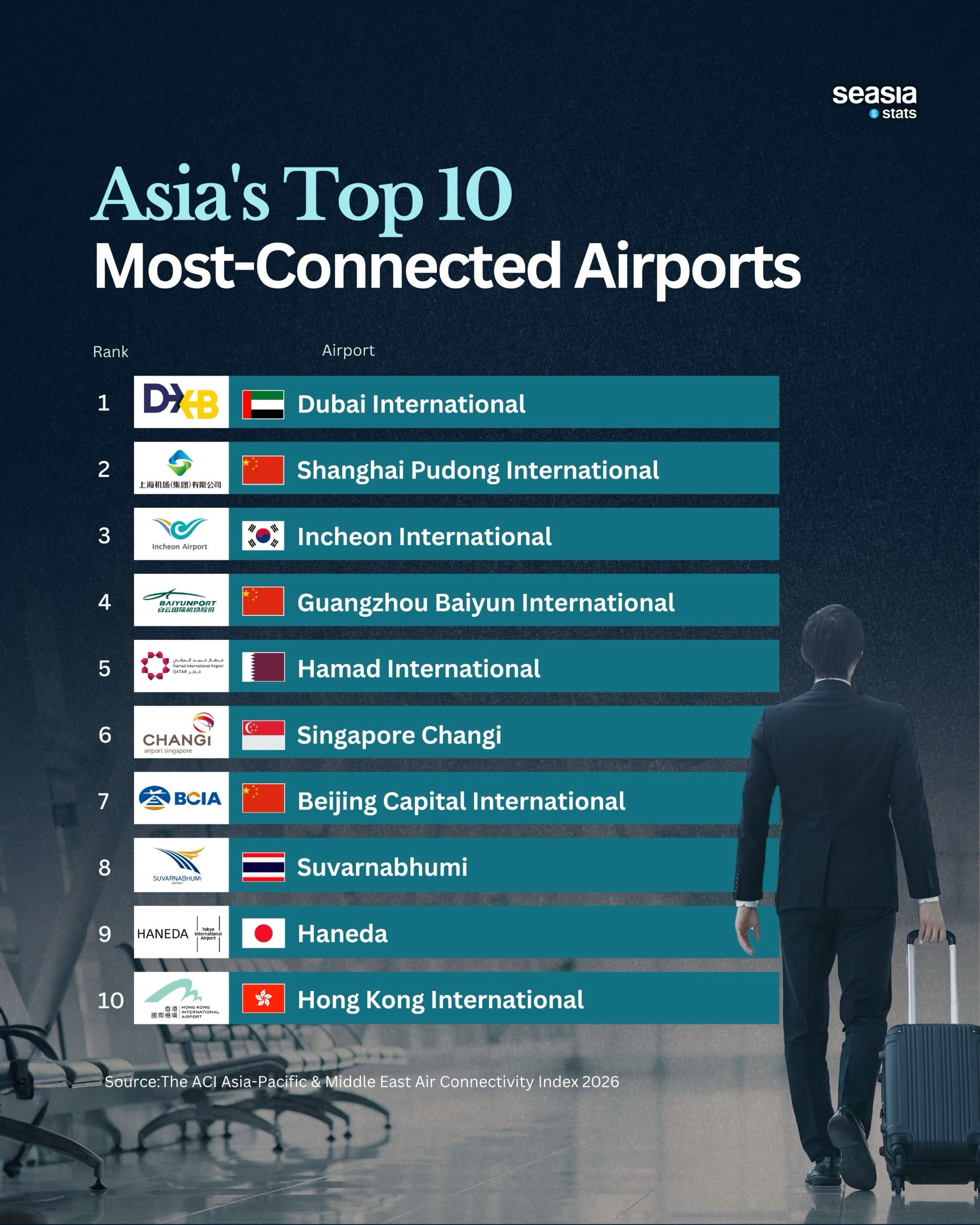
Asia and the Middle East are home to some of the world’s most important aviation hubs, linking major cities with destinations across continents.
According to the ACI Asia-Pacific and Middle East Air Connectivity Index 2026, the region’s most connected airports include major hubs in the United Arab Emirates, China, South Korea, Qatar, Singapore, Thailand, Japan, and Hong Kong.
At the top of the ranking is Dubai International Airport, reflecting Dubai’s position as a major global crossroads between Asia, Europe, Africa, and the Middle East. Its extensive international network makes it a crucial transfer point for millions of travelers.
Second is Shanghai Pudong International Airport, one of China’s most important international aviation gateways. The airport connects Shanghai with destinations throughout Asia and an expanding network of long-haul markets.
Incheon International Airport ranks third. Serving the Seoul metropolitan area, Incheon has developed into a major Northeast Asian hub, providing extensive connections to destinations across Asia, North America, Europe, and beyond.
China has another airport near the top of the list with Guangzhou Baiyun International Airport. As a gateway to southern China and the Greater Bay Area, Baiyun plays an important role in both domestic and international air transportation.
The fifth-ranked airport is Hamad International Airport. Doha's strategic location between Europe, Asia, and Africa has helped the airport become a significant global connecting hub.
Singapore Changi Airport ranks sixth. Changi is one of Southeast Asia’s leading aviation gateways and serves as a major connection point between Southeast Asia, East Asia, South Asia, Europe, and other regions.
The ranking also includes Beijing Capital International Airport, highlighting the Chinese capital's importance to international aviation. Thailand's Suvarnabhumi Airport is another leading Southeast Asian hub, connecting Bangkok with a broad range of destinations.
Japan is represented by Haneda Airport, which benefits from its location close to Tokyo and its extensive domestic and international services. Completing the top ten is Hong Kong International Airport, a major gateway linking the city with mainland China and global markets.
These airports demonstrate the extraordinary importance of Asia and the Middle East to global aviation. Their connectivity reflects not only passenger demand but also the strategic geographic locations of the cities and economies they serve.