

Asia's Most Influential Leaders
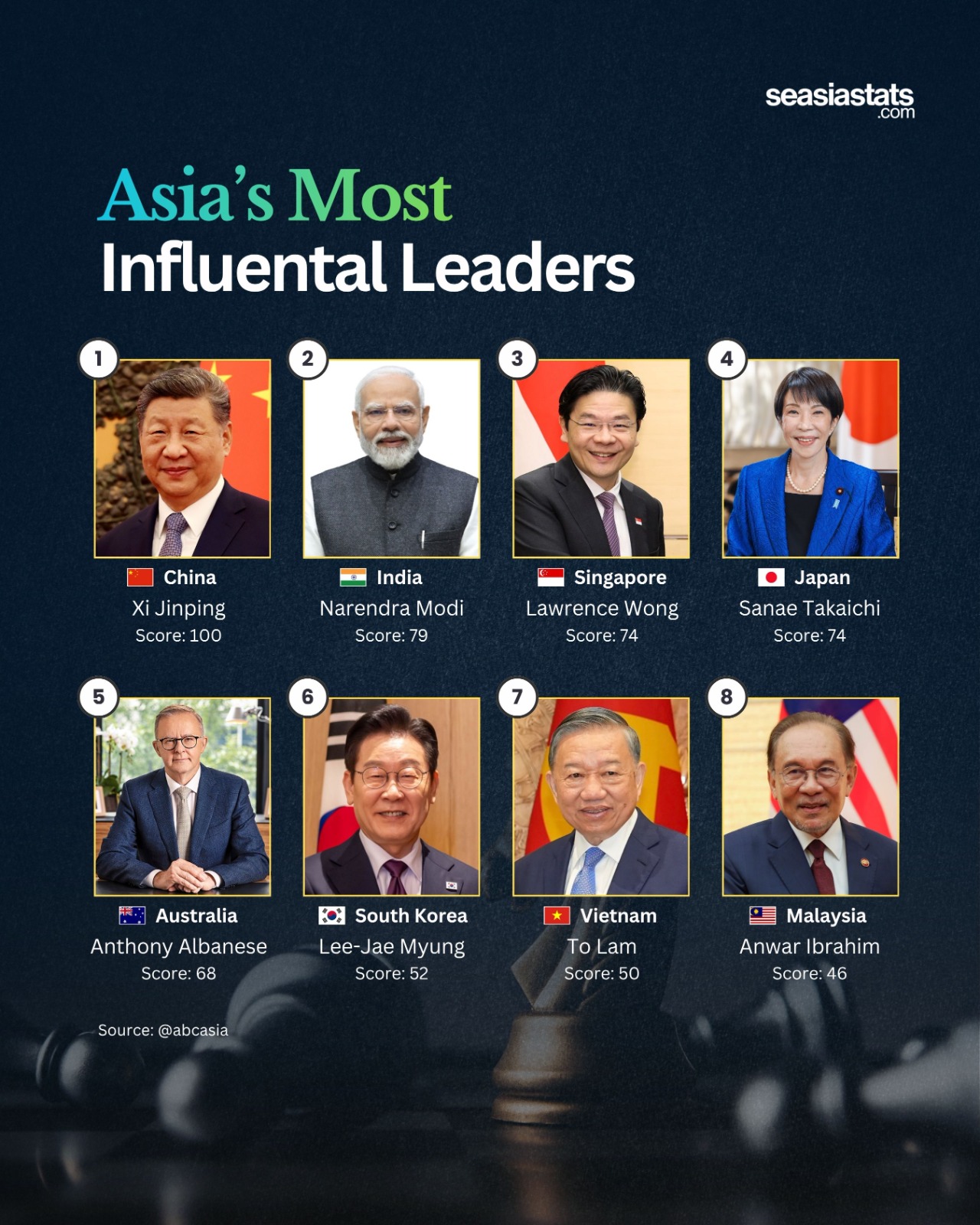
China's Xi Jinping is the most influential leader in Asia according to ABC Asia.

Asia remains one of the world's most important centers of political, economic, and strategic influence. Its leaders play significant roles in shaping international relations, driving economic development, maintaining regional stability, and addressing global challenges. According to the ABC Asia ranking, these are several most prominent leaders whose influence reflects their countries' growing importance in regional and international affairs.
Xi Jinping ranks first with 100 points, making him the most influential leader in Asia according to the ranking. As China's president and the central figure in its political system, Xi holds considerable authority over one of the world's largest economies and most powerful military forces. His leadership influences international trade, global security, technological development, and China's diplomatic relationships with countries across the world. China's growing international presence makes his position particularly significant.
In second place is Indian Prime Minister Narendra Modi, scoring 79 points. As the leader of the world's most populous country, Modi has strengthened India's international profile through economic initiatives, diplomatic engagement, and strategic partnerships. India's expanding economy and increasingly important role in international affairs contribute significantly to his influence.
Singapore's Prime Minister Lawrence Wong and Japan's Prime Minister Sanae Takaichi share third place with 74 points each. Wong represents Singapore's strategic importance as a global financial and commercial hub, while Takaichi leads Japan, a major economic and technological power in Asia. Both leaders face important challenges involving economic competitiveness, regional security, and their countries' positions in an increasingly complex international environment.
Australian Prime Minister Anthony Albanese follows with 68 points. Although Australia is geographically and politically distinct from many Asian countries, its strategic partnerships, economic connections, and security cooperation make it an important participant in regional affairs.
South Korean President Lee Jae Myung receives 52 points, reflecting South Korea's significance in technological innovation, international trade, and security matters. Meanwhile, Vietnam's leader To Lam scores 50 points. Vietnam's growing manufacturing sector and expanding diplomatic relationships have strengthened its position in the Asian region.
Finally, Malaysian Prime Minister Anwar Ibrahim records 46 points. His leadership focuses on economic development, regional cooperation, and strengthening Malaysia's international relationships.
Overall, the ABC Asia ranking highlights the diversity of political influence across the continent. While Xi Jinping maintains a commanding lead, the other leaders demonstrate that Asia's future is shaped by multiple countries with different strengths, ambitions, and strategic priorities. Together, their decisions will continue to influence the region's political and economic direction.