

Asia's Most Populous Countries in 2026
India and China are still leading the population numbers both in Asia and the world.

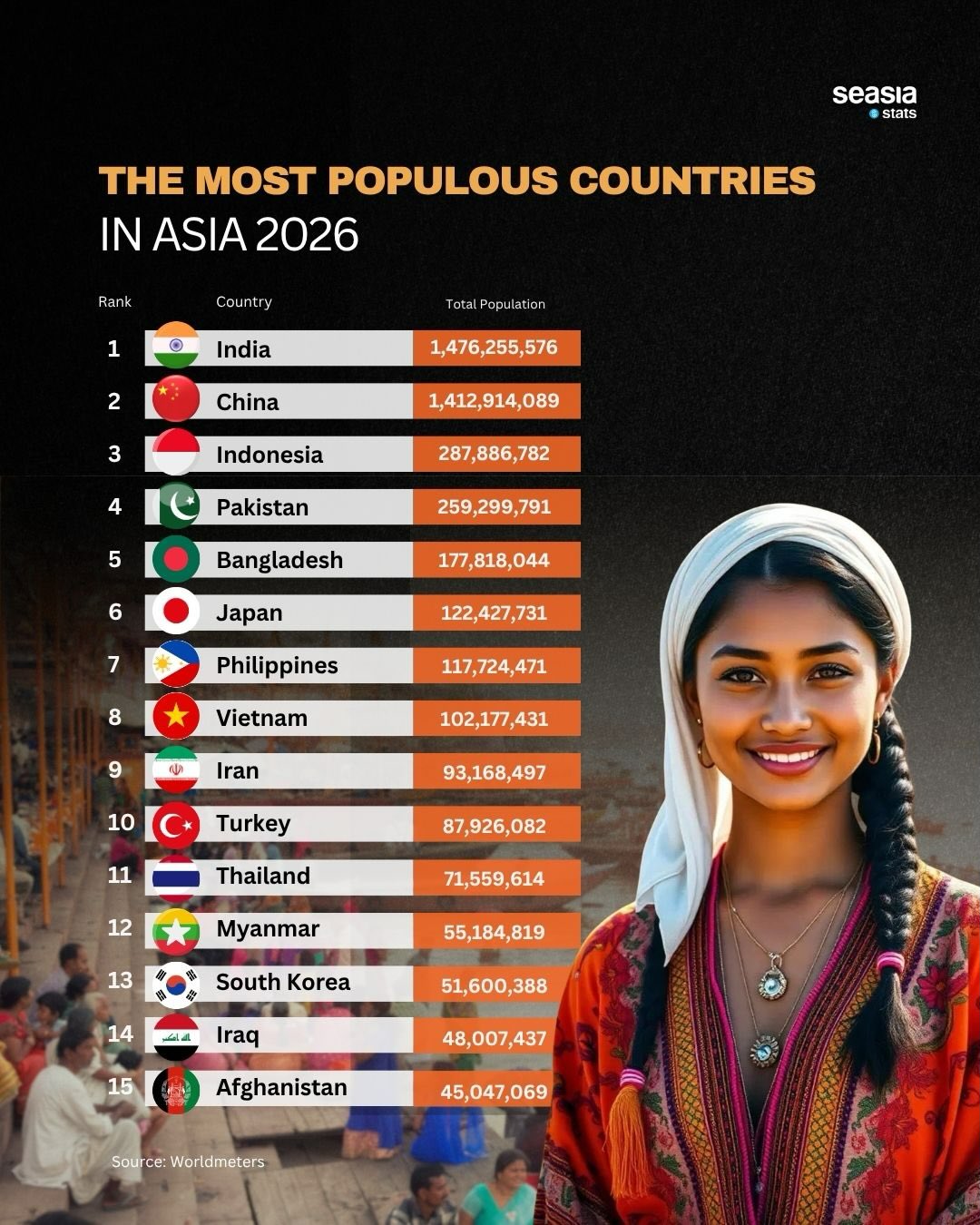
According to Worldometers, Asia remains the world's most populous continent in 2026, with several countries home to hundreds of millions of people. Population size plays a significant role in shaping economic growth, labor markets, urban development, and public services. The latest figures highlight the remarkable scale of the region's demographic landscape.
India continues to rank as the world's most populous country, with 1,476,255,576 people. It is followed by China, whose population stands at 1,412,914,089. Together, these two nations account for nearly three billion people, making them central to global economic and demographic trends.
Indonesia ranks third with a population of 287,886,782, maintaining its position as the largest country in Southeast Asia. Pakistan follows with 259,299,791 residents, while Bangladesh rounds out the top five with 177,818,044 people. These countries continue to experience significant population pressures alongside rapid urbanization and economic development.
Japan, despite its aging population, remains one of Asia's largest nations with 122,427,731 people. The Philippines follows closely with 117,724,471, reflecting its steady population growth driven by a relatively young demographic profile. Vietnam has also surpassed the 100 million mark, reaching 102,177,431 residents.
In Western Asia, Iran's population has grown to 93,168,497, while Turkey records 87,926,082 people, reinforcing their importance as regional economic and political powers. Thailand remains one of Southeast Asia's major nations with 71,559,614 inhabitants.
Myanmar has a population of 55,184,819, while South Korea records 51,600,388 residents. Although South Korea has a smaller population than many neighboring countries, it remains one of Asia's most advanced economies, supported by high levels of education, technology, and industrial development.
Rounding out the list are Iraq, with 48,007,437 people, and Afghanistan, whose population has reached 45,047,069. Both countries continue to face demographic challenges while working toward long-term social and economic development.
These population figures illustrate the immense diversity and scale of Asia. While some countries are experiencing rapid population growth, others are facing slower growth or demographic decline.
Governments across the region must balance the demands of expanding populations, aging societies, urban infrastructure, healthcare, education, and employment. As populations continue to evolve, these demographic trends will remain a major factor influencing economic development, public policy, and regional cooperation throughout Asia in the years ahead.