

Asia's Oldest National Anthems
Japan has the oldest national anthem in Asia still being sung today.

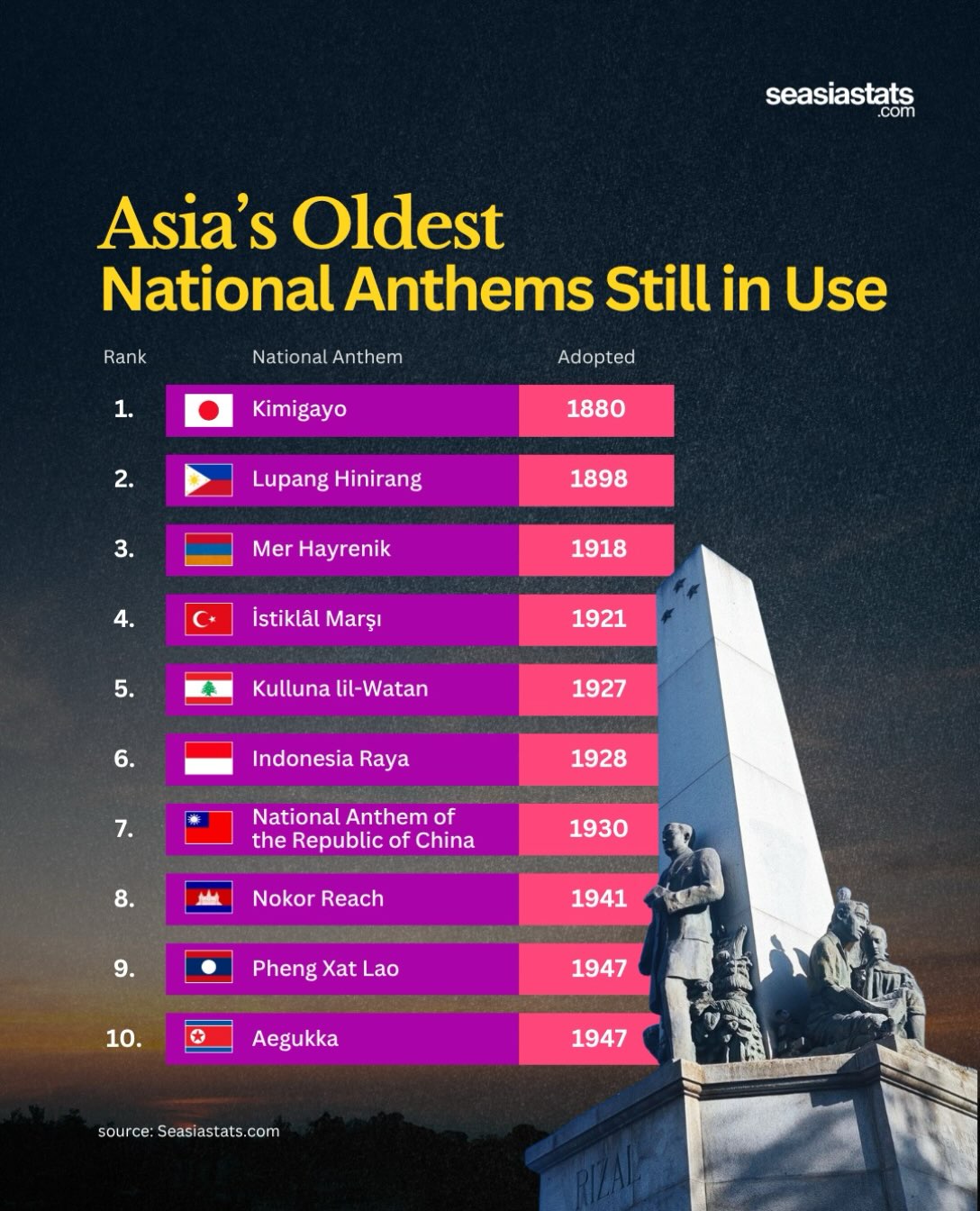
National anthems are among the most widely recognized symbols of a nation, reflecting its history, cultural identity, independence, and hopes for the future. Across Asia, several countries have national anthems with roots dating back more than a hundred years.
One of the oldest anthems still connected with a country today is Japan’s “Kimigayo,” whose current melody was composed in 1880. However, its lyrics are much older, originating from a traditional Japanese poem documented in the Kokin Wakashū around the tenth century. The anthem was officially established by law in 1999.
The Philippines’ “Lupang Hinirang” is another historically significant anthem. Its music was composed by Julián Felipe in 1898 and was first played during the declaration of Philippine independence on June 12 of the same year.
The original lyrics were written in Spanish, before the Filipino version was later adopted as the official text. Under current Philippine law, the anthem must be sung in the national language.
Armenia’s “Mer Hayrenik,” which translates to “Our Fatherland,” was adopted in 1918 by the First Republic of Armenia. The anthem fell out of use during the Soviet era but was reinstated after the country regained independence in 1991, with some changes to its lyrics. Its origins therefore predate its continuous use in modern Armenia.
Turkey’s “İstiklal Marşı,” meaning “Independence March,” was officially adopted on March 12, 1921, during the Turkish War of Independence. Written by Mehmet Akif Ersoy, it became the national anthem of the Republic of Turkey and continues to be used today.
Lebanon adopted its national anthem, “Kulluna lil-Watan,” in 1927. Its lyrics were written by Rachid Nakhle, while the musical composition was created by Wadih Sabra.
Indonesia’s “Indonesia Raya” was first introduced by Wage Rudolf Supratman in 1928 during the Youth Pledge. Following the country’s independence in 1945, it became the official national anthem of Indonesia.
The Republic of China adopted its National Anthem in 1930, and it continues to serve as the anthem of the Republic of China, based in Taiwan. Cambodia’s “Nokor Reach” was adopted in 1941, but its status changed over the years as it was replaced and later reinstated, most recently in 1993.
Lastly, Laos’ “Pheng Xat Lao” has a national-anthem history dating back to 1947. North Korea’s “Aegukka” was also adopted in 1947, following its composition in the mid-1940s.
Taken together, these anthems illustrate how music can endure through political transformations, independence struggles, changes in leadership, and the passage of generations. Across Asia, they remain meaningful expressions of national identity and lasting reminders of each country’s historical journey.