

Australia's 2025 Population by Country of Birth
32% of overseas-born in Australia comes from ten countries.

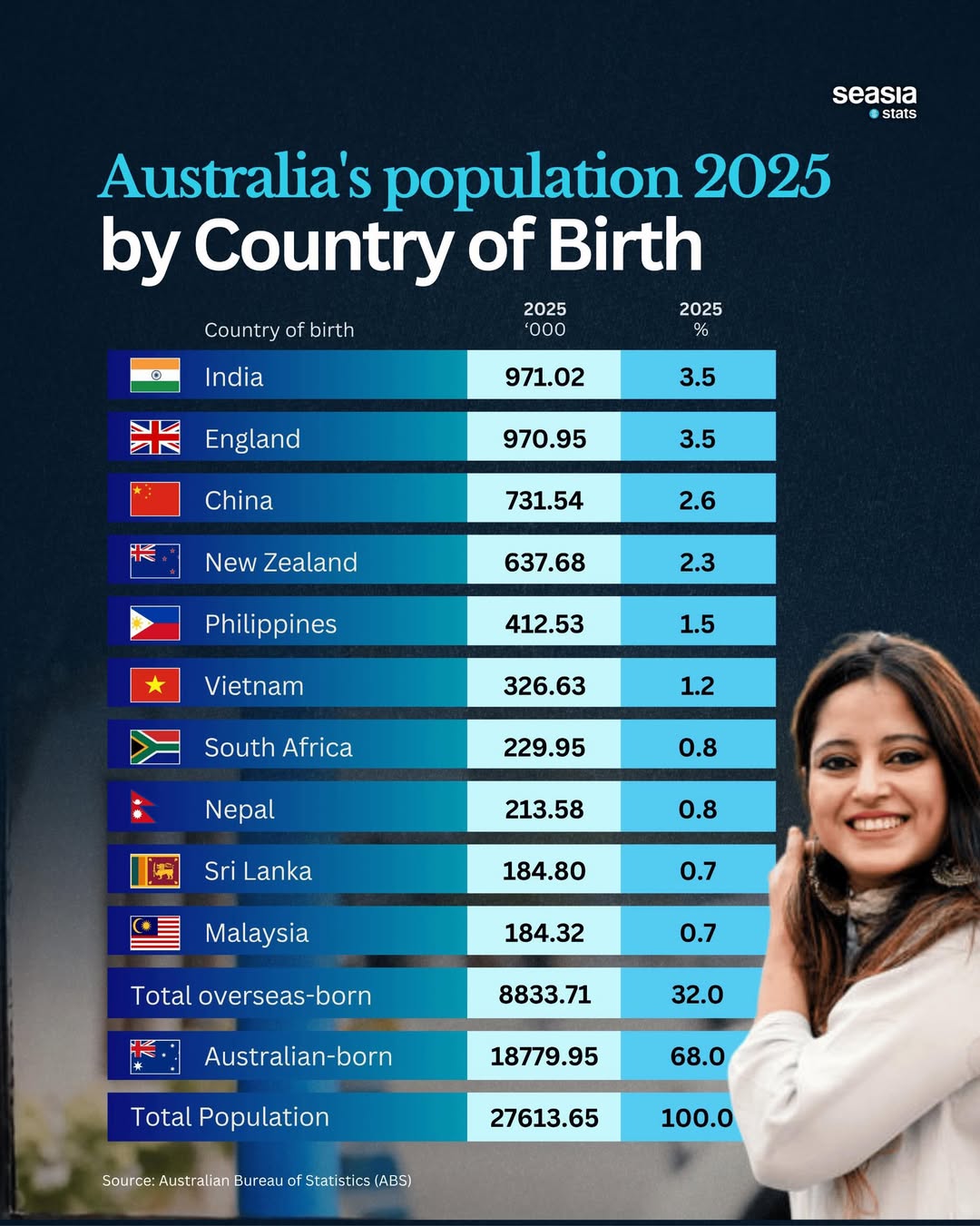
Australia remains one of the world's most multicultural nations, with migration continuing to play a significant role in shaping the country's demographic profile. In 2025, overseas-born residents account for 32.0% of Australia's population, while 68.0% are Australian-born.
This diverse population reflects decades of immigration from various regions around the world, contributing to Australia's economic growth, cultural richness, and social development.
Among overseas-born residents, India and England are the largest countries of birth, each representing 3.5% of Australia's total population. The Indian-born community has grown rapidly in recent years, driven by skilled migration, international education, and family reunification programs.
Indian Australians make substantial contributions across sectors such as information technology, healthcare, engineering, and business. Meanwhile, migrants from England continue to form a significant part of Australia's population due to the long-standing historical, cultural, and linguistic ties between the two countries.
China is the third-largest overseas-born group, accounting for 2.6% of the population. Chinese Australians contribute strongly to education, commerce, research, and international trade. New Zealand follows with 2.3%, reflecting the close relationship and freedom of movement arrangements between the two neighboring countries.
The Philippines represents 1.5% of Australia's population by country of birth. Filipino Australians are known for their growing presence in healthcare, community services, and professional occupations.
Vietnam accounts for 1.2%, highlighting the lasting impact of migration that began in the late twentieth century and has since expanded into thriving communities across major Australian cities.
Several other countries also contribute significantly to Australia's multicultural landscape. South Africa and Nepal each account for 0.8% of the population. South African migrants bring expertise across various professional fields, while the Nepalese community has experienced strong growth through education and skilled migration pathways.
Sri Lanka and Malaysia each represent 0.7% of the population, adding further cultural diversity and strengthening Australia's connections with South and Southeast Asia.
Together, these overseas-born communities contribute to Australia's identity as a dynamic and inclusive society. Their diverse languages, traditions, skills, and experiences enrich local communities and support economic development nationwide.
As migration continues to shape demographic trends, Australia's multicultural population remains one of its greatest strengths, fostering innovation, global connections, and cultural understanding.
In 2025, the balance between Australian-born residents and a substantial overseas-born population reflects the country's ongoing evolution as a diverse and globally connected nation.