

Average One Way Commute Time in Asia's Capitals
For one way commute in Asia's capitals, Dhaka has the longest average time while Tokyo has the shortest.

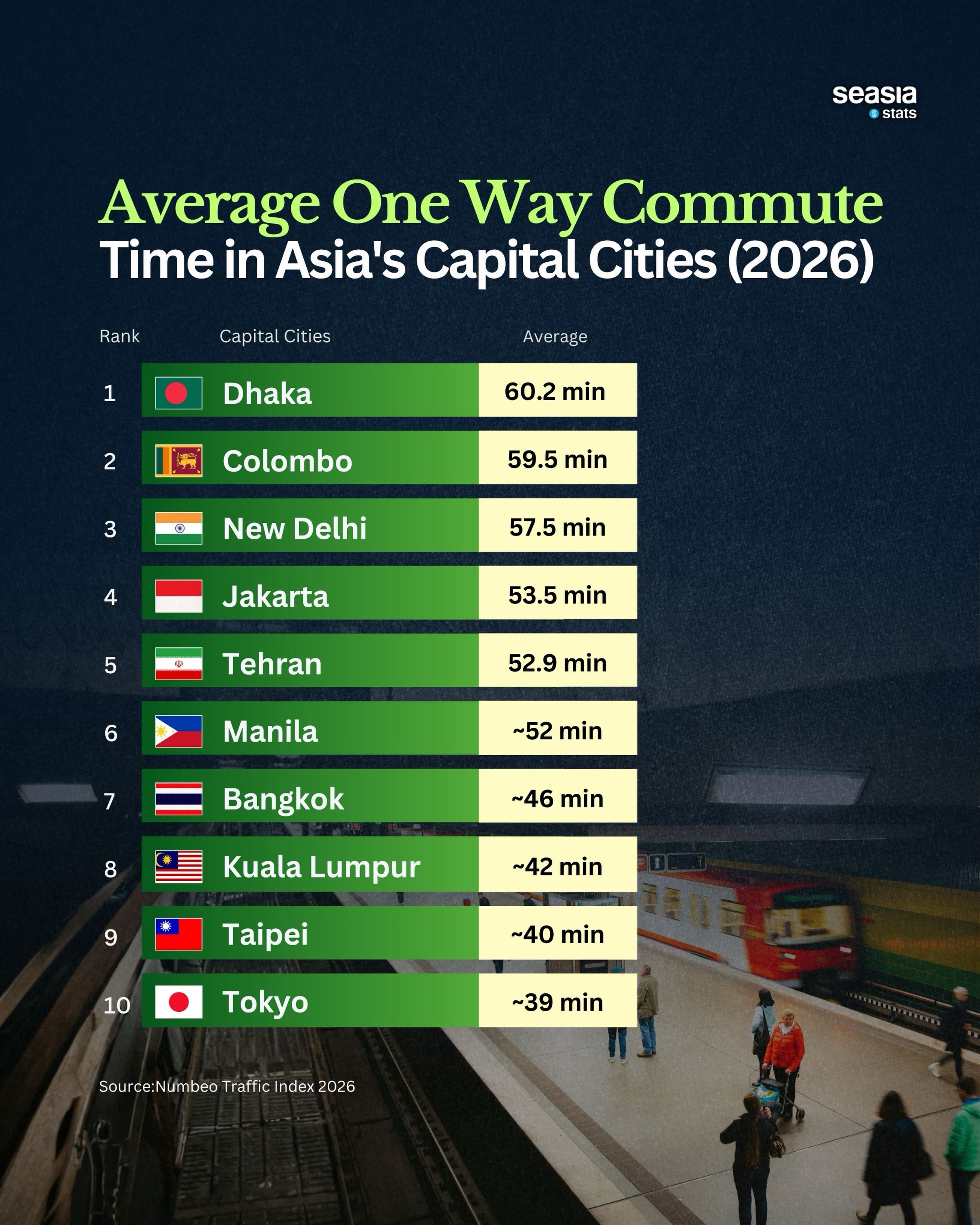
The 2026 Numbeo Traffic Index highlights the daily commuting challenges faced by millions of people across Asia's largest capital cities. Based on user-contributed data, the index measures the average one-way commute time, offering insight into the efficiency of urban transportation systems and the impact of congestion on everyday life.
Among the surveyed capitals, Dhaka recorded the longest average one-way commute at 60.2 minutes, making it the most time-consuming capital city for commuters in this comparison.
Colombo followed closely with 59.5 minutes, while New Delhi ranked third at 57.5 minutes. These figures reflect the growing pressures of rapid urbanization, increasing vehicle ownership, and infrastructure struggling to keep pace with population growth.
Jakarta ranked fourth with an average commute time of 53.5 minutes, followed by Tehran at 52.9 minutes and Manila at approximately 52 minutes.
Although these cities have expanded their public transportation networks in recent years, heavy traffic congestion, sprawling metropolitan areas, and high travel demand continue to contribute to lengthy daily journeys. For many workers, spending nearly an hour traveling to work each way has become part of everyday life.
Further down the ranking, Bangkok recorded an average commute time of around 46 minutes, while Kuala Lumpur averaged approximately 42 minutes. Both cities have invested heavily in rail transit and road infrastructure, helping to moderate commute times despite continued urban growth.
Taipei, known for its highly efficient metro system, reported an average commute of around 40 minutes, demonstrating the benefits of an integrated public transportation network.
Among the capitals listed, Tokyo had the shortest average commute time at approximately 39 minutes. Despite being one of the world's largest metropolitan areas, Tokyo's extensive railway network, frequent train services, and well-coordinated urban planning help keep travel times comparatively lower than many other major Asian capitals.
The 2026 Numbeo Traffic Index illustrates the diverse transportation challenges across Asia. While every city faces congestion to varying degrees, the results suggest that sustained investment in efficient public transportation, smart urban planning, and multimodal mobility can significantly improve commuting experiences.
As Asian cities continue to grow, reducing travel times will remain an important objective for improving productivity, economic competitiveness, and residents' overall quality of life.