

Belief in the Afterlife in Asia
Here's how many Asians believe in the afterlife.

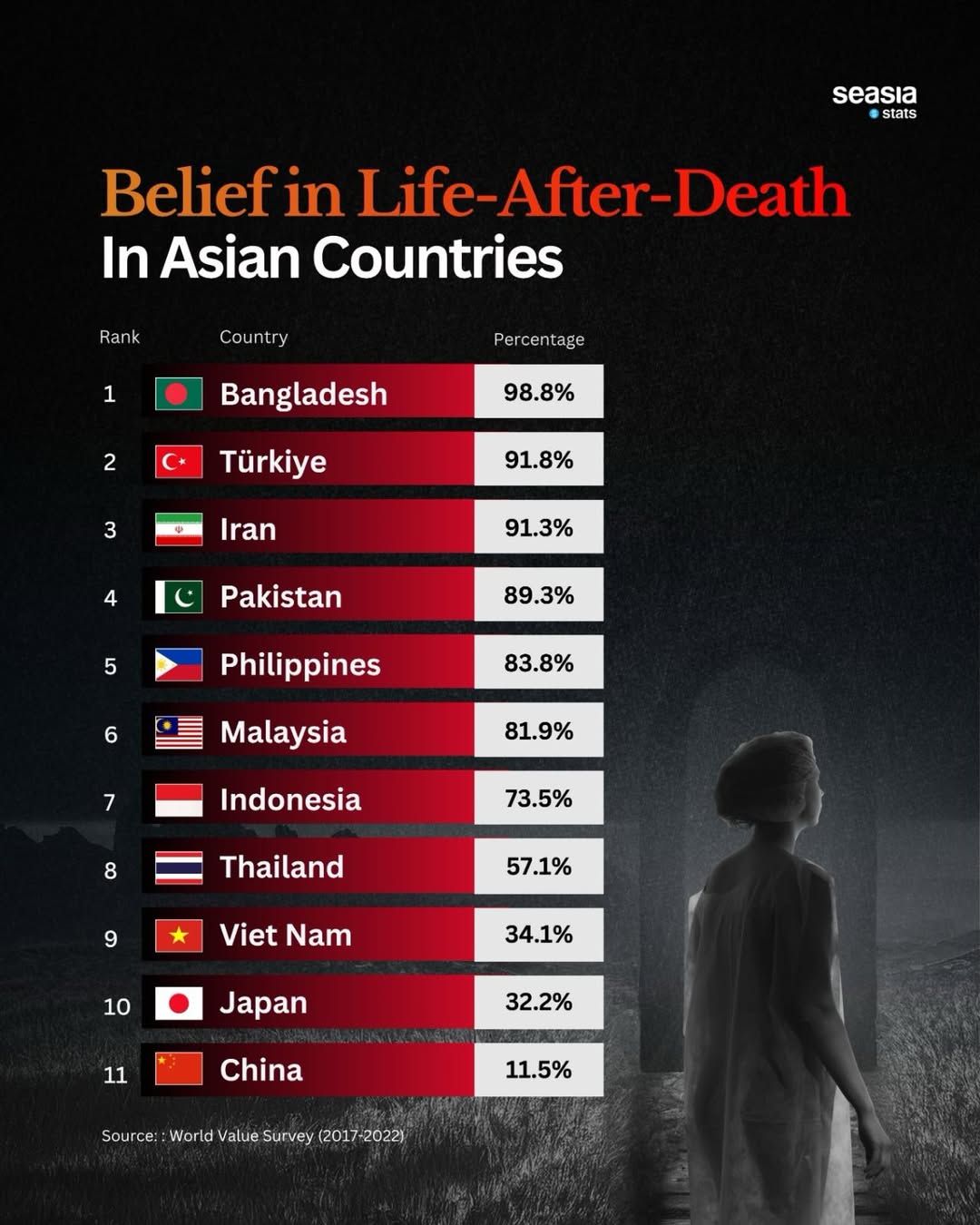
Belief in life after death remains an important aspect of religious and spiritual life across many Asian societies. According to data from the World Values Survey, significant differences exist among countries in the percentage of people who believe that life continues after death, reflecting diverse religious traditions, cultural values, and historical experiences.
At the top of the ranking is Bangladesh, where an overwhelming 98.8 percent of respondents expressed belief in life after death. This exceptionally high figure reflects the strong influence of Islam, which teaches the existence of an afterlife and accountability beyond earthly life.
Turkey ranks second with 91.8 percent, followed closely by Iran at 91.3 percent. Both countries have deep-rooted Islamic traditions that emphasize belief in the afterlife as a central element of faith. Pakistan also records a very high percentage at 89.3 percent, further demonstrating the strong role of religious belief in shaping public attitudes.
The Philippines ranks fifth with 83.8 percent. As Asia's largest predominantly Christian nation, belief in heaven, resurrection, and eternal life remains deeply embedded in Filipino culture and religious practice. Malaysia follows with 81.9 percent, reflecting the influence of Islam alongside the country's multicultural religious landscape.
Indonesia, the world's largest Muslim-majority nation, records a belief rate of 73.5 percent. While lower than several other Muslim-majority countries in the survey, the figure still indicates that belief in life after death is shared by a substantial majority of Indonesians.
Further down the list is Thailand at 57.1 percent. Thai society is strongly influenced by Buddhism, which traditionally emphasizes concepts such as rebirth and reincarnation rather than the afterlife as understood in Abrahamic religions. This difference in religious interpretation may contribute to the lower percentage.
Vietnam records a belief rate of 34.1 percent, while Japan stands at 32.2 percent. Both countries have experienced significant secularization and are influenced by religious traditions that often focus more on ancestral respect, spiritual harmony, or cyclical existence than on a clearly defined afterlife.
At the bottom of the ranking is China, where only 11.5 percent of respondents reported believing in life after death. Decades of secular governance, combined with cultural and philosophical traditions that place greater emphasis on life in the present world, may help explain this comparatively low figure.
The World Values Survey data highlights the remarkable diversity of spiritual beliefs across Asia. While belief in life after death remains nearly universal in some countries, it is far less common in others, illustrating how religion, culture, and history continue to shape perspectives on one of humanity's oldest questions.