

BRICS Member and Partner Countries
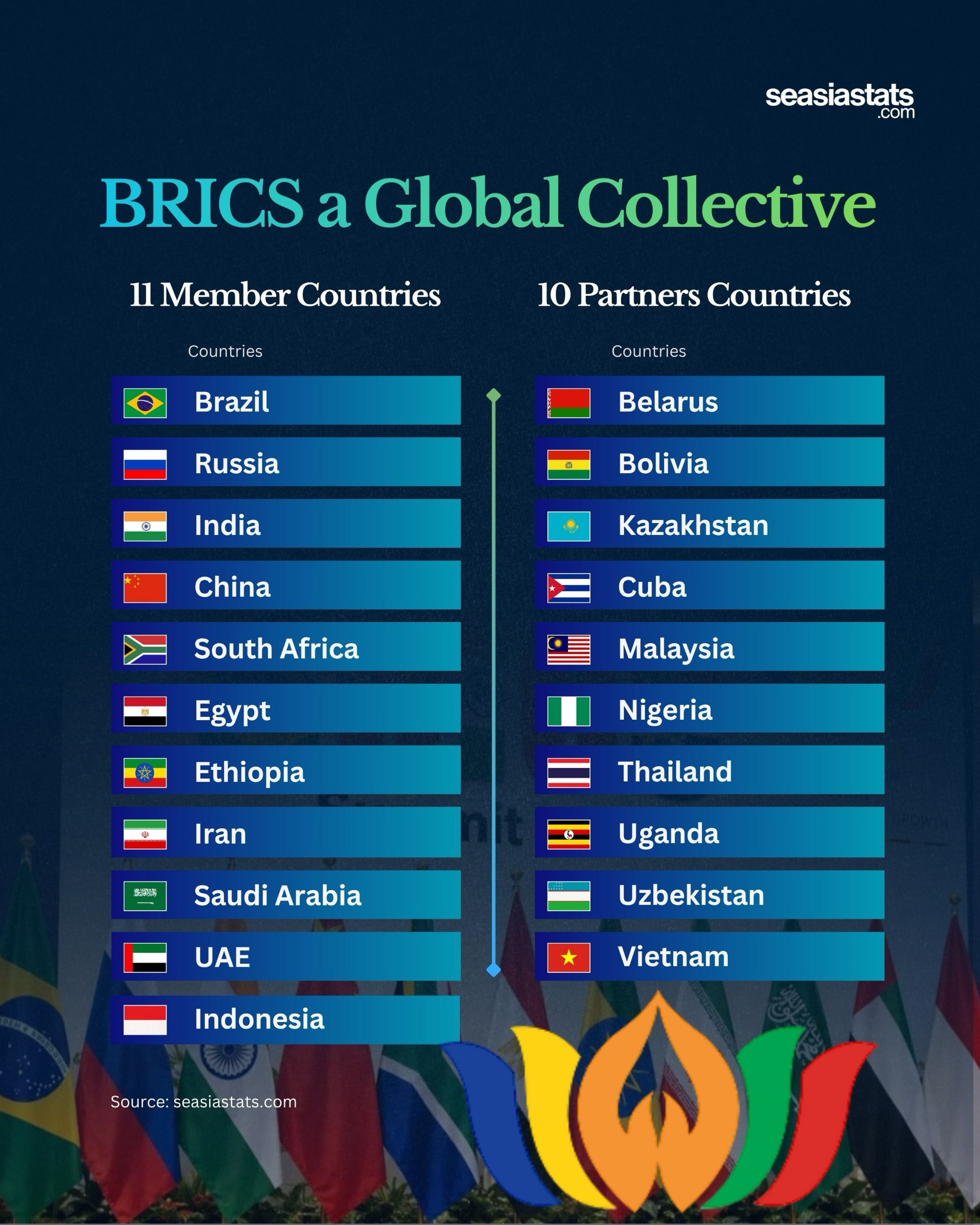
From just five, now BRICS has eleven members and ten partner countries.

BRICS is an important international grouping that brings together emerging economies from different regions of the world. It was originally formed by Brazil, Russia, India, and China, with South Africa joining in 2010.
In recent years, BRICS has expanded to include additional members and partner countries, making it a more diverse group with a larger role in global economic and political discussions.
The BRICS member countries are Brazil, Russia, India, China, South Africa, Egypt, Ethiopia, Iran, Saudi Arabia, the United Arab Emirates (UAE), and Indonesia. These countries represent a large share of the world's population, territory, natural resources, and economic activity. Each member has different strengths.
Brazil is a major agricultural producer, Russia is rich in energy and natural resources, India has a large and growing economy, while China is one of the world's leading manufacturing and trading nations.
South Africa plays an important role in Africa, while Egypt and Ethiopia provide strong connections to the African continent. Iran, Saudi Arabia, and the UAE are important energy-producing countries in the Middle East.
Indonesia, as one of Southeast Asia's largest economies and most populous countries, adds an important Southeast Asian perspective to BRICS.
Alongside its full members, BRICS has a group of partner countries. These are Belarus, Bolivia, Kazakhstan, Cuba, Malaysia, Nigeria, Thailand, Uganda, Uzbekistan, and Vietnam.
Partner countries strengthen BRICS's connections with other regions and provide opportunities for greater cooperation in areas such as trade, investment, infrastructure, energy, agriculture, technology, and development.
The expansion of BRICS reflects the growing importance of developing and emerging economies in world affairs. The group aims to promote cooperation among its members and partners while giving greater representation to countries outside traditional Western-led institutions.
BRICS discussions can cover issues such as economic development, international trade, financial cooperation, climate change, food security, and global governance.
Overall, the growing membership and partnership of BRICS demonstrate its increasing international reach.
With countries from South America, Europe, Asia, Africa, and the Middle East, the group provides a platform for diverse nations to cooperate and discuss shared interests. Its future development may have a significant influence on global economic cooperation and the balance of power in international affairs.