

China vs United States in Southeast Asia
This is how Southeast Asians choose between China and United States.

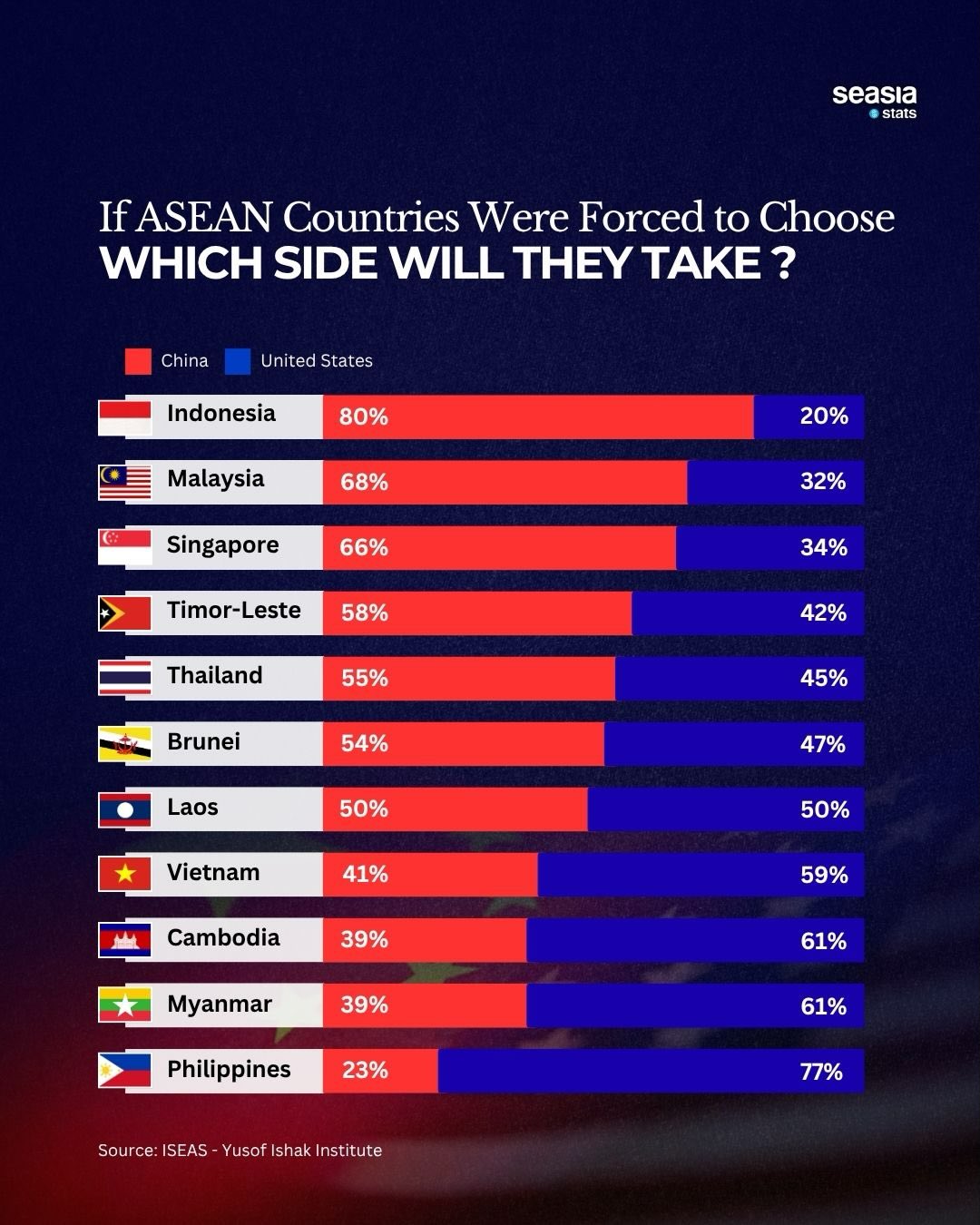
As competition between China and the United States continues to shape global politics and economics, Southeast Asia has become an increasingly important region in the strategic rivalry between the two powers.
According to survey findings from the ISEAS – Yusof Ishak Institute, respondents across Southeast Asia were asked which country they would choose if forced to align with either China or the United States. The results reveal significant differences among nations, reflecting diverse economic ties, security concerns, and historical relationships.
Among the countries surveyed, Indonesia showed the strongest preference for China, with 80% choosing China and only 20% favoring the United States. Malaysia also leaned heavily toward China, with 68% selecting China compared to 32% for the United States.
Singapore, despite its close economic and security links with the West, recorded a surprisingly strong preference for China at 66%, while 34% chose the United States.
Several other countries also showed a majority preference for China. Timor-Leste registered 58% support for China and 42% for the United States. Thailand followed with 55% favoring China and 45% choosing the United States. Brunei also leaned toward China, with a narrow majority of 54% compared to 46% for the United States.
Laos stood out as the most evenly divided country in the survey, with respondents split equally between the two powers at 50% each. This reflects the country's balancing act between its growing economic dependence on China and its broader engagement with international partners.
In contrast, several Southeast Asian nations demonstrated stronger support for the United States. Vietnam recorded 59% support for the United States and 41% for China. Cambodia and Myanmar each showed identical results, with 61% favoring the United States and 39% preferring China.
The Philippines emerged as the most pro-American country in the survey. A substantial 77% of respondents selected the United States, while only 23% chose China. This outcome is likely influenced by longstanding historical ties, defense cooperation, and public perceptions regarding regional security issues.
Overall, the survey highlights the diversity of strategic preferences across Southeast Asia. While six countries favored China, four preferred the United States, and one was evenly divided. The findings underscore that Southeast Asia is far from unified in its outlook toward the world's two leading powers.
Instead, national interests, economic opportunities, historical experiences, and security considerations continue to shape how each country views the evolving balance between China and the United States.