

Churches in Southeast Asia
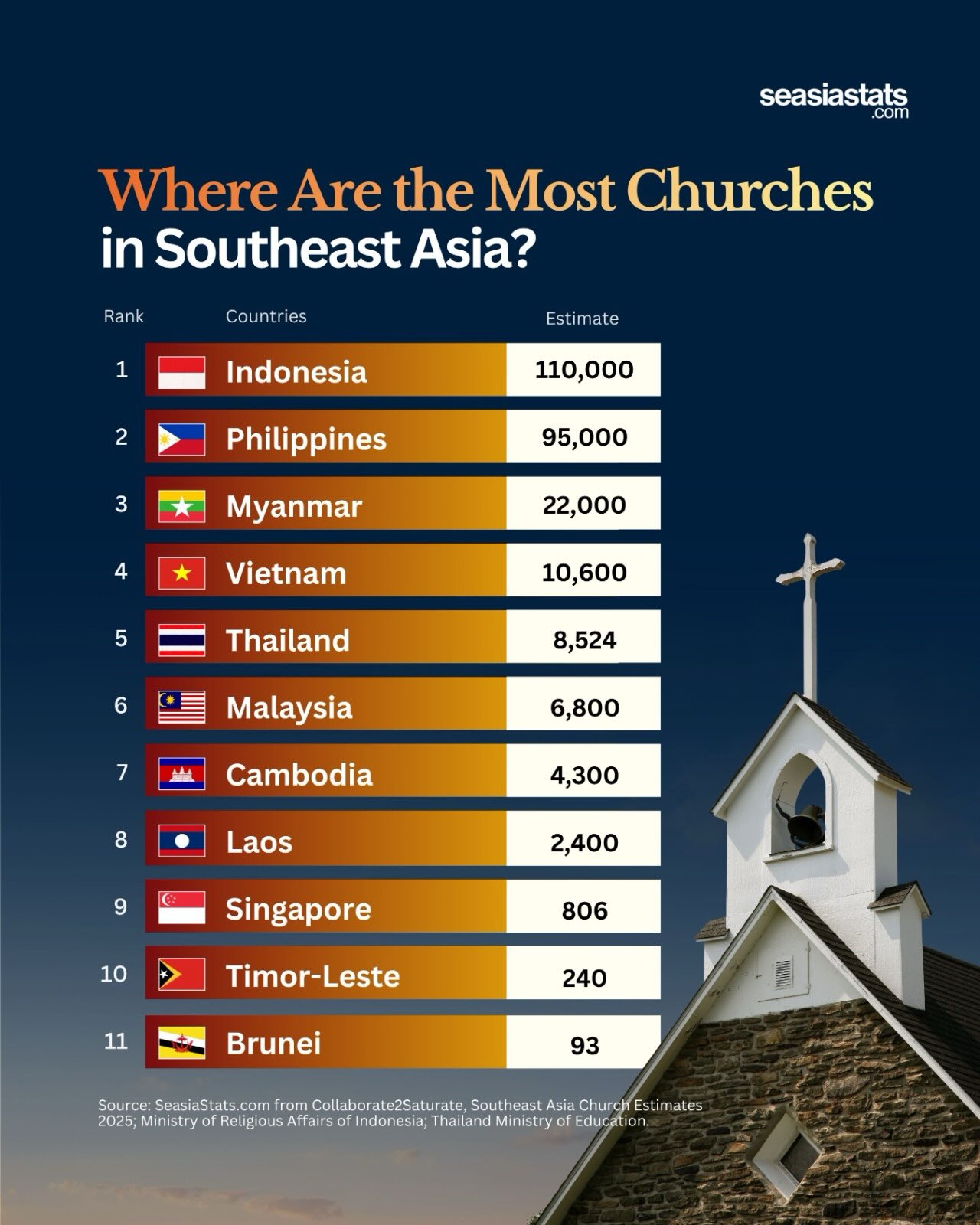
Indonesia has around 110,000 churches, the most in Southeast Asia.

Southeast Asia is a culturally and religiously diverse region, with Christianity playing an important role in the spiritual, social, and cultural life of millions of people.
Churches serve not only as places of worship but also as centers for community development, education, charitable activities, and social support. Southeast Asia has a significant presence of Christianity throughout the region based on the number of churches.
Indonesia has the largest estimated number of churches, with approximately 110,000, followed by the Philippines with 95,000. These two countries account for the overwhelming majority of churches in Southeast Asia.
Although Indonesia has a Muslim-majority population, Christianity has a substantial presence, particularly in regions such as North Sulawesi, East Nusa Tenggara, Papua, and parts of Sumatra. Meanwhile, the Philippines has a predominantly Christian population, making churches an essential part of its religious and cultural landscape.
Myanmar ranks third, with an estimated 22,000 churches, reflecting the presence of Christian communities, particularly among ethnic groups such as the Chin, Kachin, and Karen.
Vietnam follows with approximately 10,600 churches, while Thailand has an estimated 8,524. Malaysia is estimated to have 6,800 churches, reflecting its diverse Christian communities across different states, particularly Sabah and Sarawak.
Other countries also contribute to the Christian presence in the region. Cambodia has approximately 4,300 churches, while Laos has around 2,400. Singapore, despite its relatively small geographical size, has an estimated 806 churches, reflecting its diverse Christian population and well-established religious institutions.
Timor-Leste has approximately 240 churches, while Brunei has the smallest estimated number, with 93 churches.
These figures provide a useful overview of the distribution of churches across Southeast Asia. However, they should be understood as estimates rather than official, universally verified statistics. Differences in definitions, registration systems, and counting methods may influence the actual numbers.
For example, some estimates may include independent congregations, house churches, and small community worship centers, while others may count only formally registered church buildings.
In conclusion, the number of churches in Southeast Asia highlights the considerable Christian presence across the region. Indonesia and the Philippines lead significantly in the number of churches, while smaller countries also maintain important Christian communities.
These estimates offer a starting point for understanding the regional distribution of Christian institutions and can support further research into religious demographics, church development, and Christian ministry throughout Southeast Asia.