

Cities That Could Sink and Disappear by 2100
Without aggressive and immediate countermeasures, these cities could sink and disappear by 2100.

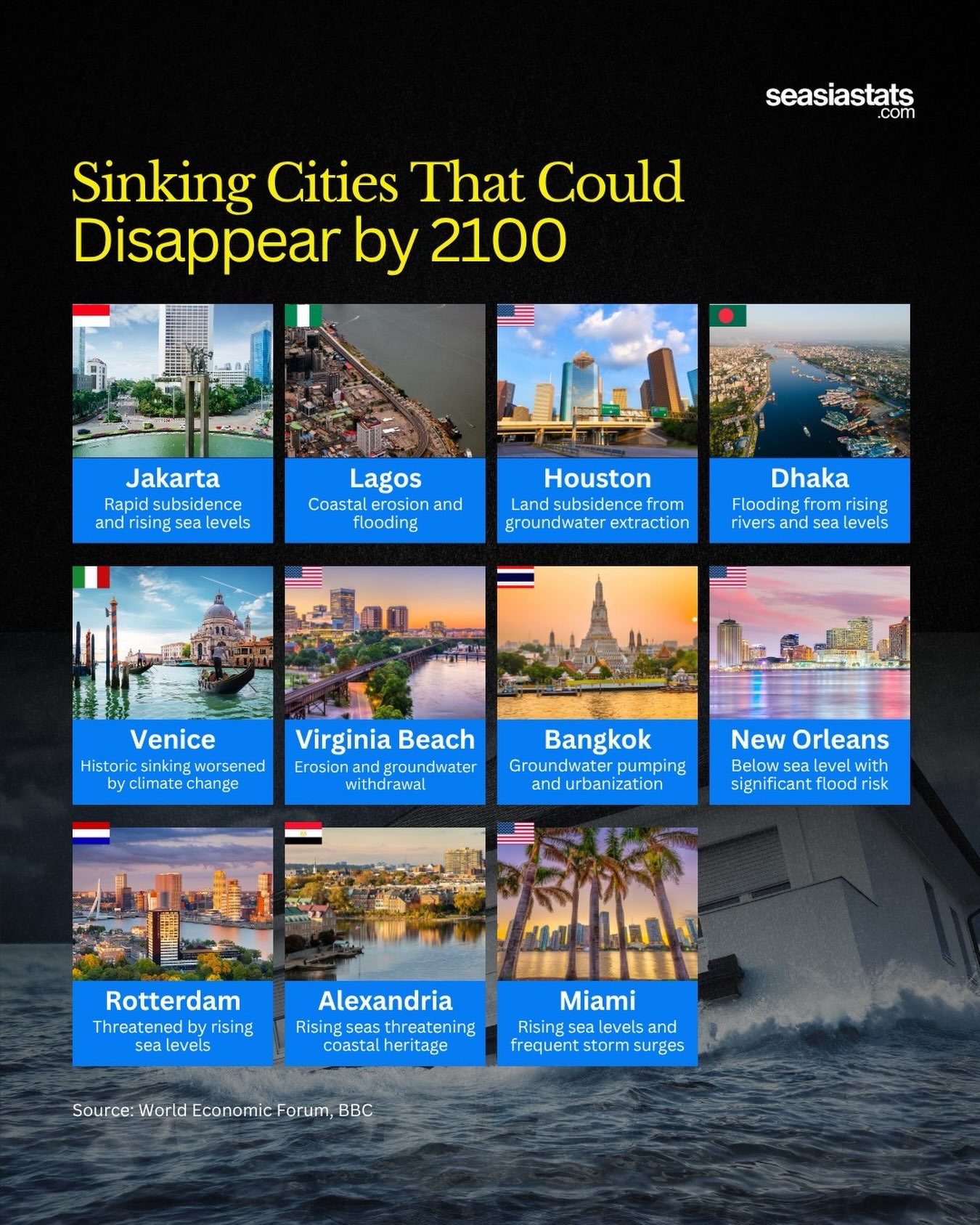
According to a 2019 World Economic Forum report, eleven major cities around the world face the serious risk of sinking and potentially disappearing by 2100.
The dual threats of rising sea levels driven by climate change and land subsidence, often caused by excessive groundwater pumping, are placing millions of residents and critical infrastructure in danger. These cities span multiple continents and highlight the urgent global challenge of coastal vulnerability.
Jakarta, Indonesia, tops the list as one of the fastest-sinking cities on Earth. Parts of the capital are dropping by as much as 6.7 inches per year due to heavy groundwater extraction. Much of the city could be underwater by 2050, prompting the Indonesian government to plan a costly relocation of the capital.
Lagos, Nigeria, Africa’s largest city, confronts relentless coastal erosion and increasing flooding from rising seas, threatening its dense population and economic hub status. Houston, Texas, is sinking at about two inches annually in some areas from groundwater pumping, making it more susceptible to devastating storms like Hurricane Harvey.
Dhaka, Bangladesh, sits in a low-lying delta highly exposed to sea-level rise. Projections suggest significant portions of the country could flood by mid-century, displacing millions despite Bangladesh’s minimal contribution to global emissions.
Venice, Italy, continues its slow subsidence while facing more frequent high tides; even with flood barriers, the historic city’s long-term survival remains uncertain. Virginia Beach, on the U.S. East Coast, experiences one of the region’s fastest rates of sea-level rise and could see nearly 12 feet of increase by 2100 when combined with land sinking.
Bangkok, Thailand, is sinking more than one centimeter per year and risks falling below sea level as early as 2030. New Orleans, Louisiana, built largely on a sinking river delta, faces ongoing land loss that heightens hurricane vulnerability.
Rotterdam, Netherlands, already has 90 percent of its area below sea level and relies on advanced engineering, yet rising waters continue to test its defenses.
Alexandria, Egypt, sees its beaches eroding as the Mediterranean advances, with forecasts of substantial sea-level rise endangering this ancient coastal city. Finally, Miami, Florida, often called a climate-risk poster child, experiences accelerated sea-level rise that already causes frequent flooding, saltwater intrusion, and infrastructure damage.
These eleven cities illustrate how human activity and climate change together amplify existential threats.
Without aggressive adaptation measures such as reducing groundwater use, building resilient infrastructure, and cutting emissions, many of these urban centers risk severe inundation or partial disappearance by the end of the century. The World Economic Forum’s warning underscores the need for coordinated global action to protect vulnerable coastal populations.