

Cities with the Most Skyscrapers
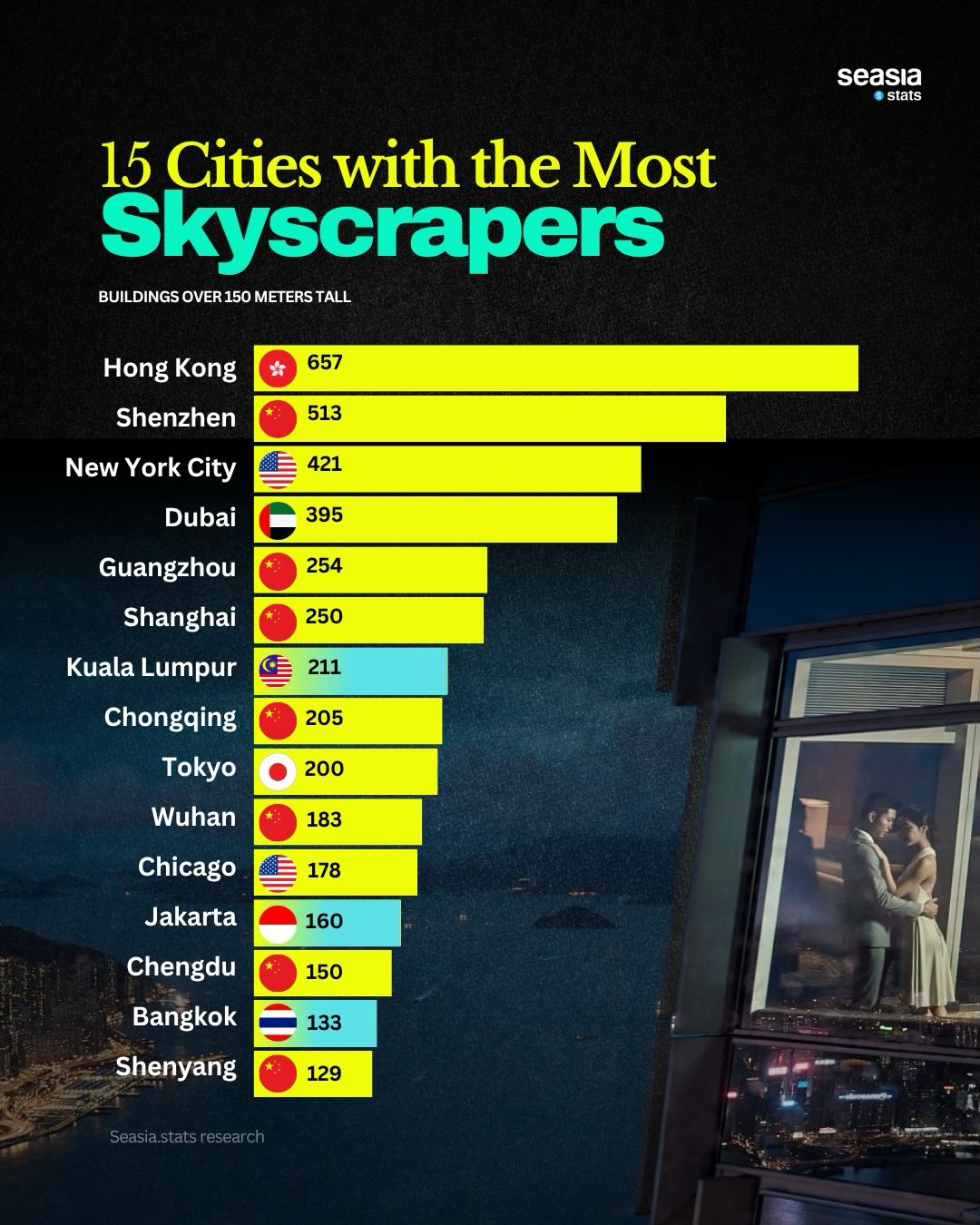
Asian cities, especially Chinese ones, are dominating the list of world's cities with the most skyscrapers.

Skyscrapers have become powerful symbols of economic growth, urbanization, and architectural ambition. Around the world, major cities continue to expand vertically as rising populations and limited land encourage high-density development.
Asia, in particular, now dominates the global skyline, with many of the world’s tallest and most numerous skyscraper clusters located across the region.
Leading the world is Hong Kong with 657 skyscrapers. The city’s mountainous geography and limited land supply encouraged extensive vertical development, creating one of the densest urban skylines on Earth. Hong Kong’s skyline has become internationally recognized as a symbol of modern finance and commerce.
China’s Shenzhen ranks second with 513 skyscrapers. Once a small fishing town, Shenzhen transformed into a global technology and manufacturing center within a few decades, resulting in one of the fastest urban expansions in modern history.
In the United States, New York City remains the Western world’s skyscraper capital with 421 towers. Famous landmarks such as the Empire State Building and One World Trade Center continue to define the city’s iconic skyline.
The Middle East is represented by Dubai, which has 395 skyscrapers. Dubai’s rapid rise was fueled by international investment, luxury real estate, and tourism, highlighted by the Burj Khalifa, the tallest building in the world.
Several Chinese cities dominate the rankings. Guangzhou has 254 skyscrapers, while Shanghai follows closely with 250. Chongqing has 205 skyscrapers, Wuhan has 183, Chengdu has 150, and Shenyang records 129. These cities reflect China’s massive urban development and economic modernization over recent decades.
Southeast Asia also has several rapidly growing skylines. Kuala Lumpur contains 211 skyscrapers and is home to the famous Petronas Twin Towers. Jakarta follows with 160 skyscrapers, driven by strong commercial and residential growth. Bangkok has 133 skyscrapers and continues expanding as one of Southeast Asia’s major business and tourism hubs.
Meanwhile, Tokyo has 200 skyscrapers despite strict earthquake-resistant building regulations, while Chicago remains historically important as the birthplace of the modern skyscraper with 178 towers.
Together, these cities showcase how skyscrapers have become defining features of modern urban development and global economic influence.