

CO₂ Emissions per Capita in Southeast Asia in 2026
Brunei has the highest CO₂ emission per capita in all of Southeast Asia.

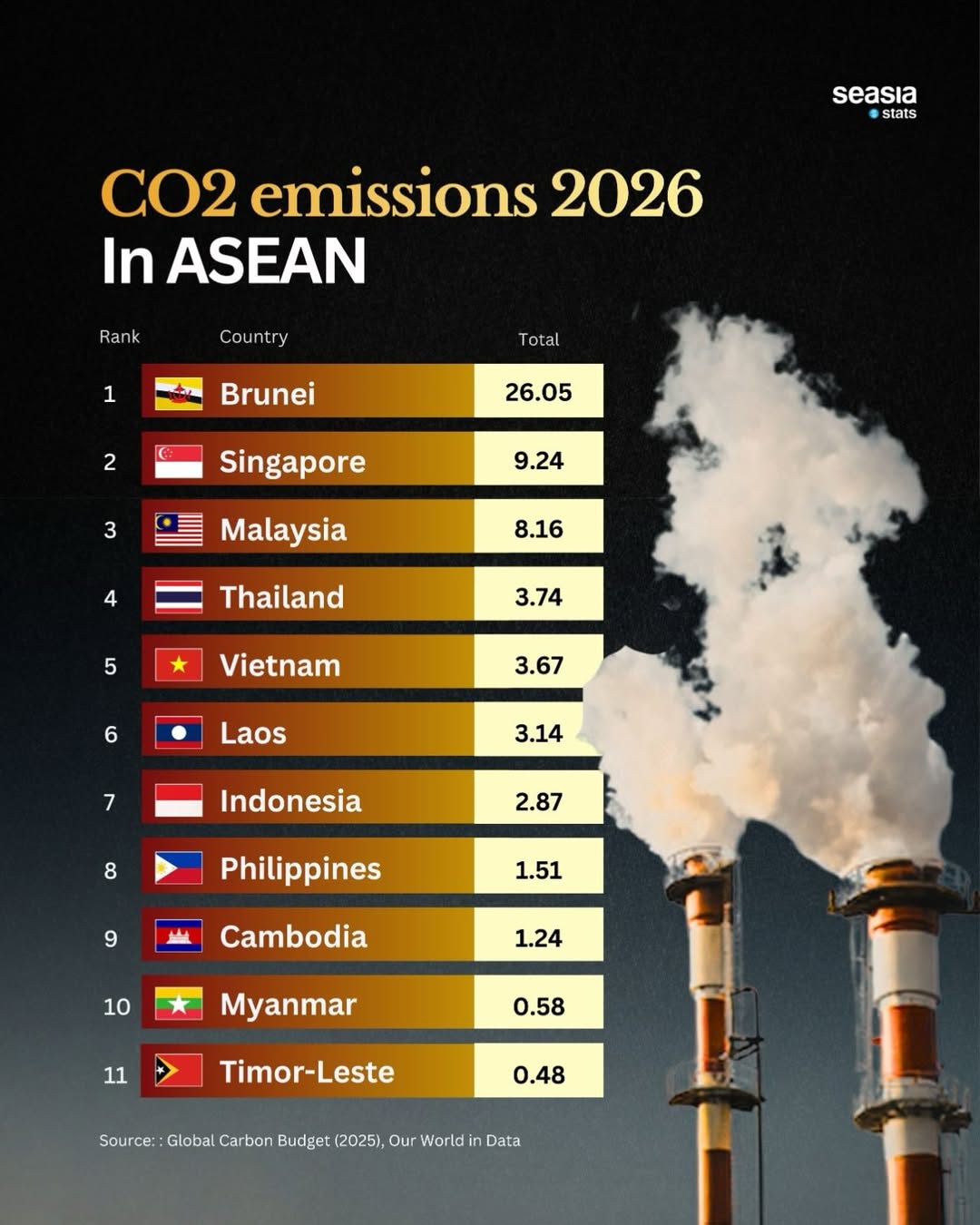
Carbon dioxide (CO₂) emissions per capita are widely used to measure the average amount of carbon dioxide emitted by each person within a country. Unlike total emissions, which are heavily influenced by population size, per capita emissions provide a better comparison of carbon footprints among countries.
According to the 2026 estimates from the Global Carbon Budget and Our World in Data, Southeast Asia displays considerable variation in CO₂ emissions per capita, reflecting differences in economic development, industrialization, energy consumption, and natural resource utilization.
Among Southeast Asian countries, Brunei records the highest CO₂ emissions per capita at 26.05 tonnes. The country's economy is heavily dependent on oil and natural gas production, while its relatively small population results in exceptionally high emissions per resident.
Singapore ranks second with 9.24 tonnes per capita. As a highly developed financial and industrial hub, Singapore's energy-intensive economy contributes to relatively high emissions despite significant investments in clean energy and sustainability initiatives.
Malaysia follows with 8.16 tonnes per capita, reflecting its diversified manufacturing sector, transportation demand, and fossil fuel-based electricity generation. Thailand and Vietnam report similar levels at 3.74 and 3.67 tonnes per capita, respectively.
Both countries have experienced rapid industrial growth and urbanization over the past decades, leading to steadily increasing energy consumption. Laos records 3.14 tonnes per capita, while Indonesia follows closely with 2.87 tonnes.
Indonesia's emissions are influenced by electricity generation, transportation, industrial activities, and land-use change, although its large population moderates its per capita figure.
The Philippines records 1.51 tonnes of CO₂ emissions per capita, while Cambodia reports 1.24 tonnes. These comparatively lower values reflect lower levels of industrialization and energy consumption, although economic growth is expected to increase future energy demand.
Myanmar records only 0.58 tonnes per capita, and Timor-Leste has the lowest emissions in the region at 0.48 tonnes per person. Limited industrial activity, lower fossil fuel consumption, and relatively modest economic development contribute to these low emission levels.
Overall, Southeast Asia exhibits a broad spectrum of per capita CO₂ emissions, ranging from less than one tonne in Timor-Leste to more than 26 tonnes in Brunei. The differences highlight the diverse stages of economic development and energy use across the region.
As Southeast Asia continues to grow economically, expanding renewable energy, improving energy efficiency, strengthening public transportation, and promoting low-carbon technologies will be essential for reducing emissions while maintaining sustainable development.
Monitoring per capita CO₂ emissions provides valuable insight into each country's environmental performance and progress toward global climate objectives.