

Countries by container volume per capita
Container volume per capita offers a revealing snapshot of how deeply integrated a country is in global trade relative to its population. The data shows a strik

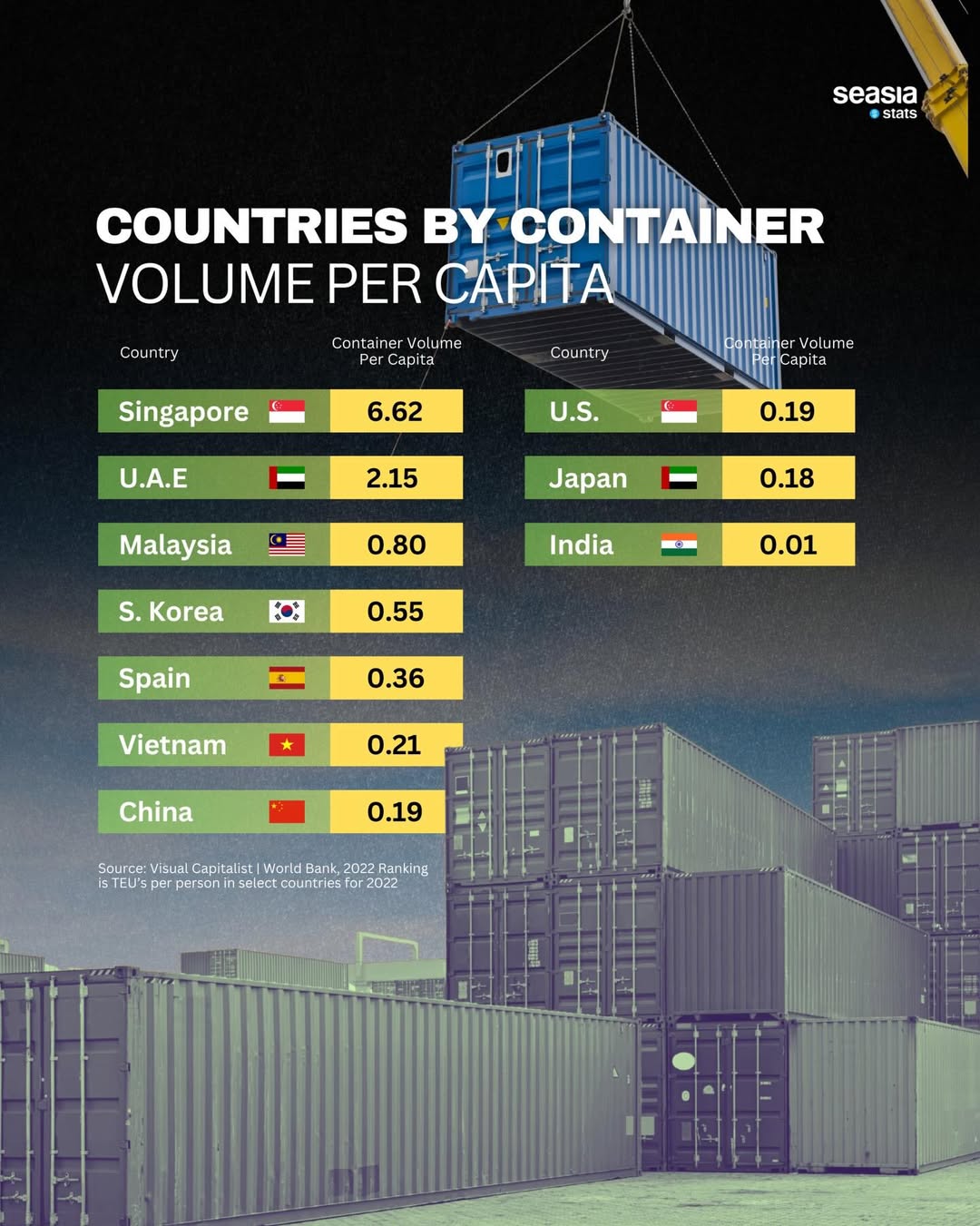
Container volume per capita offers a revealing snapshot of how deeply integrated a country is in global trade relative to its population. The data shows a striking gap between major logistics hubs and large domestic economies, highlighting how geography, port infrastructure, and trade orientation shape container throughput on a per-person basis.
Singapore stands far above all others, with a container volume per capita of 6.62, reflecting its role as one of the world’s most important transshipment and maritime hubs. The United Arab Emirates follows at a distant second with 2.15, driven by ports like Jebel Ali that serve as gateways between Asia, Europe, and Africa. Malaysia ranks third at 0.80, underscoring Southeast Asia’s growing importance in global supply chains, supported by strategic port locations and export-oriented industries.
In contrast, larger economies such as China, the United States, and Japan record much lower per capita figures despite handling massive absolute container volumes. This disparity highlights how population size dilutes per-person metrics, even for global manufacturing and consumption giants.
Overall, the data illustrates that container volume per capita is less about economic size alone and more about a country’s role as a logistics hub, trade intermediary, and connector in the global economy.