

Countries Have Been Attacked by United States in the 21st Century
For much of the 21st century, the story of American power has not only been told in Washington, New York, or on campaign stages.

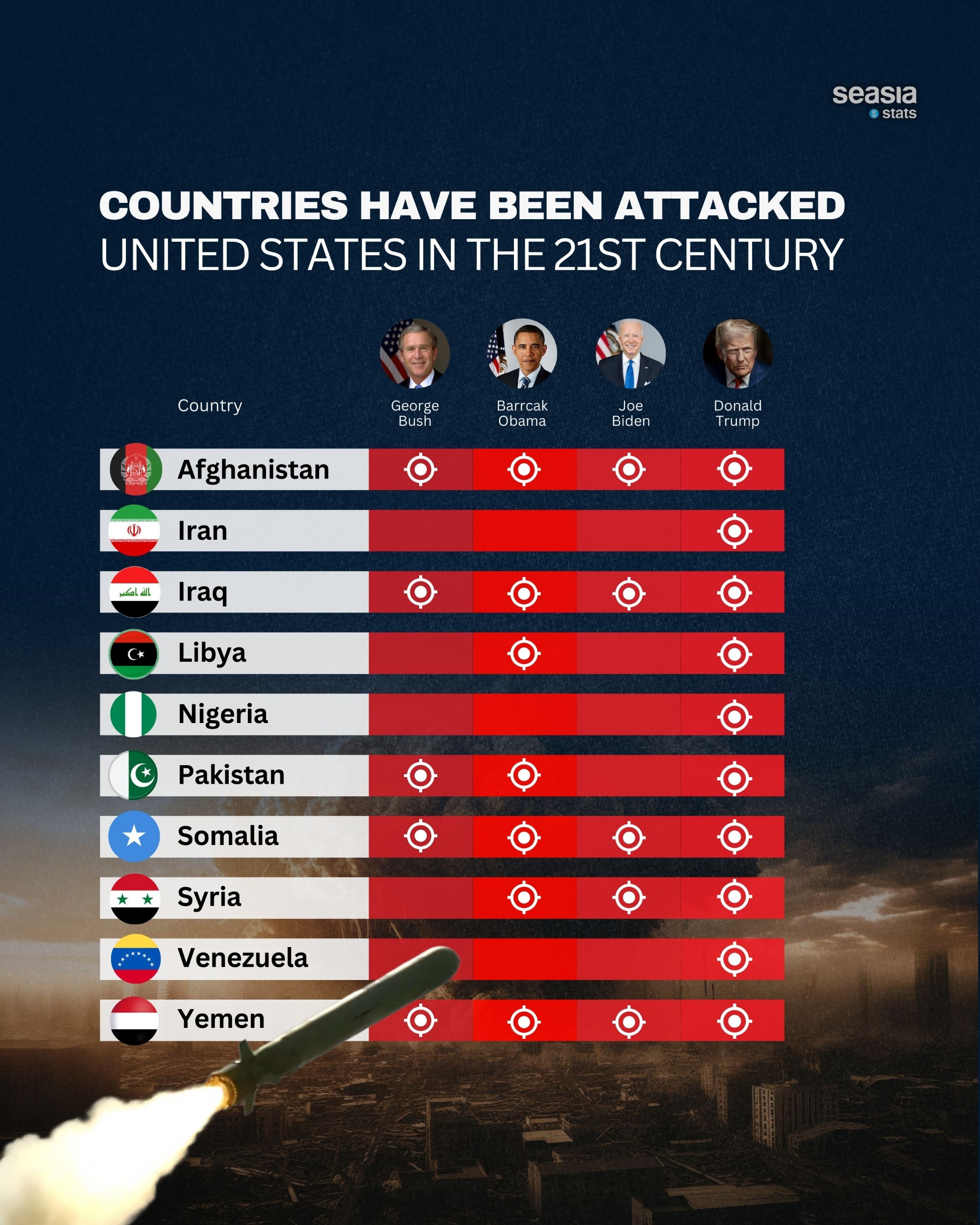
For much of the 21st century, the story of American power has not only been told in Washington, New York, or on campaign stages. It has also been written in the skies over Kabul, the streets of Baghdad, the deserts of Yemen, and the coastlines of Somalia. The Seasia Stats infographic captures that reality in stark visual form: across four U.S. presidencies, military force has remained one of the most consistent instruments of American foreign policy.
A Century Defined by Permanent Intervention
The most striking pattern in the chart is continuity. Afghanistan, Iraq, Somalia, and Yemen stand out as countries touched by U.S. military action under George W. Bush, Barack Obama, Joe Biden, and Donald Trump. That continuity matters. It suggests that while presidents may change their rhetoric, the architecture of American intervention has proved remarkably durable.
The post-9/11 era began with the invasion of Afghanistan in 2001 and Iraq in 2003, two wars that would define an entire generation of geopolitics. But over time, those large-scale invasions evolved into something more diffuse: drone campaigns, targeted assassinations, counterterrorism raids, naval operations, and “limited” strikes that often extended far beyond declared wars. Airwars, which tracks modern conflict and civilian harm, notes direct U.S. military activity in multiple countries including Afghanistan, Iraq, Yemen, Somalia, and beyond.
From Occupation to Remote Warfare
If the Bush years were defined by invasions and occupations, the Obama years marked the normalization of remote warfare. Libya and Syria entered the U.S. military map during that period, while Pakistan became synonymous with drone strikes. The tools changed, but the footprint remained wide.
Pakistan is a key example. During the late Bush years and especially under Obama, U.S. drone strikes escalated dramatically, peaking as Washington pursued al-Qaeda and Taliban-linked targets across the Afghanistan-Pakistan frontier. That campaign became one of the clearest examples of how the “war on terror” blurred borders and redefined what counted as a battlefield.
In countries like Yemen and Somalia, the U.S. increasingly favored a lighter but persistent model of intervention: intelligence-backed strikes, special operations, and partnerships with local forces. These wars rarely dominated Western headlines the way Iraq once did, yet they became part of the everyday machinery of U.S. power.
The Trump Era’s Wider Geography
What makes the 2026 update especially notable is the apparent geographic expansion of American military action. Recent reporting shows that the current Trump administration’s conflict with Iran has widened dramatically, with Reuters and AP describing an active U.S.-Iran war that has reshaped regional security and triggered new deployments across the Middle East. Reuters also reports continuing U.S. strikes on Iranian military targets even amid limited pauses on energy infrastructure.
That shift matters because it signals a move away from the older model of long counterinsurgency campaigns and toward a more fluid doctrine: short, sharp, politically flexible uses of force against states, militias, and transnational actors alike.
One line often repeated in U.S. political debate is that America wants to avoid “forever wars.” Yet the map suggests something more uncomfortable: perhaps the forever war never ended—it simply became more modular, more aerial, and less visible.
Why Southeast Asia Is Paying Attention
At first glance, this may seem like a story centered on the Middle East and Africa. But Southeast Asia has been watching closely, because every expansion of U.S. military power reverberates through the Indo-Pacific.
For countries like the Philippines, Singapore, Vietnam, and Indonesia, U.S. intervention abroad is not just a distant headline. It shapes how they think about alliance, deterrence, energy security, and strategic dependence. The Philippines, for example, has deepened security ties with Washington even as it tries to manage tensions with Beijing. At the same time, Southeast Asian governments remain wary of being trapped inside a larger contest between the United States and China. Reuters reported this week that Manila resumed talks with Beijing on the South China Sea and energy security, underscoring how regional states are trying to preserve room for maneuver even amid global instability.
That balancing act is especially visible in ASEAN. After the recent escalation with Iran, regional voices called for restraint and de-escalation rather than alignment. That instinct reflects Southeast Asia’s long-standing preference for strategic autonomy: engage the U.S., trade with China, avoid becoming the front line of someone else’s war.
The Real Legacy of American Power
What this infographic ultimately reveals is not just a list of countries. It reveals a habit.
The United States may debate whether it is retreating from the world or returning to “peace through strength,” but for many societies across the Global South, the answer looks simpler: America never really left. It only changed methods.
And that is why this map matters. It is not only about where bombs fell. It is about how a superpower’s decisions, made thousands of miles away, continue to shape how much of the world understands peace, sovereignty, and fear.