

Countries in East Asia & Pacific with the Highest Unemployment Rates
Unemployment in East Asia and Pacific is a serious issue with French Polynesia having the highest rate.

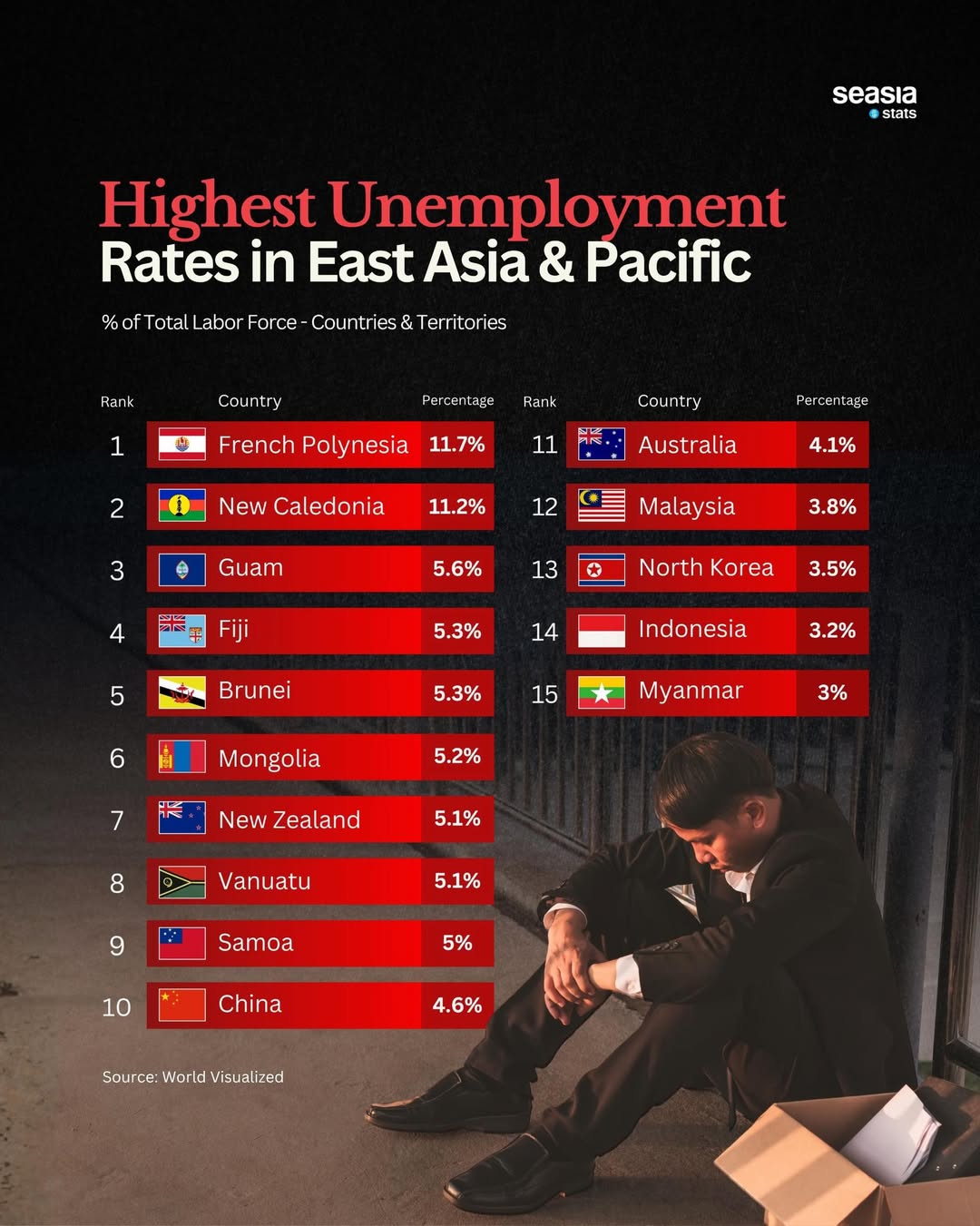
Unemployment rates across East Asia and the Pacific vary widely, reflecting differences in economic structure, population size, and labor market conditions.
According to World Visualized, several smaller island territories and developing economies report the highest unemployment rates in the region, while larger and more industrialized countries tend to have lower figures.
At the top of the list are French Polynesia (11.7%) and New Caledonia (11.2%), both of which are small island territories with limited economic diversification. Their economies rely heavily on tourism and public sector employment, making them vulnerable to external shocks and fluctuations in global demand.
Similarly, Guam (5.6%) and Fiji (5.3%) also show relatively high unemployment, reflecting similar structural constraints common among island economies.
Among Southeast Asian nations, Brunei (5.3%) stands out with one of the highest unemployment rates. Despite its wealth from oil and gas, the country faces challenges such as a mismatch between workforce skills and job opportunities.
Data from regional sources confirm that Brunei often records the highest unemployment rate in Southeast Asia, around 5% or slightly higher.
Other countries with moderate unemployment include Mongolia (5.2%), New Zealand (5.1%), Vanuatu (5.1%), and Samoa (5%). These figures suggest relatively stable labor markets but still indicate room for improvement, particularly in smaller or more remote economies.
Larger economies such as China (4.6%), Australia (4.1%), and Malaysia (3.8%) have lower unemployment rates, reflecting stronger and more diversified economic systems.
In fact, the East Asia and Pacific region overall tends to maintain relatively low unemployment compared to other parts of the world, often below 5%. This is partly due to large informal sectors and flexible labor markets.
Meanwhile, North Korea (3.5%), Indonesia (3.2%), and Myanmar (3%) report relatively low unemployment rates. However, these figures should be interpreted cautiously, as measurement methods and labor market transparency vary significantly.
For instance, Indonesia’s unemployment rate of around 3% aligns with regional data, placing it among the lower rates in Southeast Asia.
Overall, the data highlights a key pattern: smaller island economies and resource-dependent nations tend to have higher unemployment, while larger and more diversified economies maintain lower rates.
Additionally, informal employment plays a major role in keeping official unemployment figures relatively low across much of the region. These differences illustrate the complex nature of labor markets in East Asia and the Pacific.