

Countries in the World By Number of Living Languages
Language is more than a tool for communication—it is memory, identity, and worldview woven into sound.

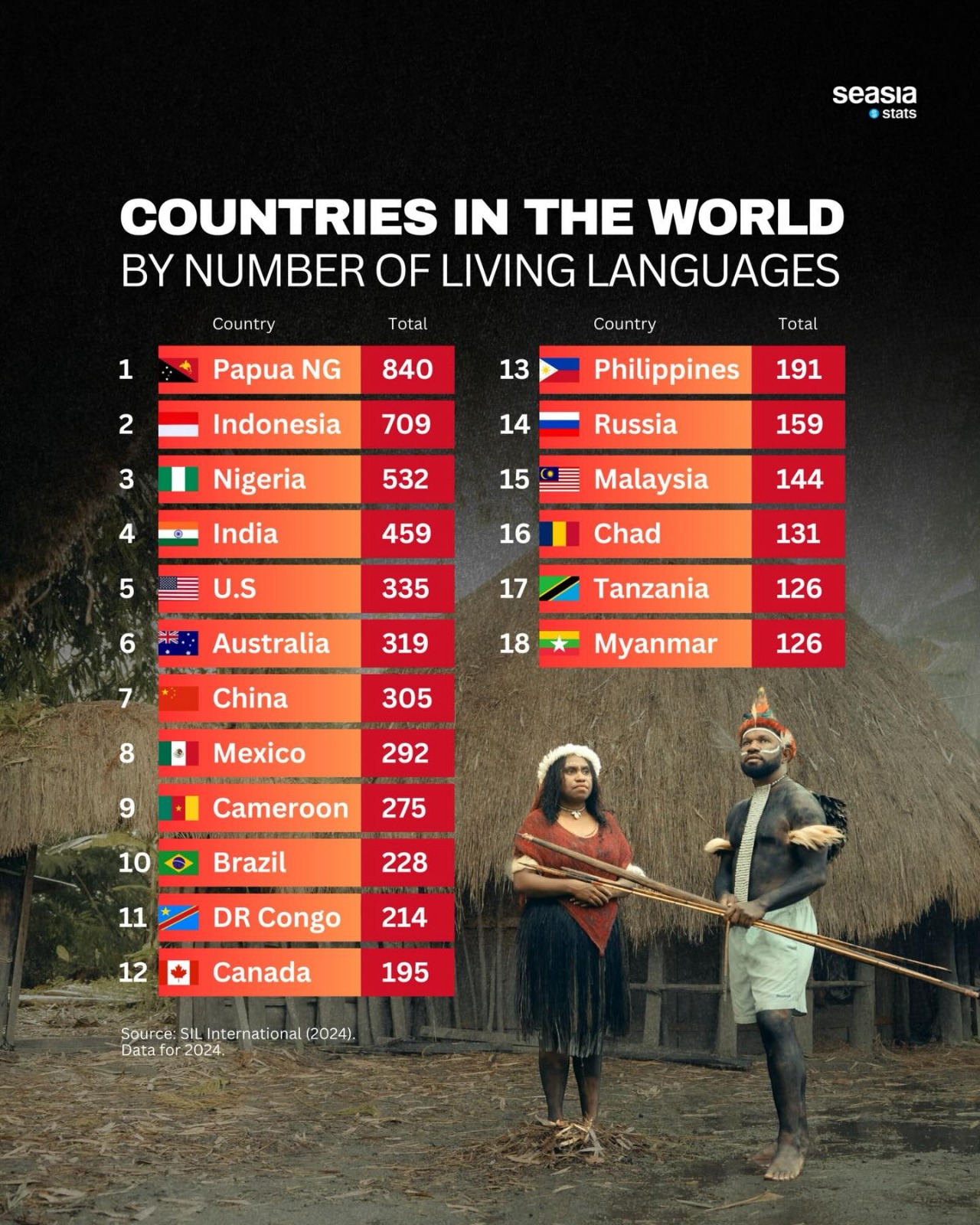
Language is more than a tool for communication—it is memory, identity, and worldview woven into sound. Across the globe, some nations carry an astonishing diversity of voices, each representing generations of history and culture. The latest data from Seasia Stats, based on SIL International (2024), reveals just how linguistically rich—and fragile—our world truly is.
A World of Many Tongues
At the very top sits Papua New Guinea, home to an extraordinary 840 living languages, making it the most linguistically diverse country on Earth. Its rugged geography—mountains, islands, and isolated communities—has allowed languages to evolve independently for centuries.
Close behind is Indonesia, ranked second with 709 languages, making it not only Southeast Asia’s most linguistically diverse nation but one of the most complex cultural landscapes globally. From Javanese and Sundanese to hundreds of indigenous Papuan languages, Indonesia’s linguistic map reflects its identity as an archipelago of thousands of islands.
Nigeria (532 languages) and India (459) follow, both countries where ethnic and cultural plurality is deeply embedded in daily life. Even the United States, often perceived as linguistically uniform, ranks fifth with 335 languages, largely due to immigration and indigenous heritage.
As linguists often point out, diversity at this scale is both a treasure and a challenge. As noted by UNESCO, “languages are the most powerful instruments of preserving and developing our tangible and intangible heritage,” underscoring why their survival matters globally.
Southeast Asia: A Hidden Epicenter of Linguistic Diversity
While Papua New Guinea and Indonesia dominate the headlines, Southeast Asia as a whole emerges as one of the world’s most linguistically vibrant regions.
The Philippines, ranked 13th with 191 languages, is a striking example. Despite having Filipino and English as official languages, the country’s linguistic reality is far more layered. Languages like Cebuano, Ilocano, and Hiligaynon are spoken by millions, each tied to distinct regional identities.
Malaysia, with 144 languages, reflects a different kind of diversity—one shaped by both indigenous groups and centuries of trade and migration. Alongside Malay, languages such as Iban, Kadazan-Dusun, and various Chinese dialects contribute to a rich multilingual society.
Myanmar, also on the list with 126 languages, highlights how linguistic diversity often intersects with ethnic complexity. Dozens of ethnic groups, from the Shan to the Karen, maintain their own languages, many of which are still under-documented.
Even countries not listed in the top rankings—such as Thailand, Vietnam, and Laos—possess significant linguistic diversity within minority communities. In Vietnam alone, more than 50 ethnic groups contribute to a mosaic of languages and dialects that extend far beyond the dominant Vietnamese language.
Geography, History, and Identity
Why are some regions so linguistically dense? Geography plays a major role. Islands, mountains, and forests create natural barriers, allowing languages to develop independently. This is especially evident in Indonesia and Papua New Guinea.
History also matters. Trade routes, colonization, migration, and religion have all shaped linguistic landscapes. Southeast Asia, positioned at the crossroads of ancient trade networks, absorbed influences from India, China, the Middle East, and Europe—leaving linguistic traces that persist today.
But perhaps the most important factor is identity. Language is often the strongest marker of who people are. It carries oral traditions, belief systems, and cultural knowledge that cannot always be translated.
A Race Against Time
Despite this richness, many of these languages are under threat. Linguists estimate that a significant portion of the world’s languages could disappear within this century. As one widely cited linguistic warning puts it: “When a language dies, we lose a unique view of the world.”
In Southeast Asia, urbanization, national language policies, and globalization are accelerating this shift. Younger generations increasingly adopt dominant languages for education and economic mobility, leaving smaller languages at risk.
Yet there is also growing awareness. From digital documentation to community-led revitalization, efforts are underway to preserve these voices before they fade.
More Than Numbers
What this ranking ultimately shows is not just which countries have the most languages, but how deeply human diversity is embedded in everyday life. In places like Indonesia and the Philippines, multilingualism is not unusual—it is normal.
And perhaps that is the most powerful takeaway: every language is a story. The more we lose, the quieter the world becomes.