

Countries Most Targeted by Spam Calls
Indonesia is the most favorite country for spam callers.

Spam calls have become a growing concern worldwide, disturbing daily life and exposing people to potential fraud. From unwanted telemarketing to suspicious calls attempting to steal personal information, these communications pose challenges for mobile phone users across many countries.
According to Hiya's Global Call Threat Report Q1 2025, several countries in the Asia-Pacific region recorded particularly high proportions of unknown calls identified as spam.
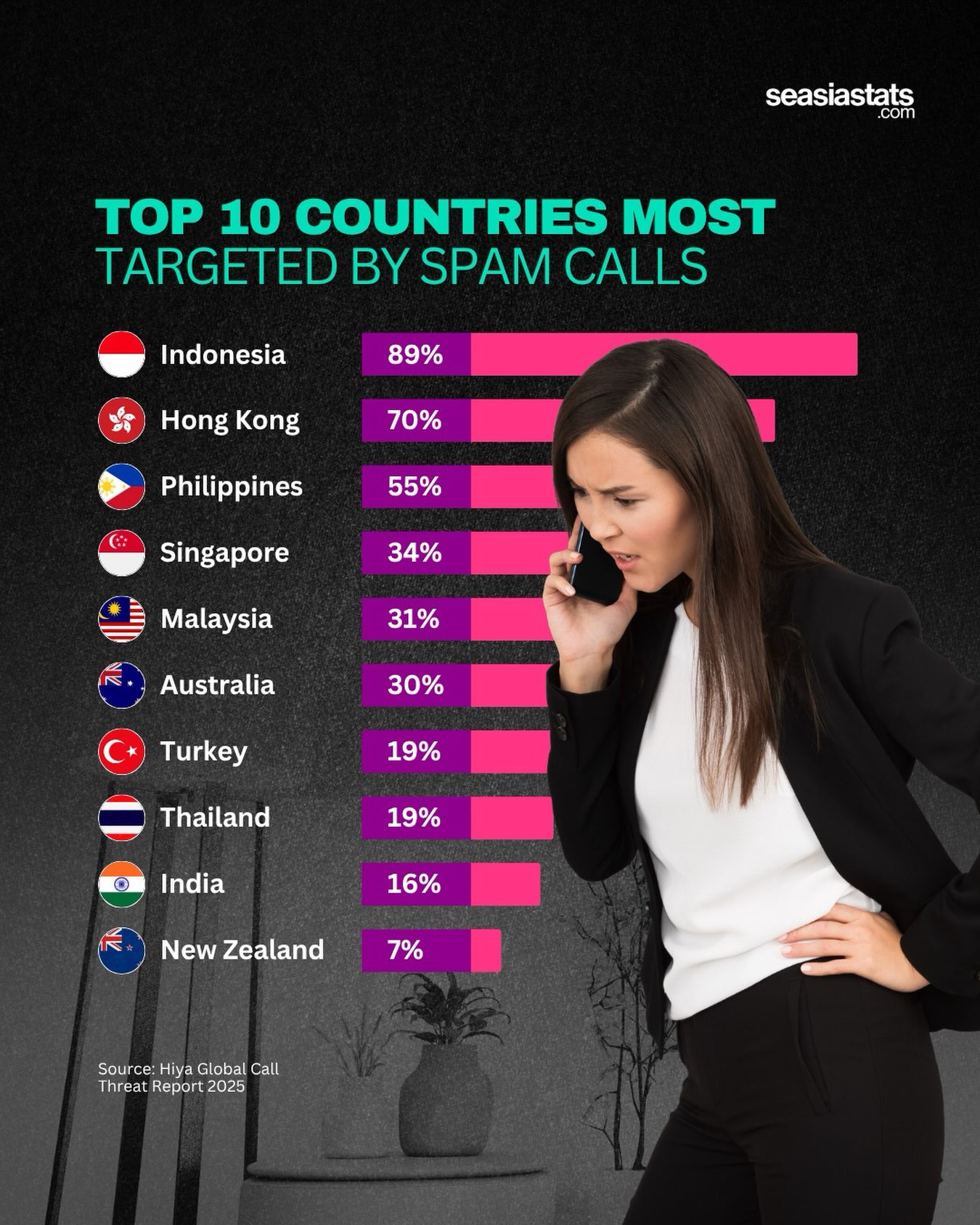
Indonesia ranks first on the list, with an astonishing 89% of unknown calls classified as spam. This means that nearly nine out of every ten calls from numbers not saved in users' contact lists were identified as unwanted. The result highlights the seriousness of the problem for Indonesian phone users and the importance of stronger awareness of telephone scams.
Hong Kong takes second place, with 70%. Despite its advanced telecommunications infrastructure, the city continues to face considerable challenges from unwanted calls. The Philippines ranks third at 55%, meaning that more than half of calls from unknown numbers were classified as spam in the report.
Singapore follows in fourth place, with 34%, while Malaysia ranks fifth at 31%. These figures demonstrate that spam calls remain a significant concern across Southeast Asia, affecting countries with different populations, economies, and levels of technological development.
Australia occupies sixth place, with 30% of unknown calls classified as spam. Although its percentage is considerably lower than Indonesia's, the figure shows that unwanted calls remain a concern even in a highly developed telecommunications market.
Turkey and Thailand share seventh place, with each recording 19%. Their results indicate that spam calls are not confined to one geographical area, but represent a broader international challenge. India follows with 16%, placing ninth on the list, while New Zealand records the lowest percentage among these ten countries, at 7%.
The report's figures refer specifically to the percentage of unknown calls identified as spam during the first quarter of 2025, rather than the percentage of all calls received or the proportion of people affected.
Hiya's definition of spam includes both nuisance calls, such as unwanted telemarketing, and suspected fraudulent calls. The findings are based on calls observed through Hiya's Voice Security Network.
Overall, these results emphasize the importance of protecting personal information and remaining cautious when answering unfamiliar numbers. Phone users can reduce their risk by avoiding sharing passwords, verification codes, or banking details with unknown callers and by independently verifying claims made over the phone.
As telephone scams continue to evolve, public awareness, effective call-filtering technology, and cooperation between telecommunications providers and authorities remain essential to tackling the problem.