

Countries That Believe Religion Helps Society
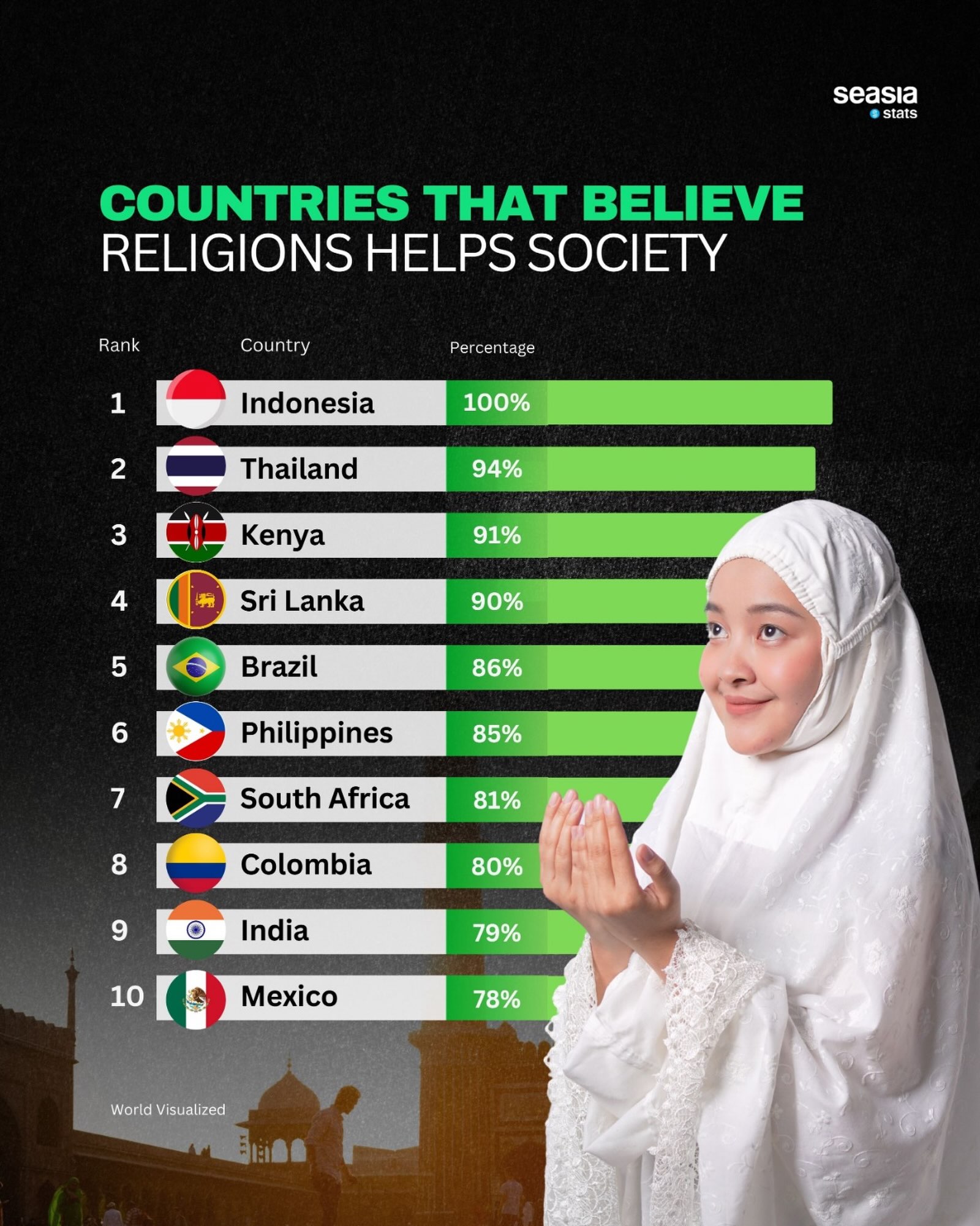
Indonesians believe the most that religions are helping society.

Religion continues to play an important role in societies around the world, influencing values, traditions, community relationships, and everyday life.
According to data highlighted by World Visualized, based on findings from the Pew Research Center’s global attitudes survey, people in several countries strongly believe that religion contributes positively to society. Across the 36 countries surveyed by Pew, a median of 77% of adults said religion mostly helps society rather than harms it.
Indonesia ranks first, with an impressive 100% of respondents saying that religion helps society. This figure reflects the strong role religion plays in Indonesian public and community life.
Indonesia is religiously diverse, with Islam, Christianity, Hinduism, Buddhism, and Confucianism represented across the country. Religion can provide moral guidance, strengthen family relationships, and encourage community cooperation.
Thailand follows with 94%, showing similarly strong confidence in the positive social role of religion. Buddhism has a major influence on Thai culture and traditions, and religious institutions can serve as important parts of local communities.
Kenya, at 91%, and Sri Lanka, at 90%, also record exceptionally high levels of agreement. Pew notes that at least 90% of adults in several countries, including Indonesia, Kenya, Sri Lanka, and Thailand, say religion helps society.
The remaining countries in the ranking also demonstrate substantial support. Brazil records 86%, followed by the Philippines at 85% and South Africa at 81%. In Latin America and Africa, religion often remains closely connected with community life and social support.
Religious organizations may contribute to charitable activities, education, and assistance for people facing economic or social difficulties.
Colombia records 80%, while India reaches 79% and Mexico records 78%. Although these countries have different religious traditions and cultural backgrounds, their relatively high percentages indicate that many people continue to view religion as a positive influence on society.
Overall, the figures demonstrate that belief in the social benefits of religion is particularly strong across parts of Asia, Africa, and Latin America.
The findings suggest that religion can be viewed not only as a matter of personal faith but also as a source of community connection, moral values, social support, and stability. At the same time, the survey measures people’s perceptions of religion’s impact on society, rather than proving that religion itself causes particular social outcomes.