

Countries That Believe Religions Help Society
Religion remains one of the few institutions that can still shape how people see morality, community, and public life all at once.

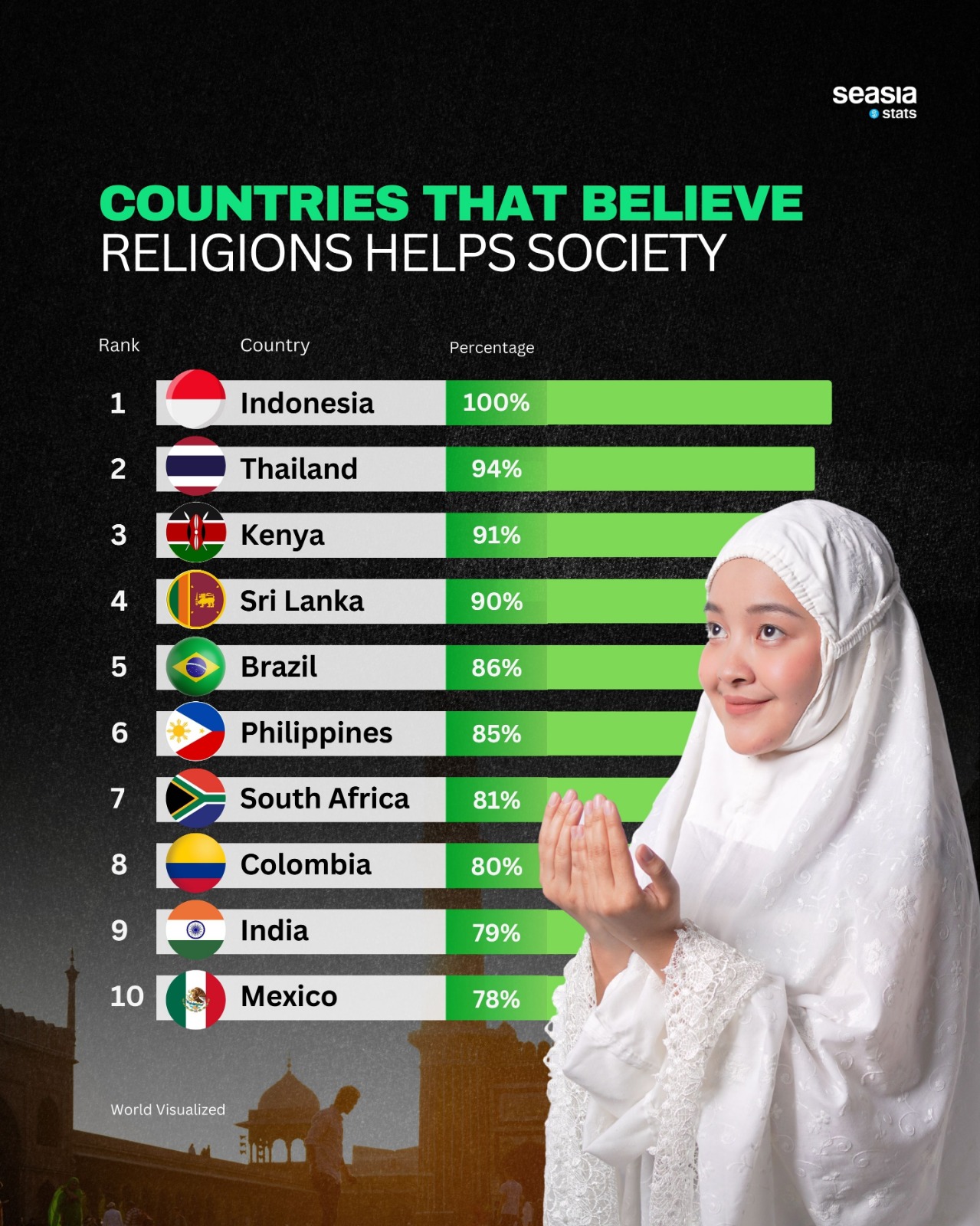
Religion remains one of the few institutions that can still shape how people see morality, community, and public life all at once. In much of the world, trust in politics or media may fluctuate—but faith still carries deep emotional and social authority. That is what makes this latest ranking so revealing: it is not simply about belief in God, but about whether people think religion actually helps society function.
Southeast Asia Leads the Conversation
According to the data highlighted by Seasia Stats and World Visualized, Indonesia ranks first, with 100% of respondents saying religion helps society. It is followed by Thailand at 94%, while the Philippines also places strongly at 85%. Together, these results suggest that Southeast Asia remains one of the clearest global examples of religion as a living public force, not merely a private identity.
That is not surprising. In Southeast Asia, religion is deeply woven into daily rhythms—Friday prayers, Sunday Mass, Buddhist merit-making, temple festivals, Ramadan bazaars, Christmas processions, and neighborhood rituals that blur the line between devotion and community life. In countries such as Indonesia, Thailand, and the Philippines, religion often functions not just as theology, but as social glue.
A useful comparison comes from Pew Research Center, which found in a 2024 study that large majorities in several Asian societies agreed that religion helps give people “meaning and purpose” and guides people to “do the right thing and treat others well.” In Vietnam, for instance, 88% said religion helps society by giving meaning and purpose.
Indonesia’s Near-Total Consensus
Indonesia’s result is especially striking. Home to the world’s largest Muslim population, the country has long maintained a public culture where religion is seen as inseparable from ethics, family values, and national identity. The state philosophy of Pancasila itself begins with belief in one supreme God, and public life—from education to ceremonies to civic discourse—still reflects that moral framework.
Yet Indonesia is not only religious; it is also plural. Islam is dominant, but Christianity, Hinduism, Buddhism, and Confucianism all remain visible in the national fabric. That diversity may actually strengthen the idea that religion contributes positively to social order, because faith is often experienced not as abstraction, but as something visible in everyday coexistence.
Thailand and the Buddhist Social Ethos
In Thailand, where 94% say religion helps society, Buddhism continues to play a major role in shaping public morality and national identity. Monasteries are not just places of worship; they are also centers of education, ritual, charity, and local memory. Even for many younger Thais who may be less formally devout, Buddhism still structures life events—from birth blessings to funerals to festivals.
Pew has also found that in Buddhist-majority societies such as Thailand, many people see a strong connection between religion and national belonging. In one regional study, more than 90% of Buddhists in Thailand, Cambodia, and Sri Lanka said religion and country are closely linked.
The Philippines and Faith as Public Culture
The Philippines, ranked sixth globally at 85%, offers a different but equally powerful model. There, Catholicism is not just a religion—it is a public language. Faith is visible in processions, fiestas, schools, politics, media, and even popular humor. The Church’s role in family life, charity, disaster response, and moral debate remains significant, even in an era of digital modernity.
This helps explain why many Filipinos still view religion as socially beneficial even amid contemporary political and economic pressures. In much of Southeast Asia, faith is not only about doctrine; it is also about solidarity.
More Than Belief, It’s About Belonging
Of course, saying religion helps society does not mean religion is free from criticism. Around the world, people also worry about religious extremism, exclusion, or political misuse. Even Pew notes that many respondents can hold both positive and negative views at the same time.
But what this ranking makes clear is that in much of Southeast Asia, religion is still widely seen as a source of meaning, moral direction, and social cohesion. In an age of fragmentation, that may be one of its most enduring powers: not just to tell people what to believe, but to remind them that they belong to something larger than themselves.