

Countries That Have Been to the Moon
These 6 countries have done incredible missions to the moon with the United States leading far ahead.

Humanity’s exploration of the Moon stands as one of the most remarkable achievements in the history of science and technology. Over the decades, only a handful of nations and political entities have successfully conducted lunar missions, demonstrating advanced capabilities in space exploration.
As of 2026, six major players have led this effort: the United States, the former Soviet Union, China, Japan, India, and the European Union.
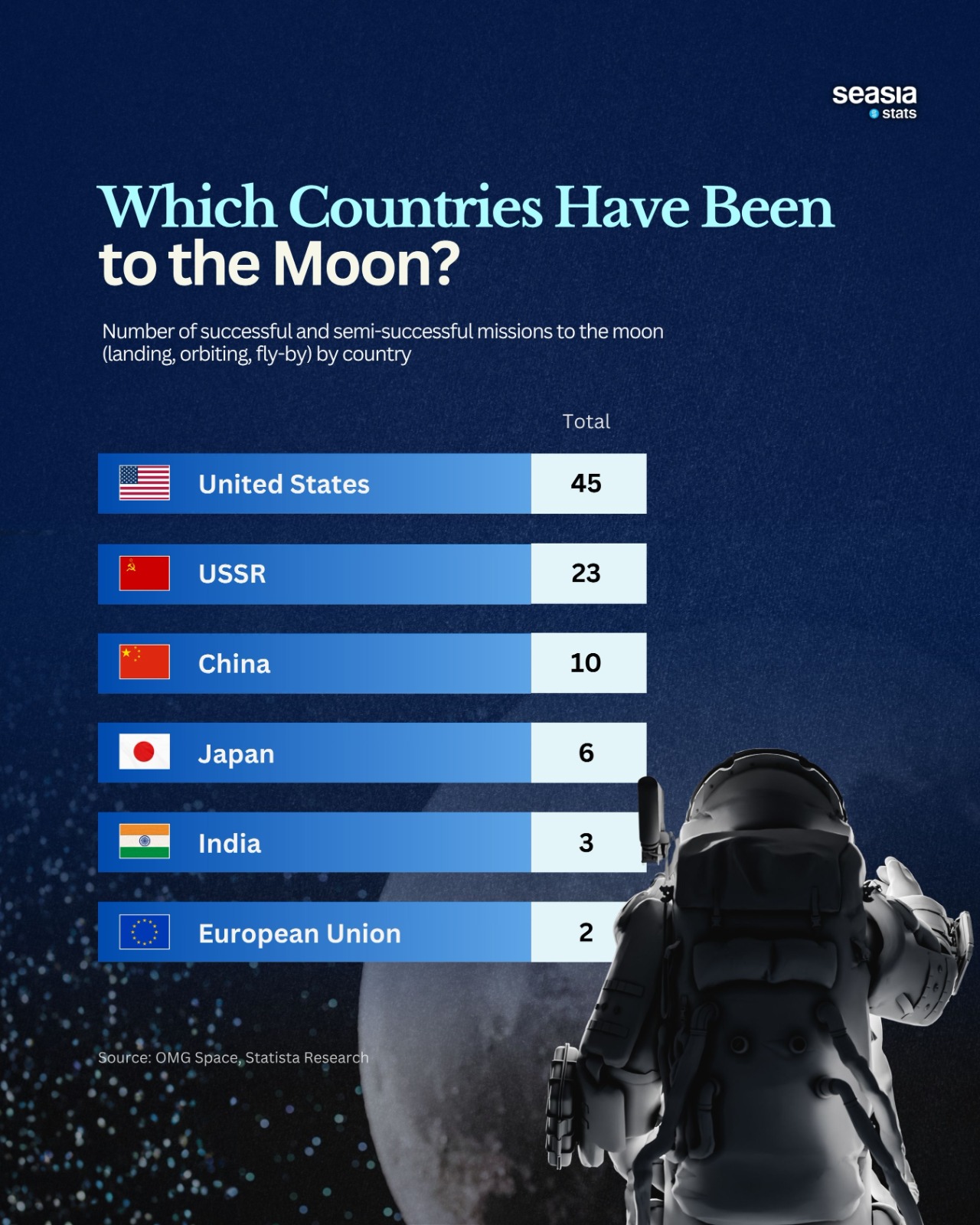
The United States remains the most experienced lunar explorer, with a total of 45 missions. Its achievements include the historic Apollo 11 Moon Landing, when humans first set foot on the lunar surface in 1969.
Through both crewed and uncrewed missions, the U.S. has conducted extensive scientific research, sample returns, and technological demonstrations, maintaining its leadership in lunar exploration.
Close behind is the Soviet Union (USSR), which completed 23 missions. Although it lost the race to land humans on the Moon, the Soviet program achieved numerous milestones, including the first robotic sample return and the deployment of lunar rovers under the Luna program. These missions laid the groundwork for robotic exploration techniques still used today.
In recent decades, China has emerged as a major space power, with 10 lunar missions. Its Chang’e program has successfully delivered orbiters, landers, and rovers, including sample return missions, marking China as a key player in modern lunar exploration.
Other countries have also made significant contributions. Japan has conducted 6 missions, focusing on orbital studies and advanced imaging through initiatives like the SELENE (Kaguya). India, with 3 missions, has gained global recognition through its Chandrayaan program, particularly for its cost-effective approach and successful soft landing attempts.
Finally, the European Union has participated with 2 missions through collaborative efforts led by the European Space Agency. While fewer in number, these missions highlight Europe’s emphasis on international cooperation and scientific research.
Together, these six entities represent the forefront of lunar exploration. Their combined efforts have transformed the Moon from a distant celestial body into a well-studied neighbor, rich with scientific insights.
As new missions are planned—including potential crewed returns and lunar bases—the legacy of these pioneering countries continues to shape the future of space exploration.