

Countries That Have Reached the Moon
When it comes to Moon missions, the United States is still the best in the world.

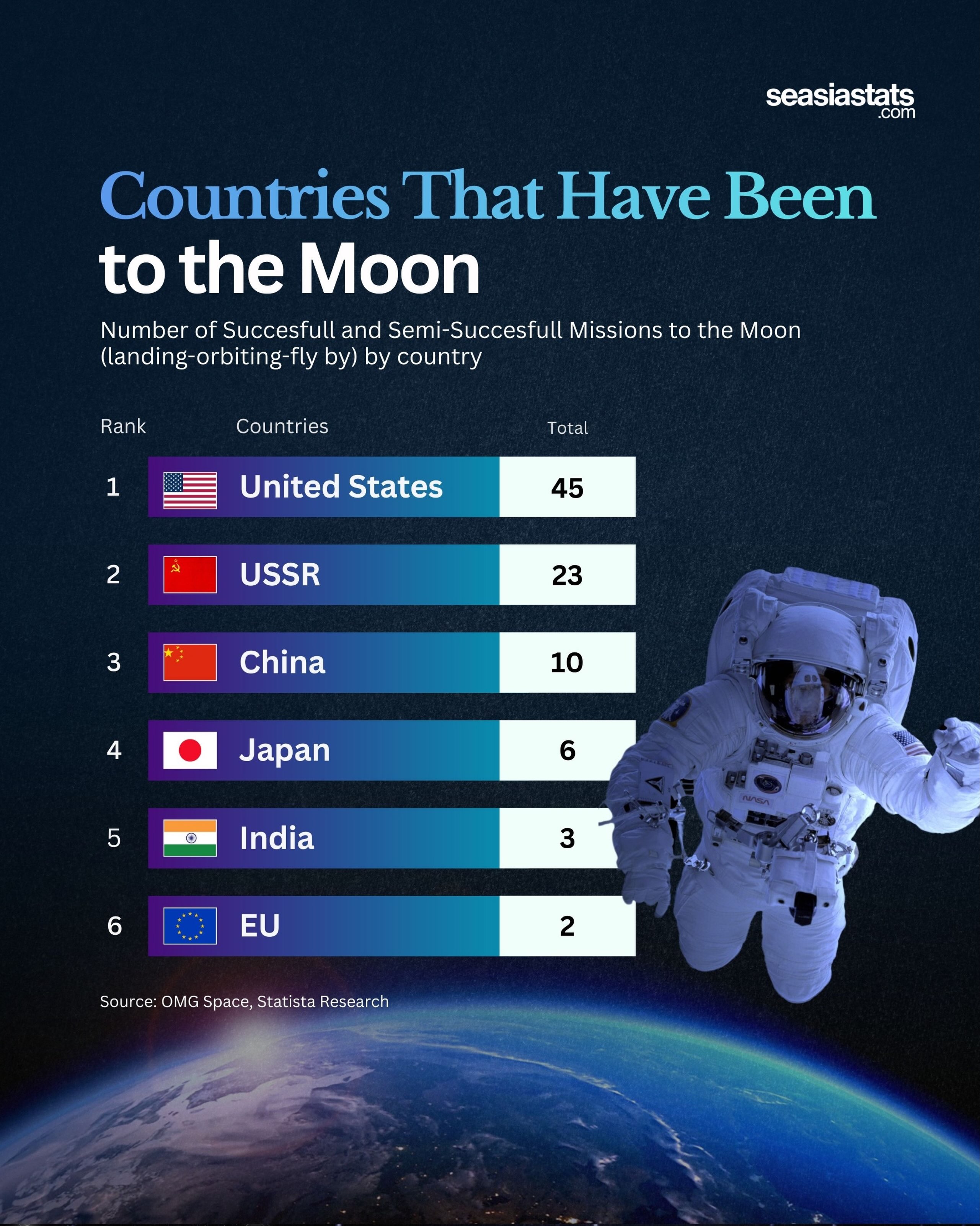
The Moon has fascinated humanity for centuries, and exploring it has become one of the greatest achievements in space exploration. Since the beginning of the Space Age, only a handful of nations and organizations have successfully or semi-successfully sent spacecraft to the Moon.
The United States remains the undisputed leader in lunar exploration. Its 45 missions include the historic Apollo program, which achieved the first human landing on the Moon in 1969, as well as numerous robotic orbiters, landers, and scientific missions. These missions have greatly expanded our understanding of the Moon's geology, environment, and potential resources.
The Soviet Union was the pioneer of early lunar exploration, completing 23 successful and semi-successful missions. It achieved many milestones, including the first spacecraft to impact the Moon, the first soft landing, the first lunar rover, and the first robotic sample return. These accomplishments established the USSR as a major force during the Space Race.
China has rapidly emerged as a leading lunar explorer with 10 missions. Through its Chang'e program, China has successfully landed rovers on both the near and far sides of the Moon and has conducted robotic sample return missions. These achievements demonstrate the country's growing technological capabilities and long-term ambitions for lunar exploration.
Japan ranks fourth with six successful and semi-successful lunar missions. Its spacecraft have contributed valuable scientific data by studying the Moon from orbit and testing precision landing technologies. Japan continues to develop advanced lunar missions in collaboration with international partners.
India has completed three successful and semi-successful lunar missions. The Chandrayaan program has made significant contributions, including the discovery of evidence for water molecules on the Moon and the successful landing of Chandrayaan-3 near the lunar south pole. These achievements have strengthened India's position in global space exploration.
The European Union has conducted two successful and semi-successful lunar missions through the European Space Agency. Although fewer in number, these missions have provided important scientific observations and technological experience while supporting international cooperation in lunar research.
As more countries invest in lunar exploration, the Moon is becoming a destination for scientific discovery, technological innovation, and future human exploration. The achievements of these six spacefaring nations and organizations continue to shape humanity's return to the Moon and eventual exploration of deeper space.