

Countries That Left OPEC Over the Years
Over the years, several countries have left OPEC with UAE being the most recent one.

Over the decades, the Organization of the Petroleum Exporting Countries (OPEC) has played a central role in coordinating global oil production and influencing energy markets. Yet not all member states have remained within the group permanently.
Several countries have exited OPEC at different times, often reflecting shifting national priorities, economic pressures, or strategic energy transitions.
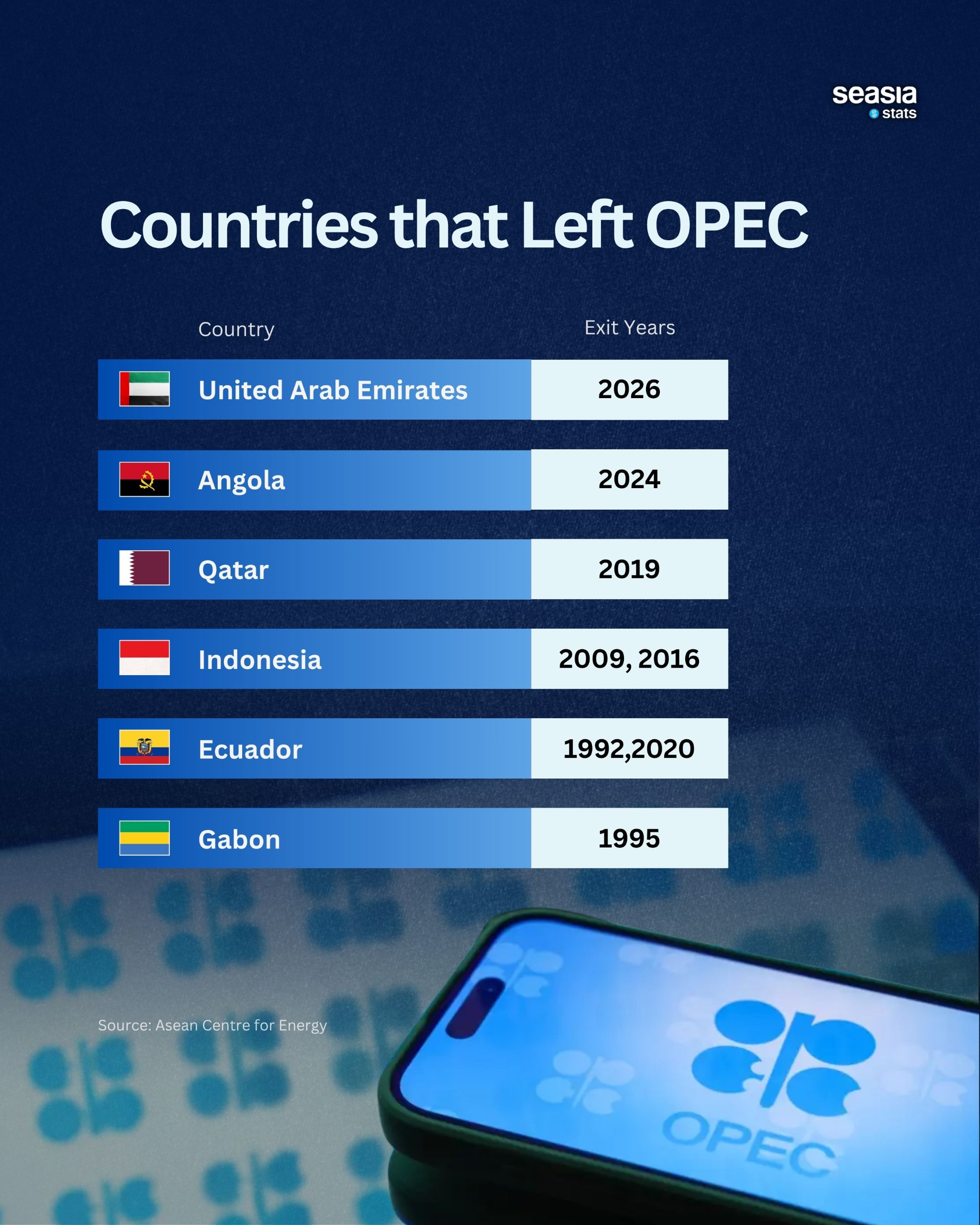
One of the most notable recent developments is the planned departure of the United Arab Emirates in 2026. As a major oil producer, the UAE’s decision signals a desire for greater independence in setting production levels and pursuing its own long-term energy strategy, including diversification beyond oil.
Earlier, Angola left OPEC in 2024 after nearly two decades of membership. The country cited disagreements over production quotas, which it argued constrained its ability to maximize oil revenues.
Similarly, Qatar exited in 2019, shifting its focus toward natural gas production, where it is a global leader. Qatar’s departure highlighted how evolving energy markets can reshape national priorities.
Indonesia presents a unique case, having left OPEC twice—first in 2009 and again in 2016 after briefly rejoining.
Once a net oil exporter, Indonesia became a net importer due to declining production and rising domestic demand. Its membership in OPEC became increasingly impractical, as the organization primarily represents exporting nations seeking to manage supply.
Ecuador also has a history of multiple departures. It first withdrew in 1992 due to financial constraints, including membership fees and production limits.
After rejoining in 2007, Ecuador left again in 2020, citing the need to increase production to support its economy amid fiscal challenges. These exits underscore how economic pressures can outweigh the benefits of collective coordination.
Finally, Gabon exited OPEC in 1995, largely due to the financial burden of membership relative to its smaller production capacity. Although Gabon later rejoined in 2016, its earlier departure reflects the difficulties smaller producers may face within large multilateral organizations.
Together, these cases illustrate that OPEC membership is not static. Countries weigh the advantages of collective action—such as market influence and price stability—against the flexibility of independent policymaking.
As global energy systems evolve, particularly with the rise of renewables and shifting demand patterns, more nations may reassess their roles within traditional oil alliances.