

Countries Where People Are Least Likely to Pray Regularly
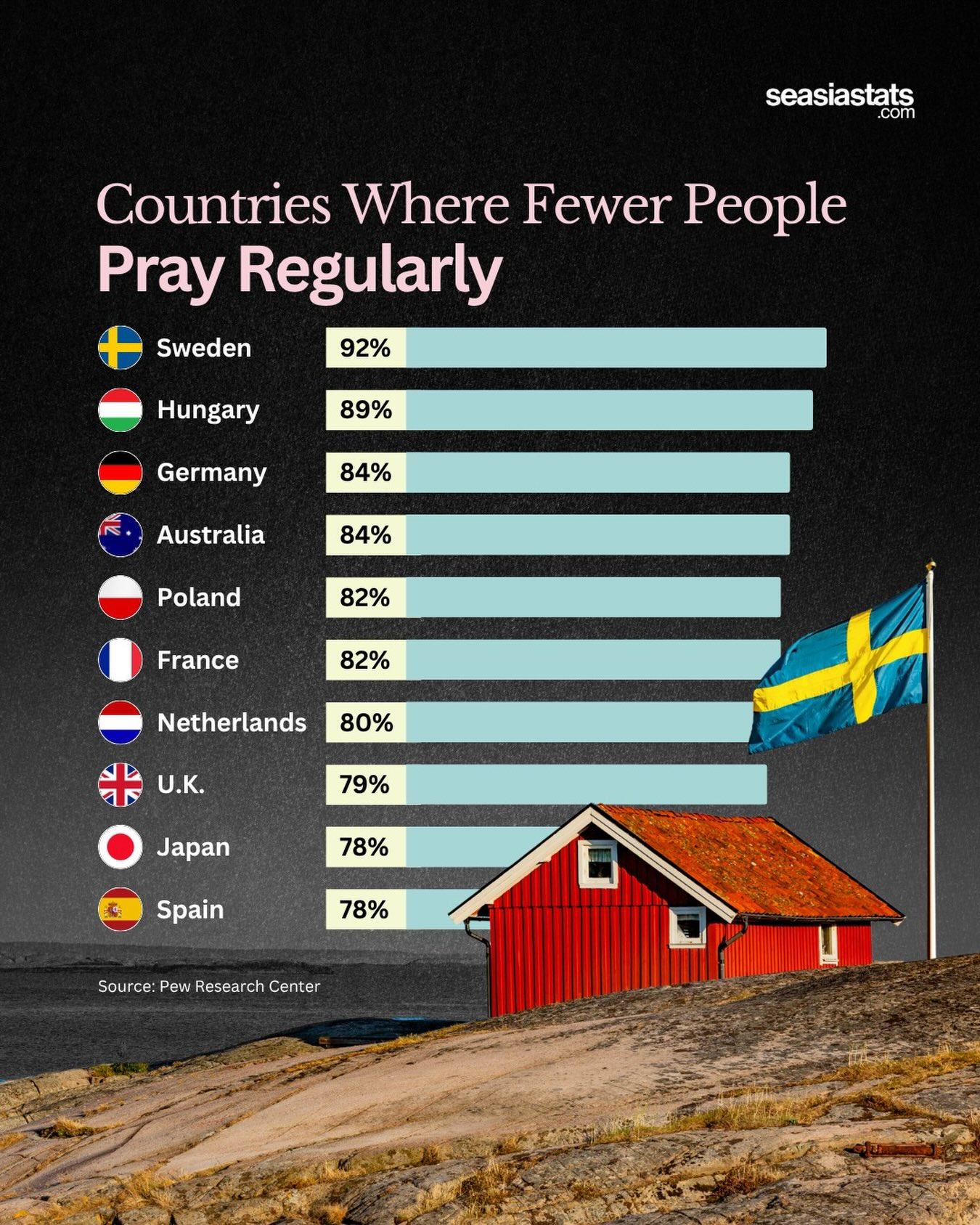
The Swedes are the least likely to pray regularly, followed by the Hungarians.

Around the world, people have very different relationships with religion and prayer. While prayer remains an important part of daily life for many people, research from the Pew Research Center shows that regular prayer is much less common in some countries.
Among the countries included in the figures, Sweden has the highest percentage of people who do not pray regularly, at 92 percent.
Sweden is followed by Hungary, where 89 percent of people reportedly do not pray regularly. The figures suggest that prayer plays a relatively limited role in the everyday lives of many people in both countries. Germany and Australia come next, with 84 percent of people in each country saying that they do not pray regularly.
Although Germany has a long Christian history, religious practice varies considerably among its population, while Australia is known for having a highly diverse society with many people who are not actively religious.
Poland and France each record 82 percent of people who do not pray regularly. The figures are particularly notable because both countries have strong historical connections to Christianity. Poland, for example, has traditionally had a large Catholic population, while France has a long Christian heritage.
However, religious identity and religious practice do not always go hand in hand. A person may identify with a particular religion because of family, culture, or tradition without regularly engaging in prayer.
The Netherlands follows at 80 percent, while the United Kingdom records 79 percent. Both countries have experienced significant changes in religious participation over recent generations. In many parts of Western Europe, fewer people attend religious services regularly or consider religious practice a central part of their lives.
Japan also appears on the list, with 78 percent of people reportedly not praying regularly. Japan's religious landscape differs from that of many European countries, with traditions such as Buddhism and Shinto influencing religious and cultural life. Finally, Spain records 78 percent, despite its longstanding Catholic heritage.
These numbers should not necessarily be interpreted as meaning that people in these countries have no religious beliefs. Not praying regularly can mean different things depending on an individual's beliefs, culture, and understanding of religion. Pew Research Center's studies have also shown that religious identity, belief, and religious practice are separate aspects of people's lives.
Overall, the figures illustrate how differently prayer fits into everyday life across countries. They also demonstrate that historical religious traditions do not always correspond to high levels of regular religious practice. As societies change, people's relationships with religion and prayer can change as well.