

Countries Where People Smile the Most and Least
According to Gallup, Indonesia is where people smile the most, while Türkiye is where people smile the least.

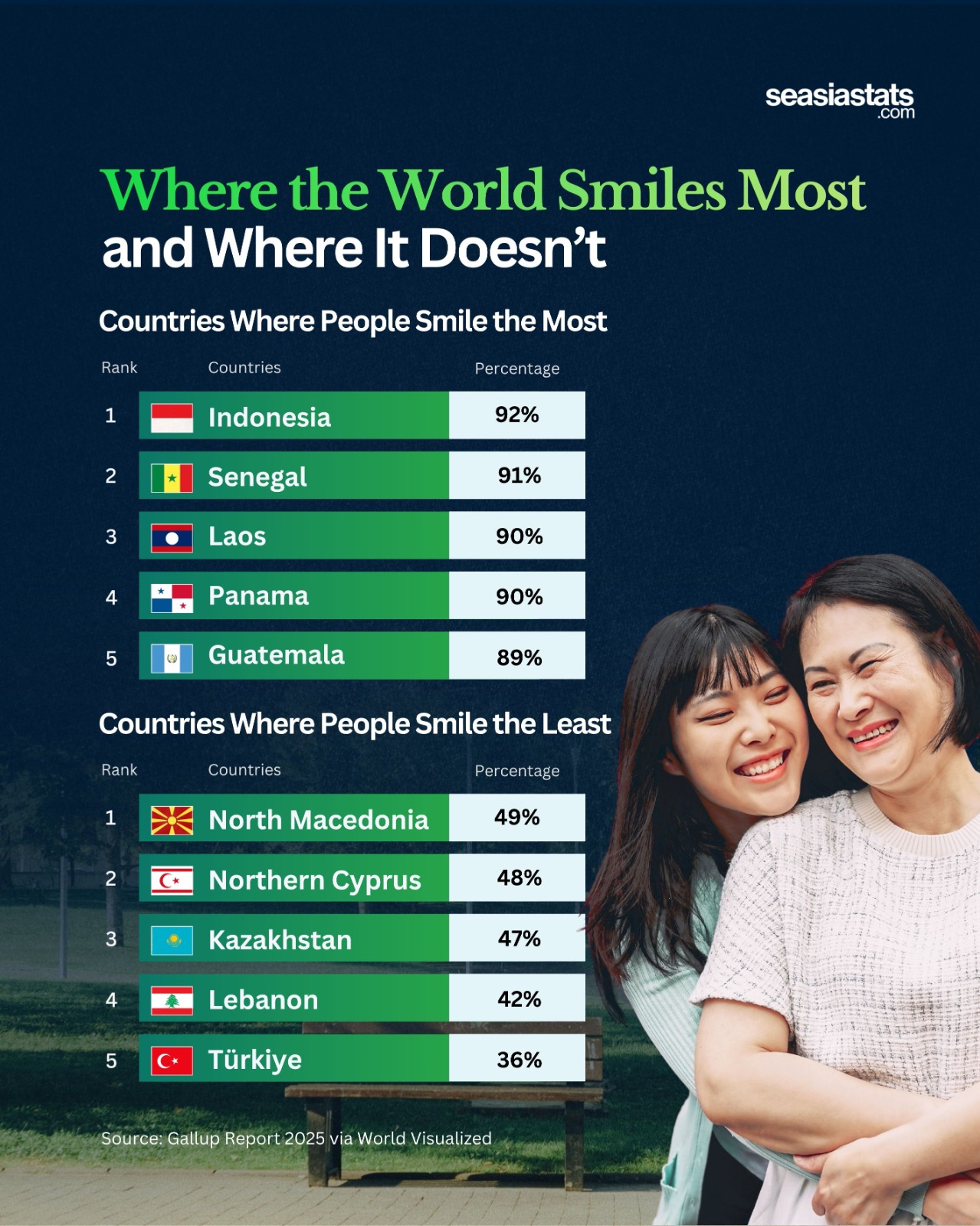
A simple smile or laugh can offer a glimpse into how people experience their everyday lives. According to Gallup’s latest global emotional-wellbeing data, countries differ considerably in the share of people who say they smiled or laughed a lot during the previous day.
The findings come from the Gallup World Poll, which surveys adults across countries and territories using nationally representative samples.
At the top of the list is Indonesia, where 92% of respondents said they had smiled or laughed a lot the previous day. The result places the Southeast Asian nation at the forefront of this particular measure of positive daily experience.
It is followed closely by Senegal, at 91%, while Laos and Panama each record 90%. Guatemala, with 89%, completes the five countries with the highest reported levels of smiling and laughter.
These figures offer an interesting picture of everyday emotional experiences around the world. In Indonesia, for example, the finding suggests that smiling and laughter are reported by a large majority of people during their daily lives.
Senegal's similarly high figure shows that this pattern is not limited to one geographic region. Meanwhile, Laos, Panama and Guatemala demonstrate that high levels of reported positive daily experiences can be found across Asia, Latin America and Africa.
At the other end of the scale, Gallup's data shows substantially lower percentages in several countries. Türkiye records 36%, the lowest figure among the countries listed.
It is followed by Lebanon, at 42%, Kazakhstan, at 47%, Northern Cyprus, at 48%, and North Macedonia, at 49%. Gallup lists Northern Cyprus separately in its international data since its political status is disputed and it is recognized as a state only by Türkiye.
The contrast between the highest and lowest figures is striking. Indonesia's 92% is more than twice Türkiye's 36%, illustrating the wide differences Gallup records in people's reports of smiling and laughing during an ordinary day.
However, these numbers should not be interpreted as a definitive ranking of which nations are “happiest.” Gallup measures a specific daily experience rather than overall life satisfaction.
Its survey asks respondents whether they experienced particular emotions or experiences “a lot” of the previous day, including enjoyment, worry, stress, anger and whether they smiled or laughed.
The results therefore provide a fascinating snapshot of emotional life across societies. They show where people are most likely to report frequent smiling and laughter, while also reminding us that happiness and wellbeing are complex concepts that cannot be captured by a single question or percentage.