

Countries with Crescents and Stars on Their Flags
Crescents and stars are quite a common sight in the world's flags.

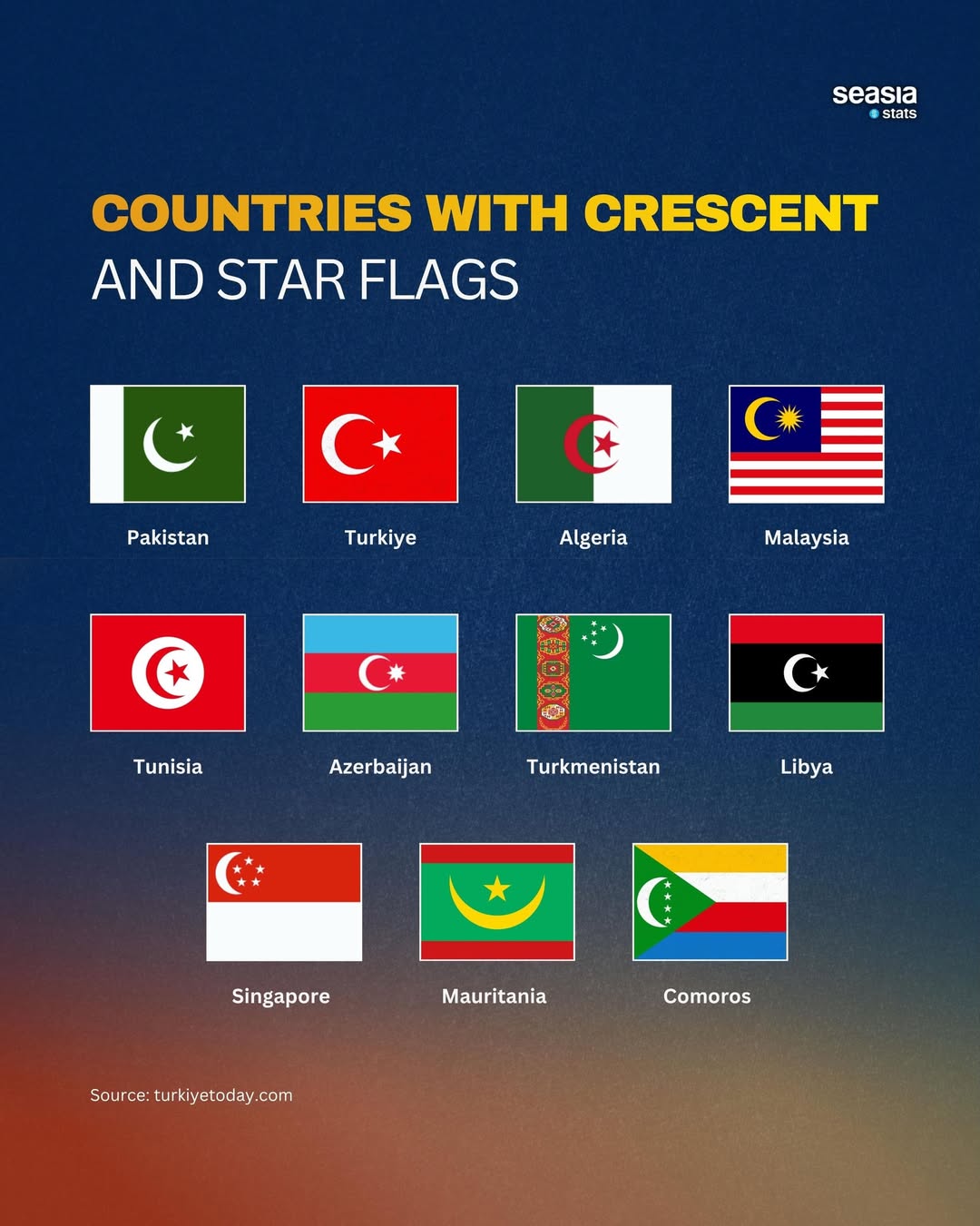
The crescent and star are powerful symbols that appear on the flags of several countries, often reflecting historical, cultural, and religious influences—particularly connections to Islam and the legacy of the Ottoman Empire.
Nations such as Pakistan, Turkey, Algeria, Malaysia, Singapore, Tunisia, Azerbaijan, Turkmenistan, Libya, Mauritania, and Comoros all feature this iconic imagery, though each interprets it in its own unique way.
In many cases, the crescent and star symbolize Islamic heritage. For instance, Pakistan’s flag prominently displays a white crescent and star on a green background, representing progress and light, alongside the country’s Muslim identity.
Similarly, Turkey’s flag, one of the most recognizable in the world, carries a white crescent and star on red—a design rooted in Ottoman history that has become a national emblem.
North African countries such as Algeria, Tunisia, Libya, and Mauritania also incorporate the crescent and star. Algeria and Tunisia use red crescents and stars against white or red backgrounds, symbolizing both Islam and national struggle.
Mauritania’s flag includes a gold crescent and star, representing Islam alongside prosperity, while Libya’s current flag features a white crescent and star centered on a black stripe, symbolizing unity after political transformation.
In Asia, Malaysia and Singapore provide interesting variations. Malaysia’s flag includes a yellow crescent and a 14-point star, symbolizing Islam as the state religion and unity among its states.
Singapore, while not an Islamic nation, uses a crescent and five stars to represent ideals such as democracy, peace, and equality, showing that the symbols can transcend religious meaning.
Central Asian and Caucasus nations like Azerbaijan and Turkmenistan also feature crescents and stars, reflecting Turkic heritage and cultural continuity. Azerbaijan’s eight-pointed star represents the Turkic peoples, while Turkmenistan incorporates the crescent as a symbol of hope and renewal.
Finally, Comoros stands out with multiple stars alongside a crescent, each star representing one of its islands, blending geographic identity with religious symbolism.
Overall, while the crescent and star are often associated with Islam, their meanings are far from uniform. Across these nations, they represent a blend of faith, history, unity, and national identity, demonstrating how shared symbols can take on diverse interpretations depending on cultural and political contexts.