

Countries with More than One Capital City
Instead of one, these countries have multiple capital cities which is very unique.

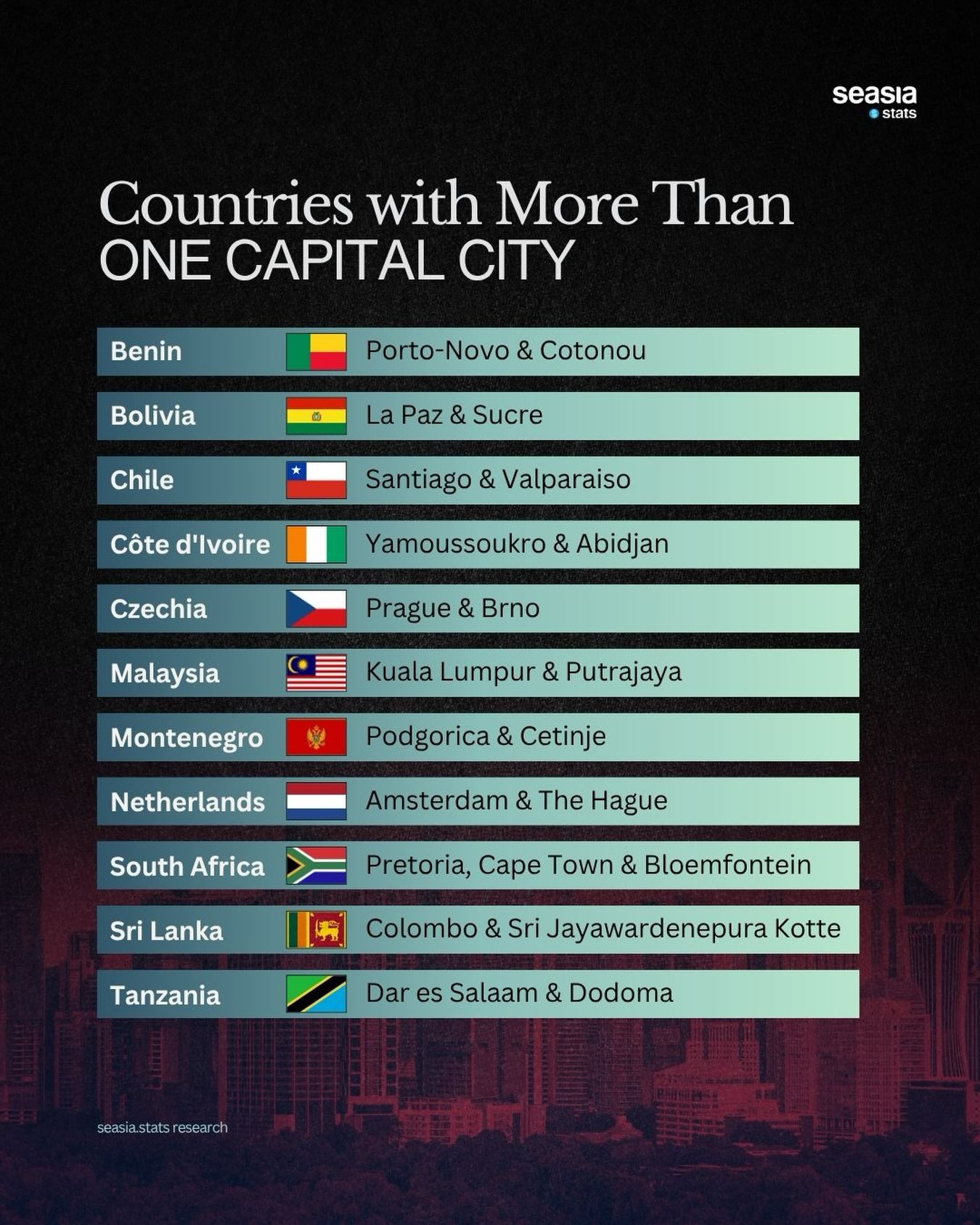
Most countries in the world have a single capital city where the main institutions of government are located. However, some countries divide important political, administrative, legislative, or judicial functions between two or more cities.
This creates unusual capital arrangements that reflect history, geography, political compromises, or the relocation of government institutions. The countries listed below are examples of this arrangement, although in several cases one city is officially the capital while another serves as the seat of government or a major government function.
In Benin, Porto-Novo is the official capital, while Cotonou serves as the country's seat of government and de facto administrative center.
Bolivia has Sucre as its constitutional capital and judicial center, while La Paz is the seat of government and hosts the executive and legislature. Chile has Santiago as its official capital, while Valparaíso is home to the National Congress, giving the two cities different political roles.
In Côte d'Ivoire, Yamoussoukro is the official capital, but Abidjan remains the country's major economic center and de facto administrative hub.
Czechia is sometimes included in lists of countries with multiple capitals because Prague is the official capital, while Brno is an important judicial center and hosts several major national institutions. Strictly speaking, however, Brno is not a second official capital.
Malaysia divides its capital functions between Kuala Lumpur and Putrajaya. Kuala Lumpur remains the constitutional and legislative capital, while Putrajaya is the principal administrative center. Montenegro has Podgorica as its administrative capital, while Cetinje retains the historic title of Old Royal Capital.
The Netherlands has Amsterdam as its constitutional capital, but The Hague is the seat of government, parliament, and many national institutions. In South Africa, the arrangement is even more distinctive: Pretoria is the administrative and executive capital, Cape Town is the legislative capital, and Bloemfontein is widely recognized as the judicial capital.
In Sri Lanka, Sri Jayawardenepura Kotte is the official legislative capital, while Colombo remains the country's major commercial center and hosts important executive and judicial institutions.
Finally, Tanzania officially moved its capital to Dodoma, although Dar es Salaam, the former capital and largest city, continues to host important government functions and remains the country's economic center.
These examples show that a country's capital does not always mean one city performs every national function.
Multiple-capital arrangements demonstrate how governments can distribute political power and administrative responsibilities among different cities. They also make geography more interesting by showing that the concept of a “capital city” can have several meanings.