

Countries with the Fastest Elevators
These countries have the fastest elevators in the world.

As cities continue to grow vertically, elevator technology has become one of the most important innovations in modern urban development. Around the world, countries are competing to build taller skyscrapers and faster elevators that can move people efficiently through massive buildings.
Today, several nations stand out for their achievements in high-speed elevator engineering, combining advanced safety systems, smooth ride experiences, and impressive speeds measured in meters per second (m/s).
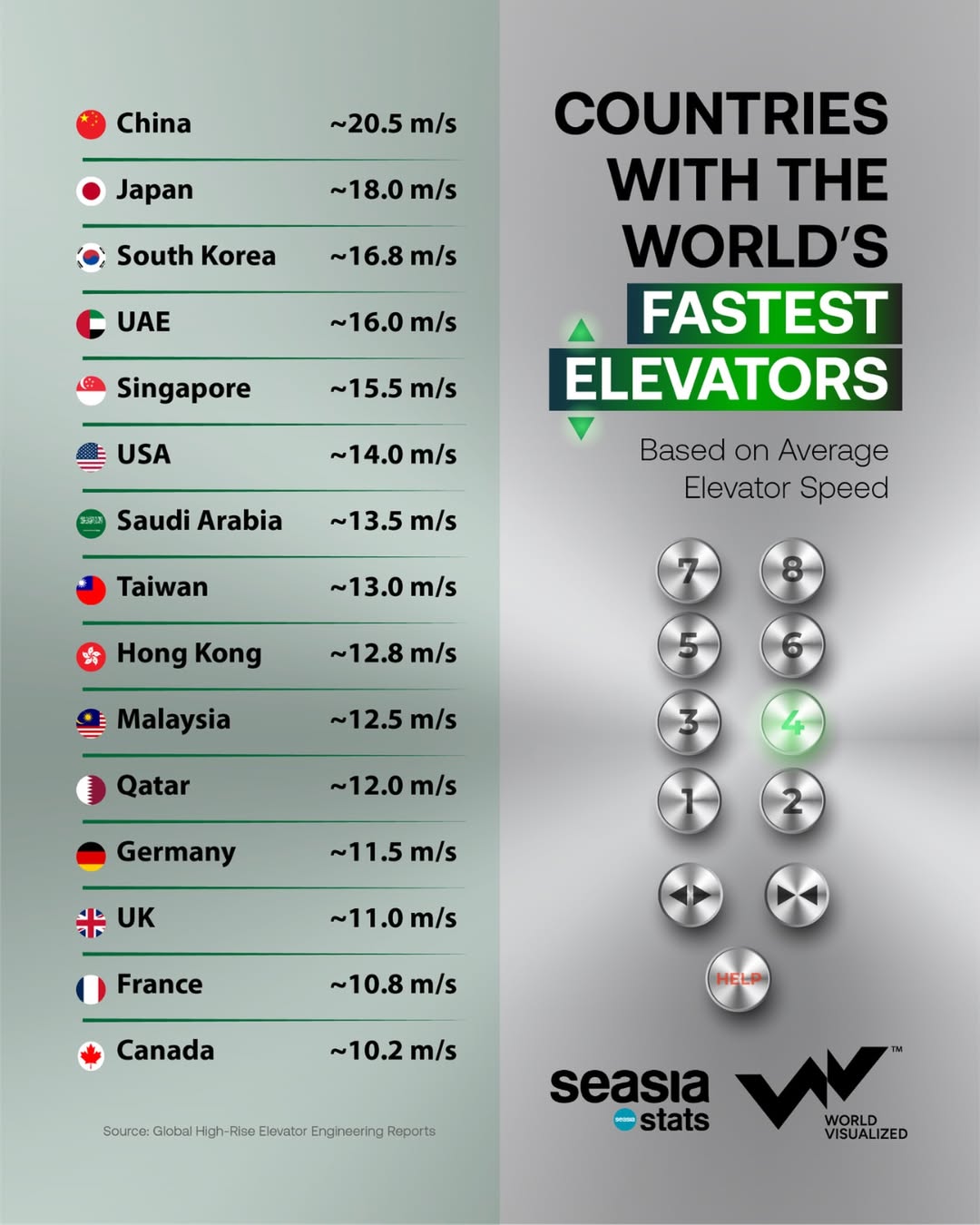
China currently leads the world with the fastest elevators, reaching an incredible speed of 20.5 m/s. These ultra-fast systems are designed for supertall skyscrapers in major cities such as Shanghai and Guangzhou. China’s rapid urbanization and ambitious construction projects have pushed the country to invest heavily in cutting-edge vertical transportation technologies.
Japan ranks second with elevators capable of traveling at 18.0 m/s. Known for precision engineering and innovation, Japan has long been a pioneer in elevator development. Japanese manufacturers focus not only on speed but also on comfort, energy efficiency, and earthquake-resistant technology, making their elevators among the safest in the world.
South Korea follows closely with speeds of 16.8 m/s, reflecting the country’s leadership in smart building technologies and futuristic urban architecture.
The United Arab Emirates comes next at 16.0 m/s, supported by iconic skyscrapers such as the Burj Khalifa in Dubai, where high-speed elevators are essential for transporting thousands of visitors and residents every day.
Singapore achieves elevator speeds of 15.5 m/s, while the United States reaches 14.0 m/s. Both countries are known for advanced commercial skyscrapers and modern urban infrastructure. Saudi Arabia records 13.5 m/s as it continues developing ambitious megaprojects and tall towers designed to reshape its urban landscape.
Taiwan and Hong Kong also play important roles in high-rise innovation, with maximum elevator speeds of 13.0 m/s and 12.8 m/s respectively. Malaysia and Qatar follow with 12.5 m/s and 12.0 m/s, demonstrating the growing importance of advanced vertical transportation across Asia and the Middle East.
In Europe, Germany leads with 11.5 m/s, followed by the United Kingdom at 11.0 m/s and France at 10.8 m/s. Canada rounds out the list with elevators reaching 10.2 m/s. Although these speeds may seem lower compared to Asian counterparts, they still represent remarkable engineering achievements.
The race for faster elevators reflects the global demand for taller, smarter, and more efficient buildings. As urban populations continue to rise, elevator technology will remain a critical part of shaping the skylines of the future.