

Countries with the Fastest Population Decline
Population decline is a dire issue faced by many countries around the world.

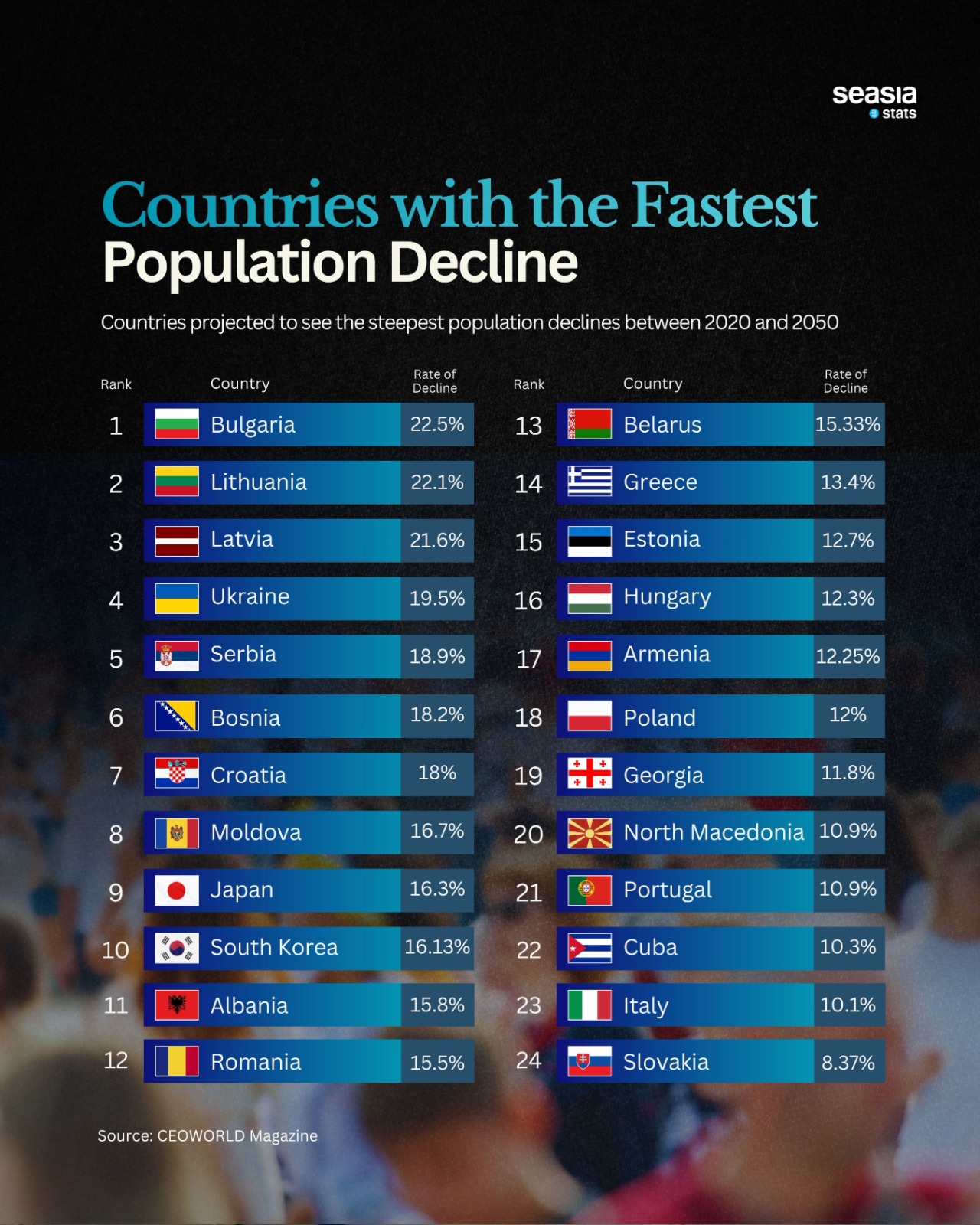
Population decline is emerging as one of the most significant demographic challenges of the 21st century.
According to a 2025 report by CEOWORLD Magazine, many countries—especially in Europe and parts of Asia—are projected to lose substantial portions of their populations between 2020 and 2050. These declines are driven by a combination of low birth rates, aging populations, and sustained emigration.
At the top of the list is Bulgaria, expected to lose 22.5% of its population, followed closely by Lithuania (22.1%) and Latvia (21.6%). These countries exemplify a broader regional trend in Eastern Europe, where economic migration and declining fertility have combined to accelerate depopulation.
Many younger citizens leave in search of better opportunities abroad, leaving behind aging populations and shrinking workforces.
Conflict and instability also play a role. Ukraine, projected to decline by 19.5%, has experienced demographic losses due to war, displacement, and public health challenges.
Similarly, countries like Serbia (18.9%), Bosnia and Herzegovina (18.2%), and Croatia (18%) continue to face long-term population declines linked to post-conflict recovery and emigration trends.
Beyond the Balkans, several other nations are projected to experience steep declines. Moldova (16.7%) struggles with one of Europe’s highest emigration rates, while Romania (15.5%), Belarus (15.33%), and Albania (15.8%) face similar demographic pressures.
Southern European countries such as Greece (13.4%), Portugal (10.9%), and Italy (10.1%) are also seeing population shrinkage due to persistently low fertility rates.
Asia is not immune to this trend. Japan is projected to lose 16.3% of its population, while South Korea follows closely at 16.13%. Both countries have some of the lowest fertility rates in the world, combined with limited immigration, leading to rapidly aging societies.
Other notable countries experiencing decline include Estonia (12.7%), Hungary (12.3%), Armenia (12.25%), Poland (12%), Georgia (11.8%), North Macedonia (10.9%), Cuba (10.3%), and Slovakia (8.37%). Together, these figures reveal a widespread demographic shift affecting both developed and developing nations.
While population decline can ease pressures such as overcrowding and environmental strain, it also creates serious economic challenges. Shrinking labor forces, rising dependency ratios, and increased strain on social services are among the key concerns.
As these countries confront demographic contraction, policies that encourage higher birth rates, support families, and manage migration will become increasingly critical in shaping their future stability.