

Countries with the Fastest Population Decline in the World
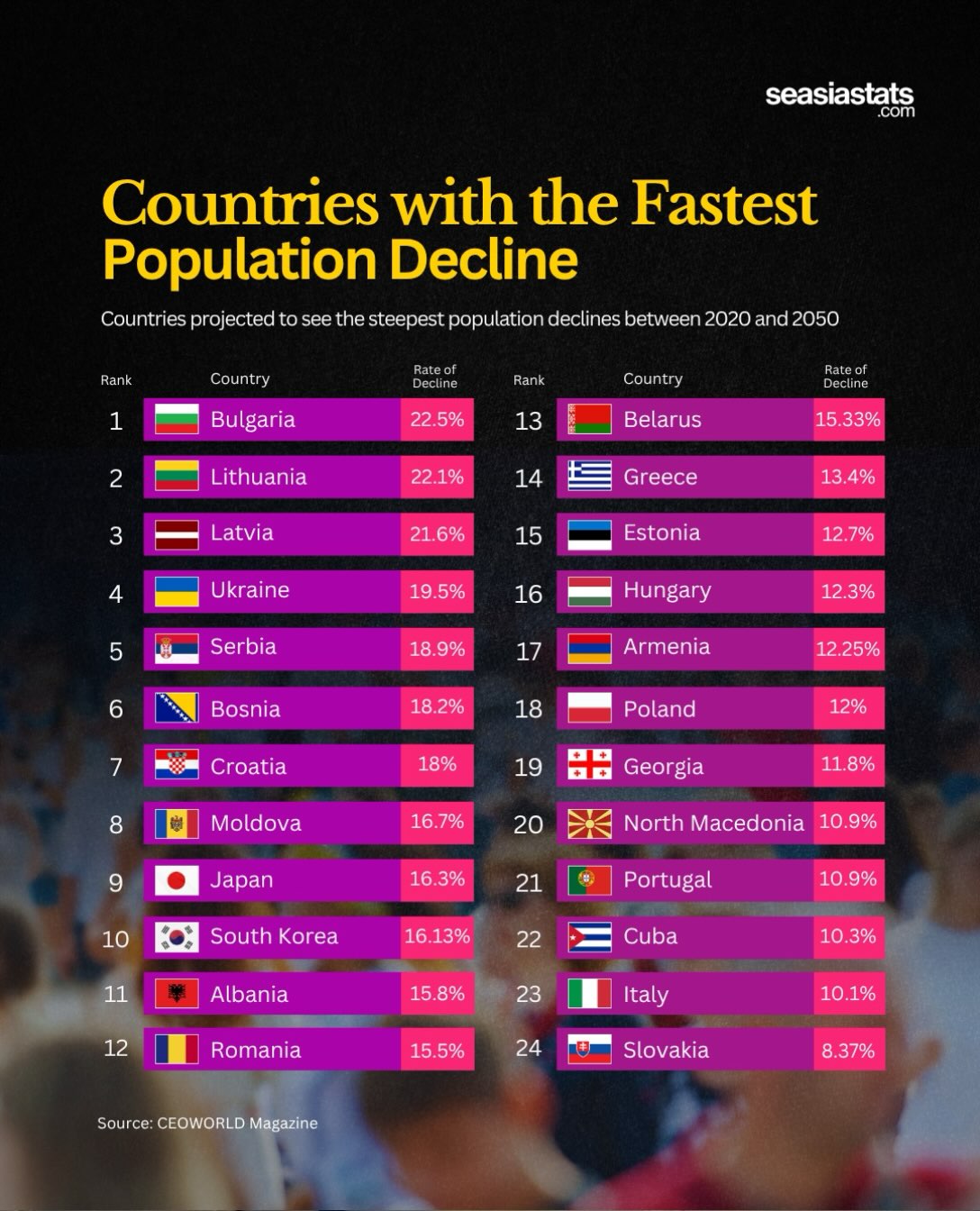
With 22.5%, Bulgaria is seeing the fastest population decline in the world.

Population decline is becoming one of the most pressing demographic issues around the world in the 21st century.
According to a 2025 report by CEOWORLD Magazine, numerous countries, particularly across Europe and parts of Asia, are expected to experience significant population losses between 2020 and 2050. This trend is largely driven by persistently low birth rates, aging populations, and continued emigration.
Bulgaria ranks first, with its population projected to decrease by 22.5%, followed by Lithuania at 22.1% and Latvia at 21.6%. These nations reflect a wider pattern across Eastern Europe, where economic migration and falling fertility rates have contributed to increasingly rapid population decline.
Many young people move overseas in pursuit of better employment and living opportunities, leaving their home countries with older populations and increasingly smaller workforces.
Political conflict and instability are additional contributing factors. Ukraine, which is projected to see a population decline of 19.5%, has suffered substantial demographic losses associated with war, displacement, and public health difficulties.
Likewise, Serbia (18.9%), Bosnia and Herzegovina (18.2%), and Croatia (18%) continue to experience long-term population decreases influenced by post-conflict challenges and ongoing emigration.
Outside the Balkans, several other countries are also expected to face considerable demographic contractions. Moldova (16.7%) struggles with one of Europe's highest emigration rates, while Romania (15.5%), Belarus (15.33%), and Albania (15.8%) face comparable demographic pressures.
In Southern Europe, countries including Greece (13.4%), Portugal (10.9%), and Italy (10.1%) are also experiencing shrinking populations, largely as a result of persistently low birth rates.
Asia faces similar challenges. Japan is forecast to lose 16.3% of its population, followed closely by South Korea at 16.13%. Both nations have some of the world's lowest fertility rates and relatively limited immigration, contributing to rapidly aging societies.
Other countries expected to experience population decline include Estonia (12.7%), Hungary (12.3%), Armenia (12.25%), Poland (12%), Georgia (11.8%), North Macedonia (10.9%), Cuba (10.3%), and Slovakia (8.37%). Collectively, these figures highlight a broad demographic transformation affecting countries at different stages of economic development.
Although a declining population may reduce certain pressures, such as overcrowding and environmental stress, it can also introduce substantial economic difficulties. A shrinking labor force, higher dependency ratios, and growing demands on social services are among the most significant concerns.
As these nations grapple with declining populations, implementing policies that promote higher birth rates, provide stronger support for families, and address migration will become increasingly important in maintaining long-term economic and social stability.