

Countries with the Highest Number of National Parks
With an astonishing number of 685, Australia has the most national parks in the world.

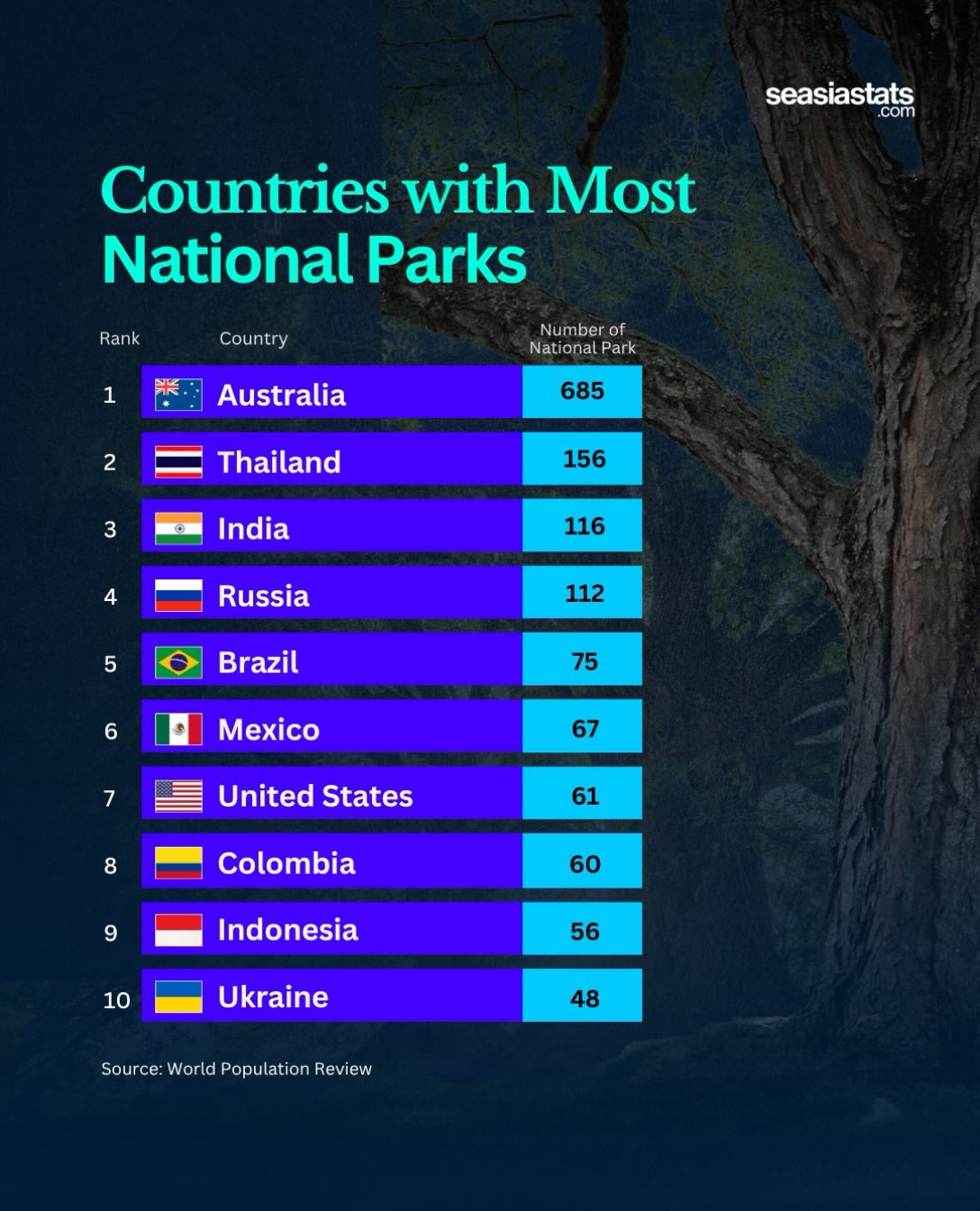
National parks play an essential role in conserving biodiversity, protecting natural landscapes, and encouraging sustainable tourism. Across the globe, governments designate national parks to preserve ecosystems, protect endangered species, and create spaces for outdoor recreation and environmental education.
Among the countries with the greatest number of national parks, Australia ranks first by a significant margin, highlighting its dedication to preserving its rich and diverse natural heritage.
Australia takes the top spot with an impressive 685 national parks. The country features an extraordinary variety of ecosystems, ranging from tropical rainforests and arid deserts to coastal environments and mountain ranges.
These protected areas provide habitats for numerous endemic species while attracting millions of local and international tourists each year.
Thailand ranks second with 156 national parks, reflecting its strong commitment to nature conservation. Its parks safeguard dense forests, spectacular waterfalls, limestone mountains, and marine environments that support a wide variety of plant and animal life.
India comes next with 116 national parks, offering vital habitats for well-known wildlife species, including Bengal tigers, Asian elephants, rhinoceroses, and lions. These protected areas play a significant role in the country's wildlife conservation programs and growing ecotourism sector.
Russia ranks fourth, with 112 national parks spread across extensive areas of forests, tundra, mountains, and lakes throughout the world's largest country.
Brazil follows with 75 national parks, many situated in the Amazon rainforest and other ecologically significant regions. These protected landscapes are essential to conserving some of the richest biodiversity found anywhere on Earth.
Mexico has 67 national parks that protect a diverse range of environments, including volcanic terrain, deserts, forests, and coastal habitats. The United States ranks next with 61 national parks, several of which are globally famous for their breathtaking scenery, from deep canyons and towering mountains to expansive forests and geothermal wonders.
Colombia takes eighth place with 60 national parks, preserving rainforests, coral reefs, wetlands, and high-altitude environments that sustain an exceptional variety of wildlife.
Indonesia has 56 national parks distributed across its thousands of islands. These areas conserve tropical rainforests, coral reefs, mangrove forests, and habitats for endangered animals such as orangutans, Komodo dragons, Sumatran tigers, and Javan rhinoceroses.
Ukraine rounds out the top ten with 48 national parks, protecting forests, wetlands, rivers, and mountainous regions that form an important part of the country's natural heritage.
The number of national parks in each country offers insight into its efforts to protect natural resources and preserve ecological balance.
Although these protected areas differ considerably in size, landscape, and environmental characteristics, they share common goals: conserving biodiversity, advancing scientific research, and promoting tourism that respects the natural environment.