

Countries with the Largest Coral Reef Areas
These countries have the largest coral reef areas in the world.

Coral reefs are among the most diverse and valuable ecosystems on Earth. They provide habitat for thousands of marine species, protect coastlines from erosion, support fisheries, and contribute greatly to tourism economies.
Although reefs occupy only a small portion of the ocean, their ecological importance is enormous. Several countries stand out for possessing especially large reef areas, many of which are located in tropical waters with ideal conditions for coral growth.
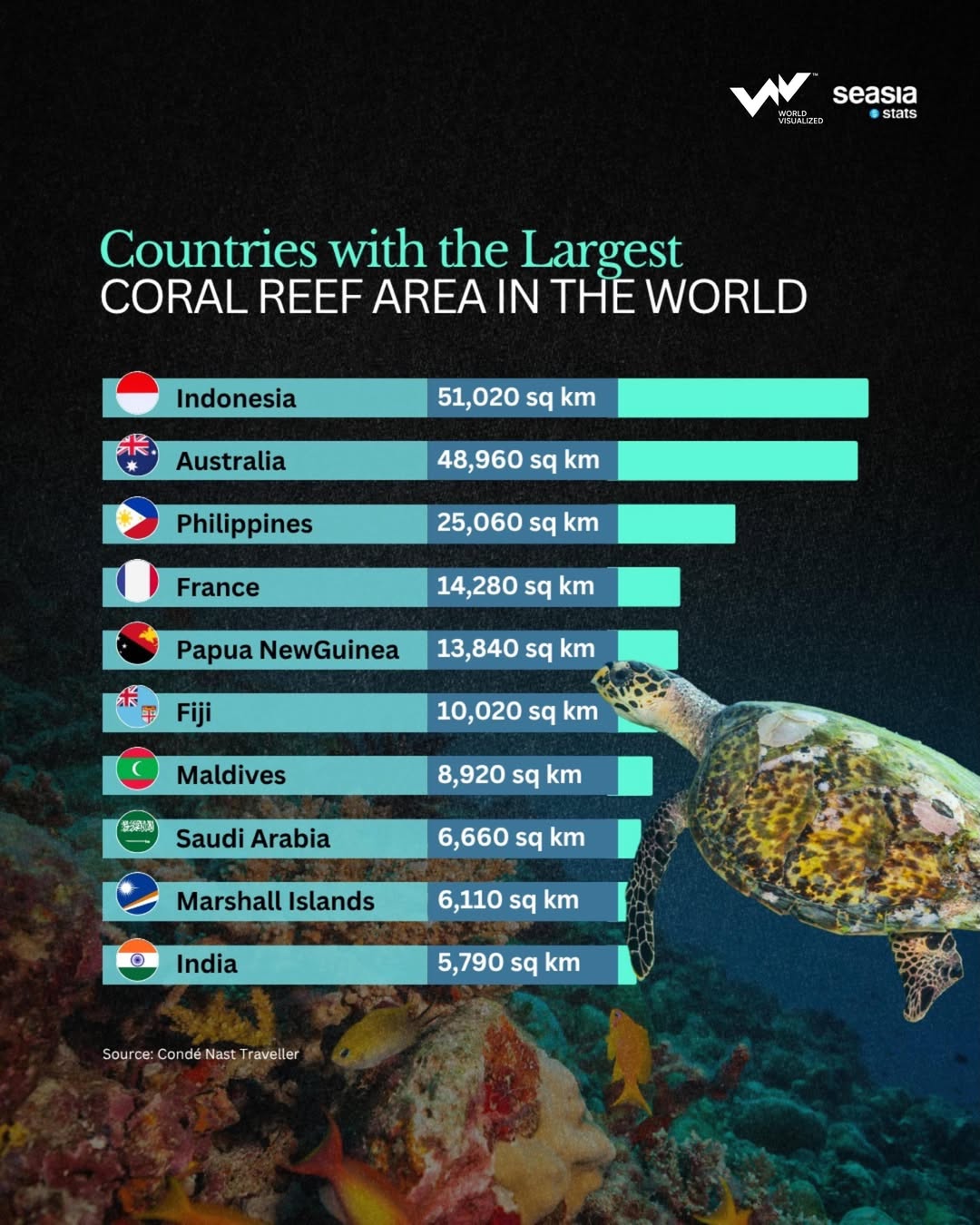
Indonesia has the world’s largest reef area, covering approximately 51,020 square kilometers. Located within the Coral Triangle, Indonesia’s reefs are considered the global center of marine biodiversity.
The country’s thousands of islands create extensive reef systems that support countless species of fish, corals, and other marine organisms. Indonesian reefs are also essential for local fishing communities and tourism industries.
Australia ranks second with about 48,960 square kilometers of reef area. The country is home to the famous Great Barrier Reef, the largest coral reef system in the world.
Stretching along the northeastern coast, the reef is recognized as a UNESCO World Heritage Site and is one of the most studied marine ecosystems on the planet. However, climate change and coral bleaching remain major threats to its survival.
The Philippines possesses around 25,060 square kilometers of reefs. Like Indonesia, the Philippines lies within the Coral Triangle and contains exceptionally rich marine biodiversity. Coral reefs play a crucial role in food security and coastal protection for millions of Filipinos.
France ranks fourth with 14,280 square kilometers of reef area, largely due to its overseas territories in the Pacific and Indian Oceans, such as New Caledonia and French Polynesia. Papua New Guinea follows with 13,840 square kilometers, hosting extensive reefs that remain relatively untouched compared to many other regions.
Fiji, with 10,020 square kilometers of reefs, is internationally known for its vibrant coral ecosystems and marine tourism. The Maldives, covering about 8,920 square kilometers of reef area, depends heavily on reefs for tourism and protection against rising sea levels.
Saudi Arabia has approximately 6,660 square kilometers of coral reefs along the Red Sea coast. These reefs are notable for their ability to survive in warmer and saltier waters. The Marshall Islands contain about 6,110 square kilometers of reefs, supporting both biodiversity and local livelihoods in the Pacific Ocean.
India rounds out the list with around 5,790 square kilometers of reef area. Indian coral reefs are found mainly in the Lakshadweep Islands, the Gulf of Mannar, and the Andaman and Nicobar Islands.
Together, these countries contain some of the world’s most important coral reef ecosystems. Protecting them is essential not only for marine life, but also for the millions of people who depend on healthy oceans for food, income, and environmental stability.