

Countries With the Largest Freshwater Resources Per Capita
Russia has the most renewable freshwater resources per capita in the world.

Freshwater is one of the world's most important natural resources, supporting drinking water supplies, agriculture, industry, ecosystems, and human development. However, freshwater resources are distributed very unevenly across countries.
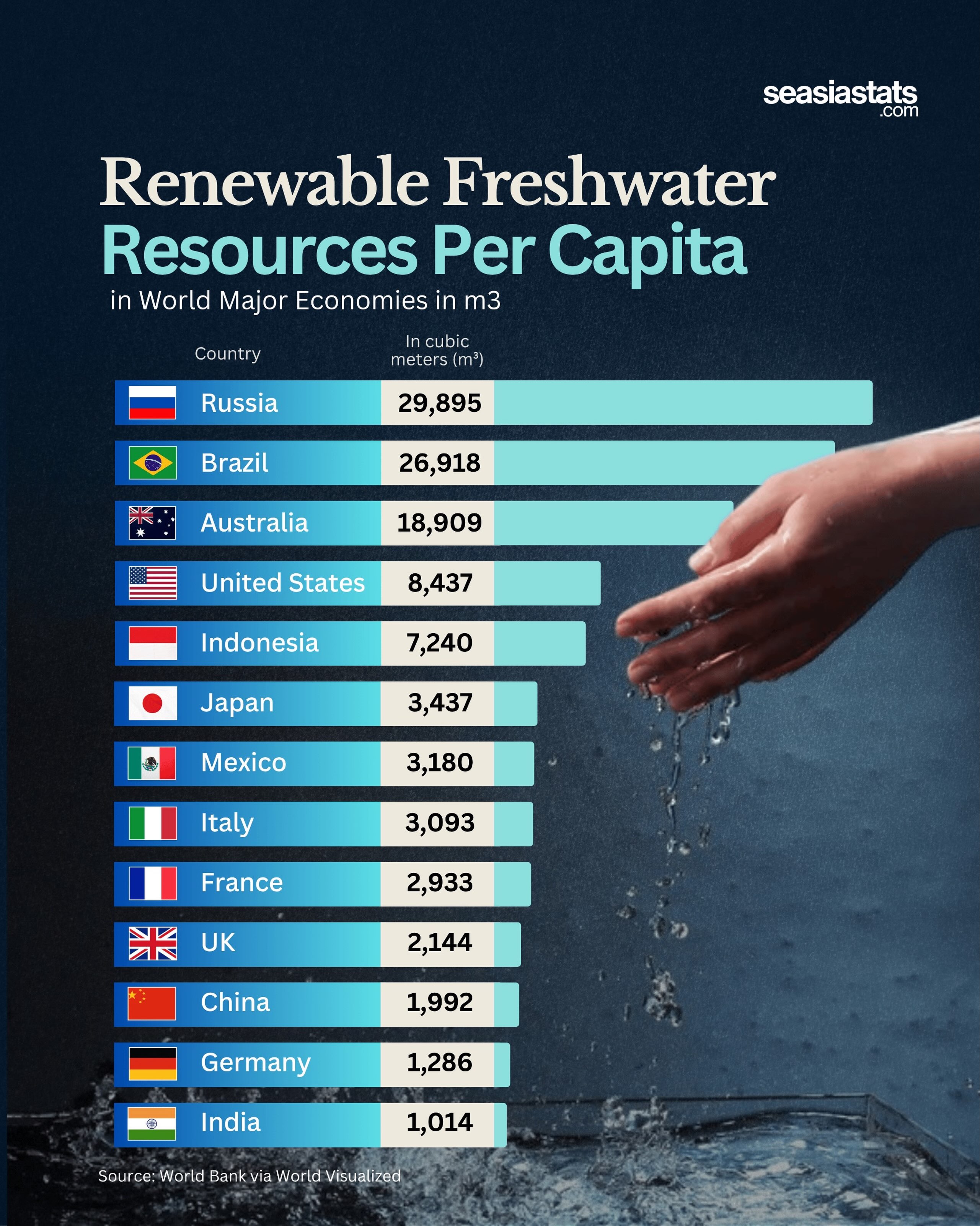
According to the World Bank figures provided, Russia, Brazil, and Australia have some of the world's largest amounts of renewable freshwater resources per capita, while densely populated countries such as India and China have considerably lower amounts per person.
Russia ranks first among the countries on the list, with 29,895 cubic meters of freshwater resources per capita. The country's enormous territory contains extensive rivers, lakes, wetlands, and other freshwater resources. Its relatively large freshwater supply combined with its population gives Russia a particularly high amount of water available per person.
Brazil follows closely with 26,918 cubic meters per capita. Brazil is home to the Amazon River and one of the world's largest concentrations of freshwater resources. Its vast river systems and high levels of rainfall contribute significantly to its abundant water supply.
Australia ranks third, with 18,909 cubic meters per capita. Despite being known for its arid and semi-arid regions, Australia has substantial freshwater resources relative to its population. However, the availability of water varies considerably across the country and between different regions.
The United States has 8,437 cubic meters per capita, placing it well above many other developed countries. Indonesia, with its tropical climate and extensive rainfall, has 7,240 cubic meters per capita, making it one of the most water-rich countries in Asia on a per-person basis.
Among other major economies, Japan has 3,437 cubic meters per capita, followed by Mexico at 3,180 and Italy at 3,093. France has 2,933 cubic meters, while the United Kingdom has 2,144 cubic meters per person.
The figures become considerably lower for some of the world's most populous countries. China has 1,992 cubic meters per capita, while Germany has 1,286. India ranks last among the countries listed, with just 1,014 cubic meters per capita.
These figures illustrate why population size is an important factor when considering freshwater availability. A country may possess enormous total water resources but have a much smaller amount available per person if it has a large population.
At the same time, per-capita figures do not necessarily indicate how easily people can access water, because geography, climate, infrastructure, pollution, and seasonal variations also influence actual water availability.
Overall, the data highlight the significant differences in freshwater resources around the world and the importance of responsible water management for future generations.