

Countries with the Most Air Conditioner Users
People in these countries are using air conditioner the most.

Air conditioners have become an essential part of everyday life in many countries, especially in regions with hot climates or humid summers. As global temperatures continue to rise and living standards improve, the demand for cooling systems has grown significantly.
Some countries have reached exceptionally high household air conditioner adoption rates, reflecting both climate conditions and economic development.
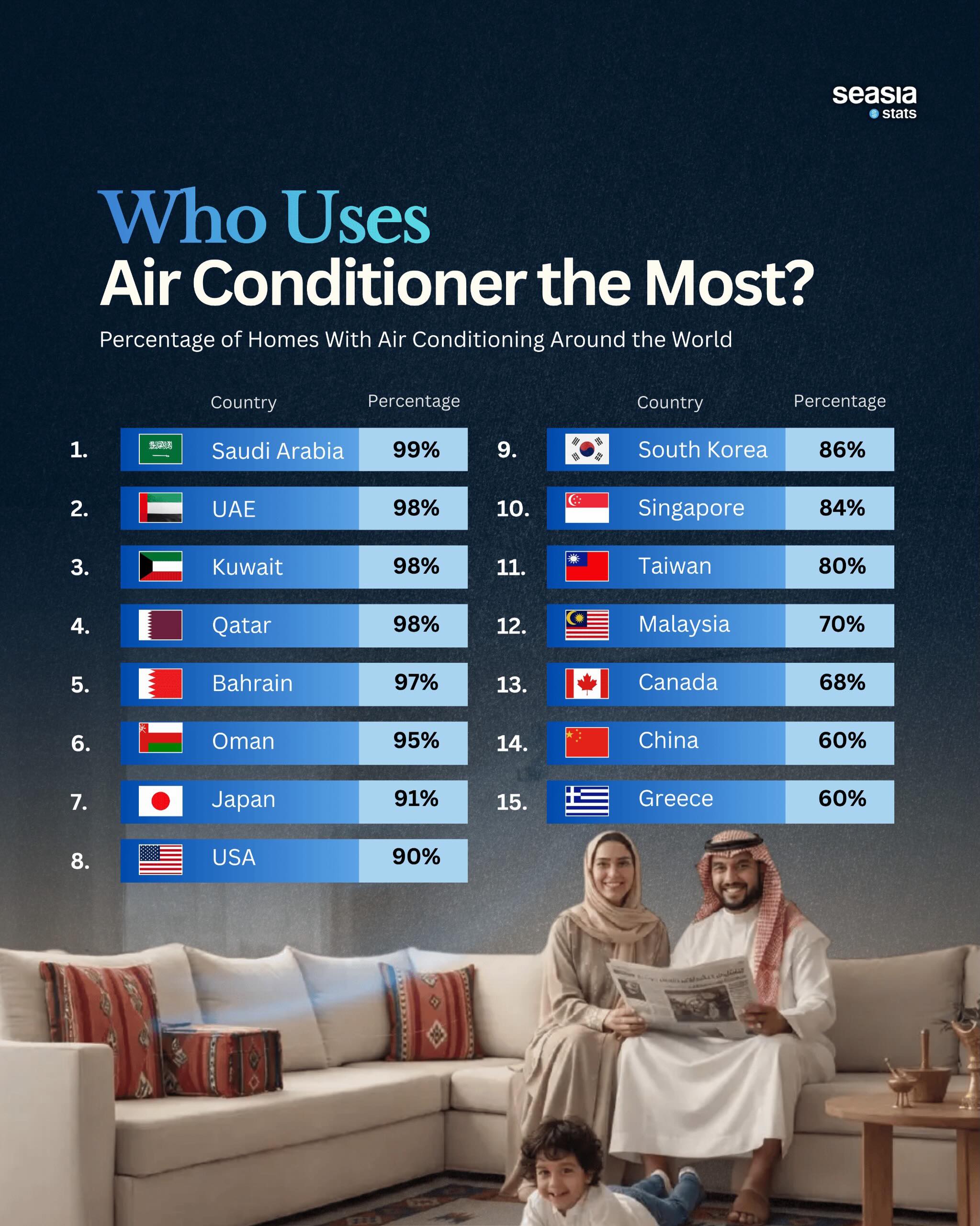
Saudi Arabia leads the world with an impressive 99% air conditioner usage rate. The country's desert climate brings extremely high temperatures for much of the year, making air conditioning indispensable for homes, businesses, and public spaces.
Close behind are the United Arab Emirates, Kuwait, and Qatar, each with 98% usage. Bahrain follows with 97%, while Oman records 95%. Across the Gulf region, air conditioning is considered a necessity rather than a luxury due to prolonged periods of intense heat.
Outside the Middle East, Japan has one of the highest adoption rates at 91%. Its hot, humid summers have encouraged widespread use of energy-efficient air conditioning systems.
The United States follows closely with 90%, where air conditioners are common in homes, offices, schools, and commercial buildings, particularly in warmer states. South Korea also demonstrates high adoption at 86%, driven by urban living and increasingly warm summers.
Singapore, located near the equator, records 84% air conditioner usage because of its consistently hot and humid tropical climate. Taiwan follows at 80%, while Malaysia reaches 70%, reflecting the growing affordability of cooling systems and increasing urbanization.
Interestingly, cooler countries also report substantial air conditioner ownership. Canada has a usage rate of 68%, as warmer summers and more frequent heat waves have increased demand for residential cooling.
China records 60%, supported by rapid economic growth, expanding middle-class incomes, and widespread urban development. Greece also stands at 60%, where hot Mediterranean summers make air conditioning increasingly common in homes, hotels, and businesses.
These figures highlight how climate, economic prosperity, urbanization, and changing lifestyles influence the adoption of air conditioning worldwide. While countries in the Middle East dominate the rankings due to extreme desert temperatures, nations across Asia, North America, and Europe are also experiencing growing reliance on cooling technologies.
As climate change contributes to rising global temperatures, the demand for energy-efficient air conditioning is expected to continue increasing, making sustainable cooling solutions an important priority for governments, businesses, and households around the world.