

Countries with the Most Coral Reefs
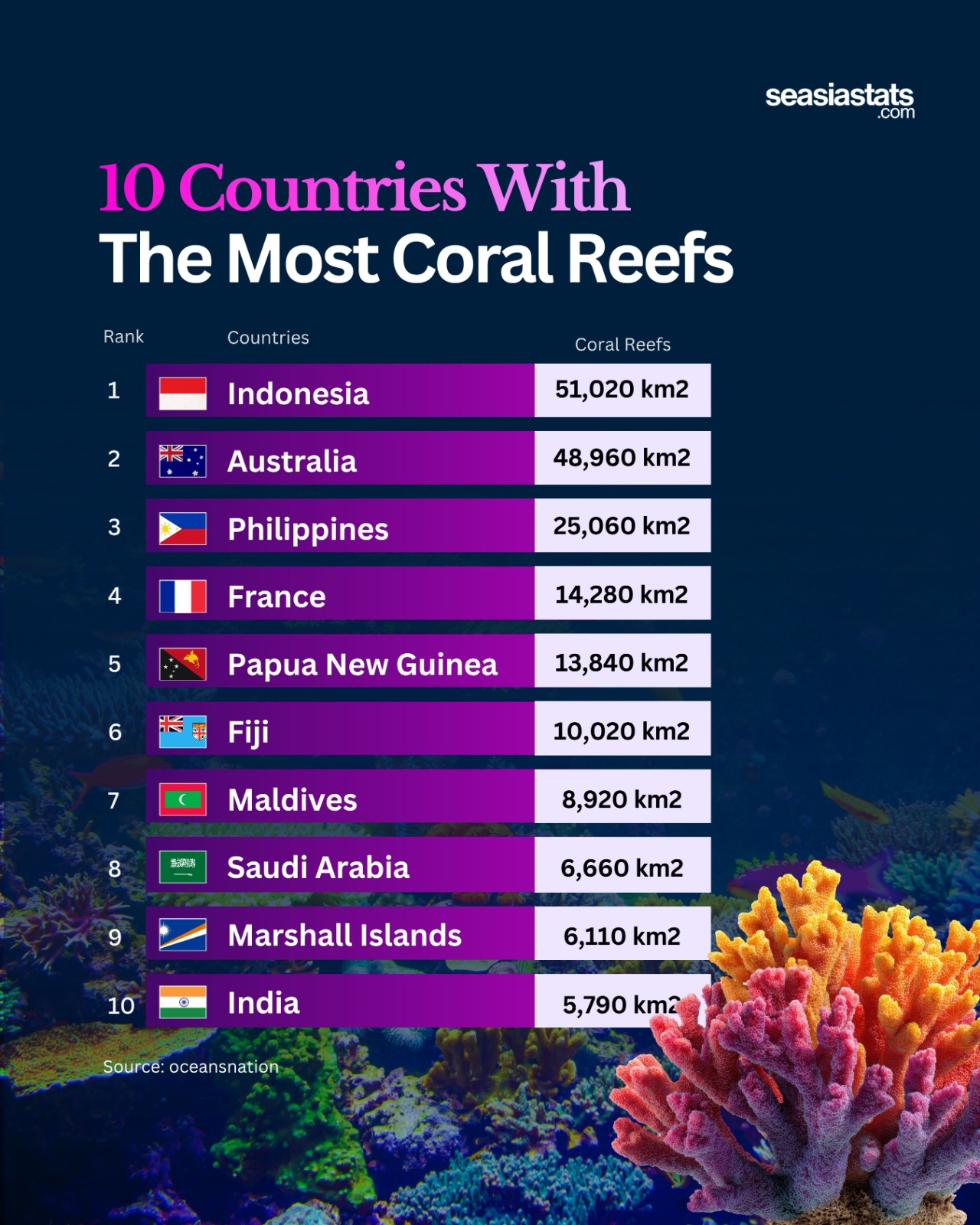
Indonesia has the most coral reefs in the world, followed by Australia.

Coral reefs are among the most valuable marine ecosystems on Earth, providing habitats for thousands of marine species while supporting fisheries, tourism, and coastal communities.
According to data from OceansNation, several countries stand out for having the largest coral reef areas in the world. They are home to extensive underwater ecosystems that play an essential role in maintaining marine biodiversity.
Indonesia ranks first globally, with an estimated coral reef area of 51,020 square kilometers. Located at the heart of the Coral Triangle, Indonesia possesses extraordinary marine biodiversity and thousands of islands surrounded by tropical waters.
Its coral reefs provide habitats for countless fish, turtles, and other marine organisms, making the country one of the most important centers of marine life in the world.
Australia follows in second place, with approximately 48,960 square kilometers of coral reefs. Much of its remarkable reef coverage is associated with the Great Barrier Reef, the world's largest coral reef system. This natural wonder is internationally recognized for its ecological importance and attracts millions of visitors interested in marine tourism.
The Philippines ranks third, with 25,060 square kilometers of coral reefs. Like Indonesia, the country is part of the Coral Triangle, making its surrounding waters exceptionally rich in marine biodiversity. Its reefs support fishing communities and contribute significantly to the country's coastal economy.
France occupies fourth place, with an estimated 14,280 square kilometers of coral reefs, largely distributed across its overseas territories in the Caribbean, Indian Ocean, and Pacific. Papua New Guinea follows in fifth place, with 13,840 square kilometers, reflecting its important position within the Coral Triangle.
Fiji ranks sixth, with approximately 10,020 square kilometers of coral reefs. Its tropical marine environment supports diverse coral formations and vibrant underwater habitats. The Maldives comes seventh, with 8,920 square kilometers, making coral reefs essential to its tourism industry, fisheries, and coastal protection.
Saudi Arabia ranks eighth, with 6,660 square kilometers of coral reefs, particularly along its Red Sea coastline. The Marshall Islands follows in ninth place, with 6,110 square kilometers, highlighting the importance of coral ecosystems across the Pacific islands.
Finally, India completes the top ten, with approximately 5,790 square kilometers of coral reefs, distributed across areas such as the Andaman and Nicobar Islands, Lakshadweep, and the Gulf of Mannar.
Overall, these ten countries demonstrate the global importance of coral reef ecosystems. From Southeast Asia to the Pacific, the Indian Ocean, and the Red Sea, their reefs provide essential environmental and economic benefits.
Protecting these underwater treasures from climate change, ocean warming, pollution, and destructive fishing practices is crucial for preserving marine biodiversity for future generations.