

Countries with the Most Data Centers
More AI means more data centers, and these countries seem to be ready for AI era.

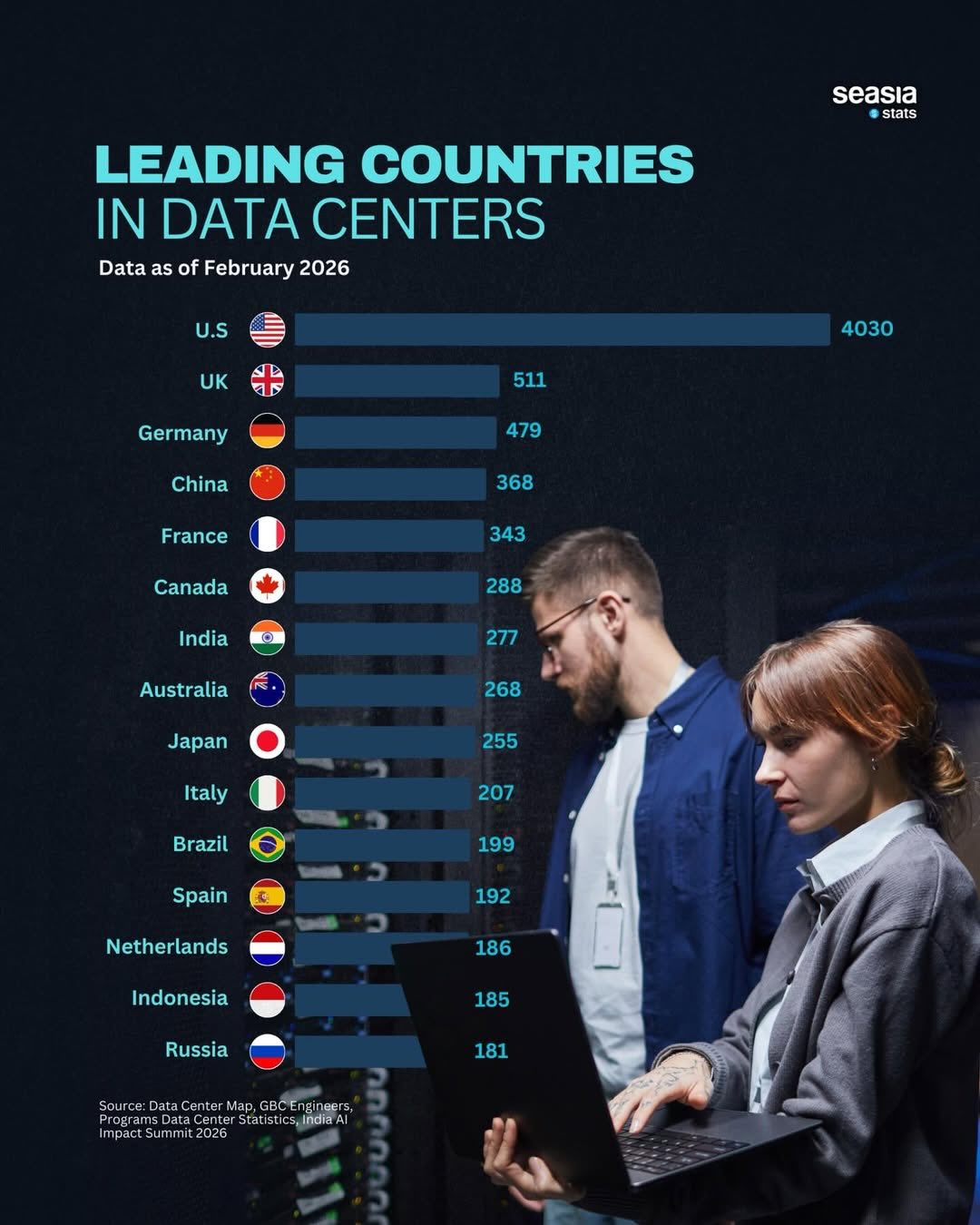
The rapid expansion of artificial intelligence, cloud computing, and digital services has intensified global demand for data centers, making them critical infrastructure in the modern economy. As of February 2026, the United States remains by far the world leader in data center capacity, hosting approximately 4,030 facilities.
The scale of America’s dominance reflects the country’s strong technology ecosystem, massive cloud computing industry, and the presence of hyperscale operators such as Amazon Web Services, Microsoft Azure, and Google Cloud. Industry reports note that the U.S. alone accounts for more data centers than the next several countries combined.
The United Kingdom ranks second globally with 511 data centers, narrowly ahead of Germany with 479. Both countries have become major digital infrastructure hubs in Europe due to strong connectivity, advanced economies, and increasing enterprise demand for cloud services.
France follows with 343 facilities, reinforcing Europe’s role as one of the world’s most concentrated data center regions. Analysts frequently describe the European “FLAP-D” markets—Frankfurt, London, Amsterdam, Paris, and Dublin—as the backbone of the continent’s digital economy.
China, despite its massive population and rapidly growing technology sector, ranks fourth globally with 368 data centers. The country’s infrastructure growth has accelerated due to rising AI adoption, e-commerce expansion, and government-backed digital transformation initiatives.
Meanwhile, Canada holds 288 facilities, benefiting from cooler climates and reliable energy supplies that help reduce cooling costs for large-scale server operations. India, with 277 data centers, has emerged as one of the fastest-growing digital markets in the world as internet penetration and cloud adoption continue to rise.
In the Asia-Pacific region, Australia hosts 268 data centers while Japan operates 255. Both countries are major regional hubs for enterprise cloud infrastructure and international connectivity. Italy, with 207 facilities, and Brazil, with 199, demonstrate growing demand for localized digital infrastructure in Southern Europe and Latin America.
Spain follows closely with 192 data centers, ahead of the Netherlands at 186 and Indonesia at 185. Indonesia’s inclusion among the global leaders highlights Southeast Asia’s increasing importance in the digital economy. Russia rounds out the ranking with 181 facilities.
As AI applications, streaming services, and cloud platforms continue expanding worldwide, countries are investing heavily in digital infrastructure. The global race to build more data centers is expected to intensify further throughout the decade, shaping the future of technology, energy consumption, and economic competitiveness.