

Countries with the Most Islands in the World
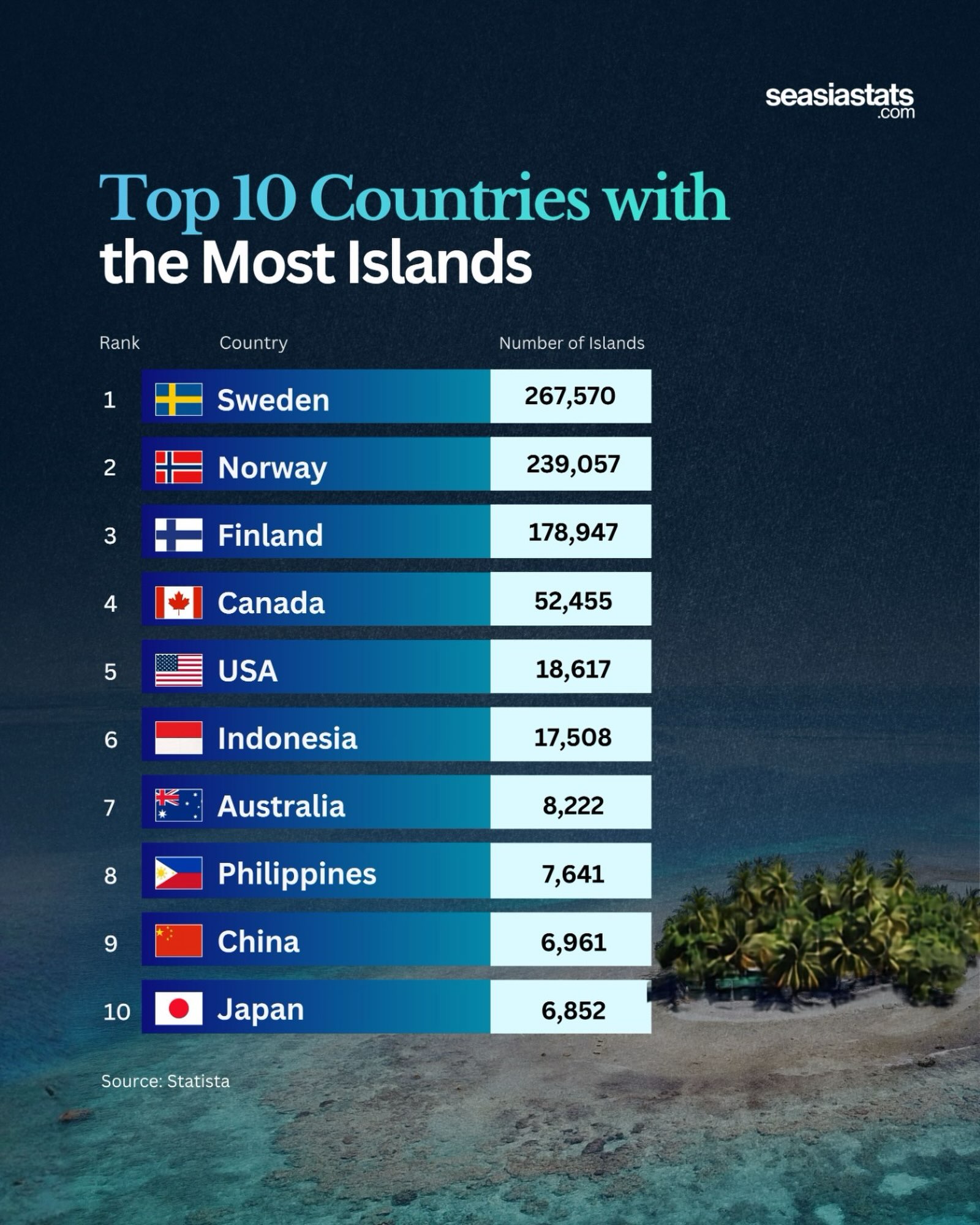
Three Nordic countries have the most islands in the world.

Islands are among the world's most diverse and fascinating geographical features, supporting unique ecosystems, rich cultural traditions, and thriving tourism industries.
While many people associate island nations with having the greatest number of islands, several continental countries also possess vast archipelagos and island chains. The following ten countries have the highest number of islands, showcasing remarkable geographic diversity and extensive coastlines.
Sweden ranks first in the world with an astonishing 267,570 islands. Most of these islands are uninhabited and are scattered across the Baltic Sea, the Gulf of Bothnia, and numerous inland lakes. Sweden's extensive archipelagos, particularly around Stockholm, are renowned for their natural beauty and recreational opportunities.
Norway follows with 239,057 islands. Its rugged coastline, shaped by glaciers over thousands of years, is home to countless islands, skerries, and fjords. These islands contribute to Norway's rich maritime heritage and support fishing, tourism, and coastal communities.
Finland occupies third place with 178,947 islands. Known as the "Land of a Thousand Lakes," Finland actually has far more islands than many people realize. The country's lakes and Baltic coastline create a landscape dotted with islands that are important for recreation and biodiversity.
Canada ranks fourth with 52,455 islands, spread across the Arctic, Atlantic, and Pacific Oceans, as well as numerous inland lakes. Many of these islands are remote and provide critical habitats for wildlife while supporting Indigenous communities and scientific research.
The United States has 18,617 islands, including well-known island groups in Alaska, Hawaii, Florida, and New England. Indonesia follows closely with 17,508 islands, making it the world's largest archipelagic nation by territory.
Stretching across the equator, Indonesia's islands are home to extraordinary biodiversity, hundreds of ethnic groups, and some of the planet's richest marine ecosystems.
Australia has 8,222 islands, many located off its extensive coastline and surrounding coral reefs. The Philippines ranks eighth with 7,641 islands, forming one of the largest archipelagos in Southeast Asia. These islands feature diverse landscapes, vibrant cultures, and globally recognized beaches.
China has 6,961 islands, most of them situated along its eastern coastline. These islands support economic development, fisheries, and tourism. Japan rounds out the top ten with 6,852 islands, extending from the northern island of Hokkaido to the subtropical islands of Okinawa. Japan's island geography has profoundly influenced its culture, economy, and history.
Together, these ten countries illustrate the remarkable diversity of the world's islands. Whether they are remote Arctic outposts, tropical paradises, or forested Baltic isles, these islands contribute significantly to biodiversity, economic activity, scientific research, and cultural heritage.