

Countries with the Most National Parks in the World
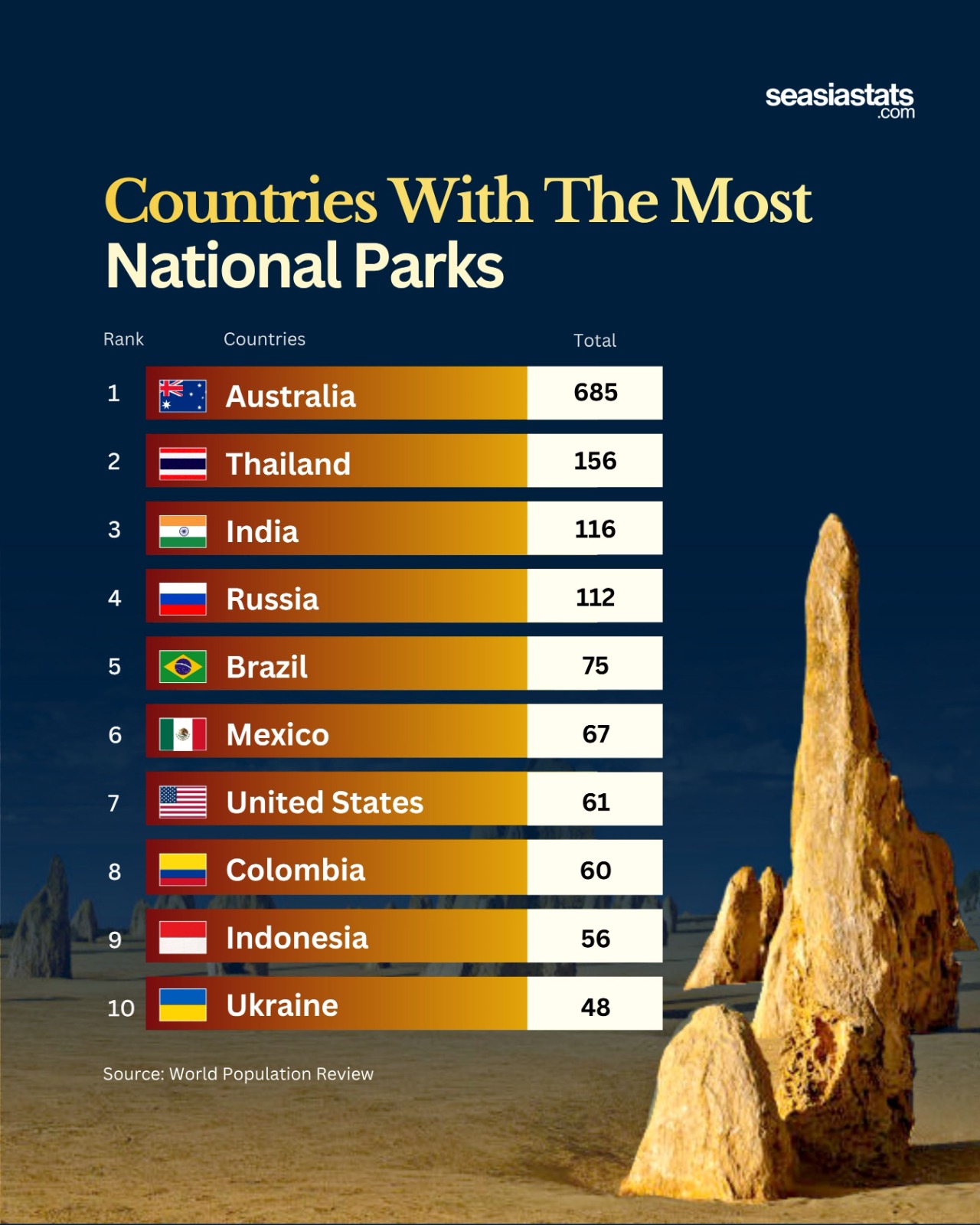
Australia has 685 national parks, the most in the world by a landslide.

National parks play an essential role in conserving biodiversity, protecting natural environments, and encouraging sustainable tourism. Across the globe, countries establish these protected areas to preserve valuable ecosystems, protect threatened wildlife, and create spaces for outdoor recreation, environmental awareness, and scientific research.
Among the nations with the largest number of national parks, Australia takes the leading position by a significant margin, highlighting its strong commitment to preserving its rich and diverse natural heritage.
Australia ranks first worldwide with an impressive total of 685 national parks. Its diverse geography includes tropical rainforests, vast deserts, coastal environments, and impressive mountain ranges. These protected landscapes provide shelter for numerous unique and endemic species while attracting millions of local and international tourists each year.
Thailand ranks second with 156 national parks, reflecting the country's ongoing efforts to protect its natural resources. Its national parks encompass dense tropical forests, spectacular waterfalls, limestone formations, and marine environments that support an extraordinary variety of plant and animal life.
In third place is India, with 116 national parks that provide essential habitats for some of the world's most recognizable wildlife species, including Bengal tigers, Asian elephants, rhinoceroses, and Asiatic lions. These protected areas play an important role in the country's wildlife conservation programs while also supporting its growing ecotourism sector.
Russia takes fourth place with 112 national parks. Given its enormous geographical size, the country contains extensive protected landscapes featuring dense forests, Arctic tundra, mountain ranges, and freshwater lakes. These natural areas contribute significantly to preserving Russia's diverse ecosystems.
Brazil ranks fifth with 75 national parks, many of which are situated in the Amazon rainforest and other ecologically significant regions. These protected territories are particularly important for conserving the country's exceptional biodiversity and safeguarding some of the world's most valuable natural habitats.
Mexico occupies sixth position with 67 national parks, protecting a wide variety of environments, including volcanic regions, arid deserts, forests, and coastal landscapes.
The United States follows in seventh place with 61 national parks, several of which are internationally recognized for their extraordinary natural beauty. Their landscapes include dramatic canyons, towering mountains, extensive forests, and remarkable geothermal features.
Colombia ranks eighth, with 60 national parks established throughout its diverse territory. These protected areas encompass tropical rainforests, coral reefs, wetlands, and high-altitude environments, providing habitats for an impressive range of wildlife and plant species.
Indonesia comes ninth with 56 national parks distributed across its thousands of islands. Its protected areas conserve tropical rainforests, mangrove forests, coral reefs, and important wildlife habitats. They are particularly valuable for protecting endangered animals such as orangutans, Komodo dragons, Sumatran tigers, and Javan rhinoceroses.
Completing the top ten is Ukraine, which has 48 national parks dedicated to preserving its natural landscapes. These protected areas include forests, wetlands, river systems, and mountainous environments that form an important part of the country's environmental and natural heritage.
The number of national parks established in each country provides an indication of its efforts to protect natural resources and maintain ecological stability.
Although these protected areas differ considerably in size, geography, and ecological characteristics, they share several important objectives: conserving biodiversity, providing opportunities for scientific study, protecting wildlife habitats, and promoting responsible tourism.
As environmental pressures continue to intensify, particularly through climate change, habitat destruction, and the ongoing decline of biodiversity, national parks are becoming increasingly important.
Their protection and sustainable management will remain essential to preserving the planet's natural wealth and ensuring that future generations can continue to benefit from these irreplaceable environments.