

Debt-to-GDP Ratio in Southeast Asia
Singapore has the biggest debt-to-GDP ratio in the entire Southeast Asia.

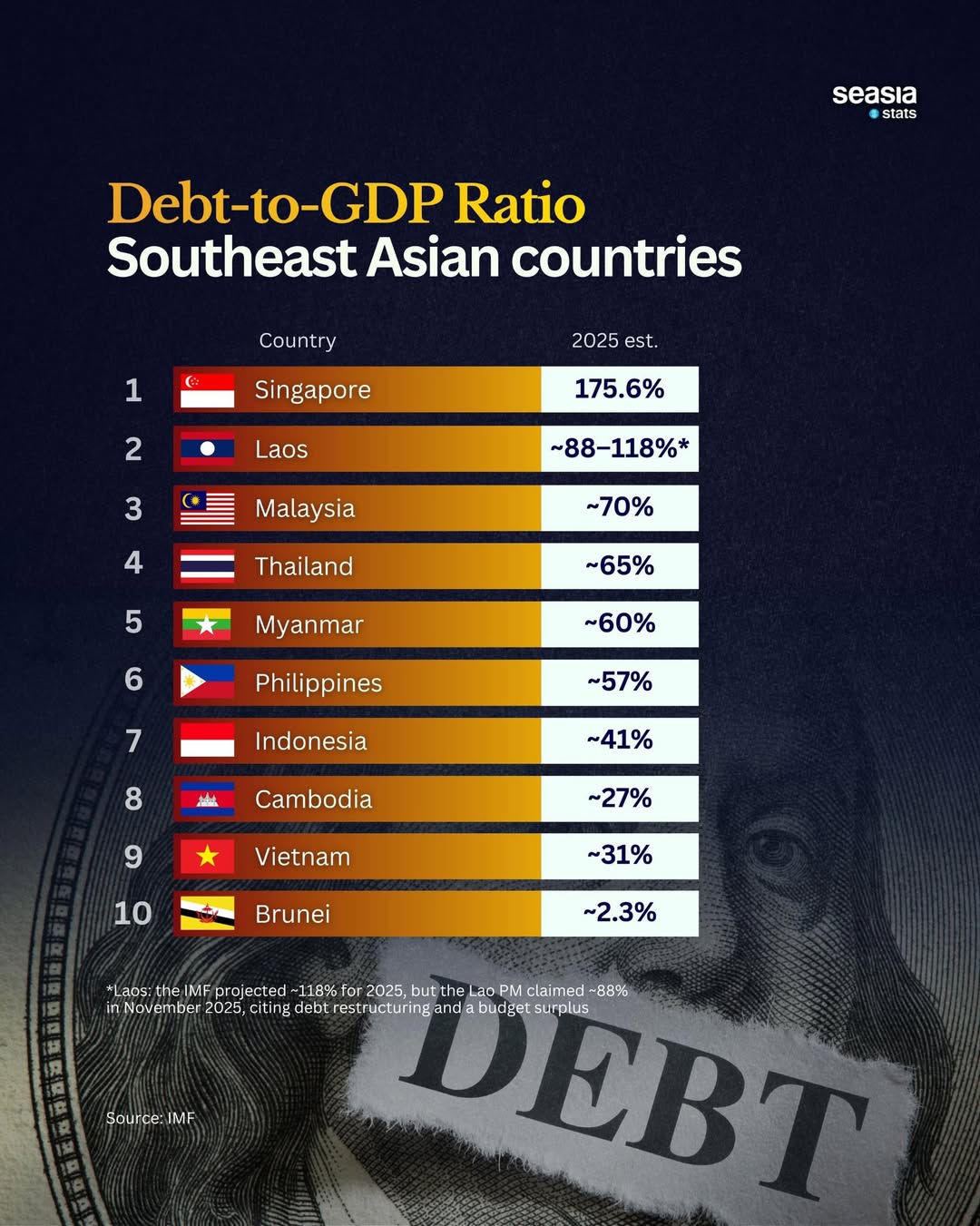
Debt-to-GDP ratio is one of the most important indicators used to measure a country’s financial health. It compares a nation’s total public debt with the size of its economy. A higher ratio generally means a government owes more relative to its economic output, while a lower ratio suggests stronger fiscal stability and greater room for future borrowing.
Among Southeast Asian countries, Singapore has the region’s highest debt-to-GDP ratio at 175.6%. However, Singapore’s case is unique because much of its debt is internally managed and backed by strong sovereign assets and reserves. The country issues debt mainly to support its financial markets and pension system rather than to finance large fiscal deficits.
Laos faces one of the most challenging debt situations in the region. The Lao government has stated that debt stands at around 88% of GDP, while the International Monetary Fund estimated it at approximately 118% in recent assessments.
The difference reflects varying accounting methods and concerns over external obligations and state-backed liabilities. High debt levels have increased concerns about inflation, currency depreciation, and debt sustainability in Laos.
Malaysia and Thailand also carry relatively high debt burdens, with debt-to-GDP ratios of 70% and 65% respectively. Both countries increased public spending during and after the COVID-19 pandemic to support economic recovery, healthcare systems, and businesses.
Myanmar stands at 60%, while Philippines records 57%. The Philippines experienced a sharp rise in borrowing during the pandemic, although strong economic growth has helped stabilize its fiscal position in recent years.
Meanwhile, Indonesia maintains a relatively moderate debt level of 41%, which is considered manageable compared with many global economies. Indonesia’s fiscal rules and large domestic market have helped preserve investor confidence.
Lower debt ratios can be seen in Viet Nam at 31%, Cambodia at 27%, and Brunei at only 2.3%. Brunei’s extremely low debt reflects its substantial oil and gas wealth, which provides strong government revenues.
Overall, Southeast Asia displays wide variation in debt levels. While high debt does not automatically signal economic weakness, sustainable borrowing and strong economic growth remain essential for maintaining long-term financial stability across the region.