

Distribution of Foreign Residents in Taiwan as of June 2026
Indonesians are the largest foreign residents in Taiwan per June 2026.

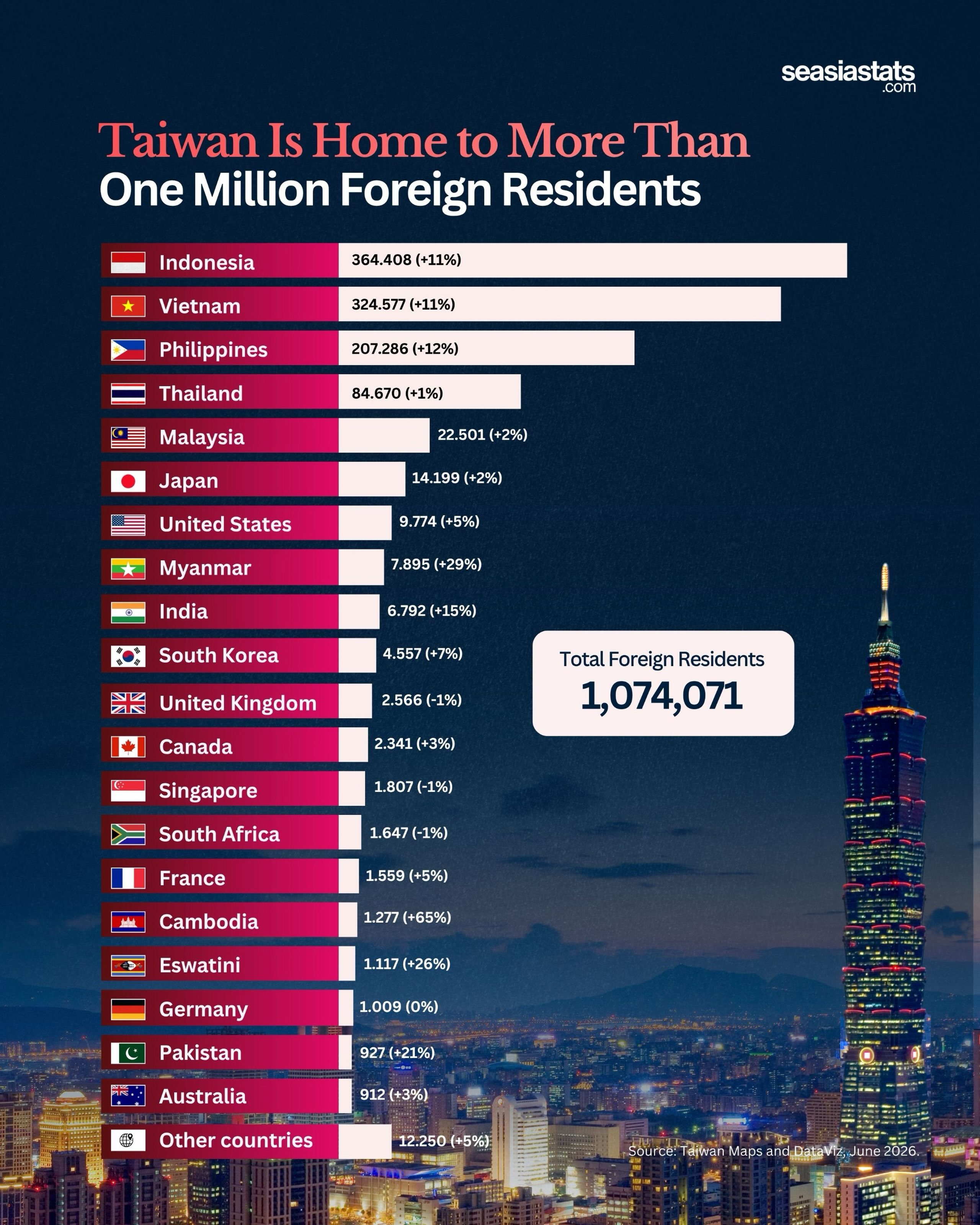
As of June 2026, Taiwan was home to more than one million foreign residents from a wide range of countries and regions. Their distribution highlights Taiwan’s strong connections with Southeast Asia, East Asia, and other parts of the world.
The figures also show how the foreign-resident population has changed compared with the previous year, with most nationalities recording increases.
Indonesia had the largest foreign-resident population in Taiwan, with 364,408 residents, an increase of 11% from the previous year. Vietnam followed closely with 324,577 residents, also rising by 11%.
Together, Indonesia and Vietnam accounted for a substantial share of Taiwan’s foreign population. The Philippines ranked third, with 207,286 residents, representing a significant 12% increase.
Other major Southeast Asian communities included Thailand, with 84,670 residents, up 1%, and Malaysia, with 22,501 residents, up 2%.
Myanmar recorded one of the fastest increases among the larger groups, reaching 7,895 residents, or 29% more than the previous year. Cambodia experienced an even larger percentage increase of 65%, although its population was smaller at 1,277 residents.
East Asian residents also formed an important part of Taiwan’s foreign population. There were 14,199 Japanese residents, an increase of 2%, while 4,557 South Korean residents represented a 7% increase.
The United States had 9,774 residents, up 5%, while the United Kingdom had 2,566 residents, a slight 1% decrease. Canada had 2,341 residents, increasing by 3%, and Australia had 912 residents, up 3%.
Residents from South Asia and Europe also contributed to Taiwan’s diverse population. India had 6,792 residents, an increase of 15%, while Pakistan had 927, rising by 21%.
Among European countries, France had 1,559 residents, up 5%, and Germany had 1,009, showing no change from the previous year. Singapore recorded 1,807 residents, down 1%, while South Africa had 1,647, also down 1%.
The data demonstrate that Taiwan’s foreign-resident population is highly diverse. Indonesia, Vietnam, and the Philippines were by far the largest communities, while several smaller groups experienced particularly rapid growth.
Notably, Cambodia, Eswatini, Myanmar, and Pakistan recorded some of the highest percentage increases. Meanwhile, residents from other countries totaled 12,250, an increase of 5%.
Overall, the June 2026 figures show Taiwan as an increasingly international society, with foreign communities contributing to its workforce, culture, economy, and social diversity.