

Divorce Rates Across Asian Countries 2025
Marriage statistics rarely tell the full story of love, family, or modern life—but they do reveal how societies are changing.

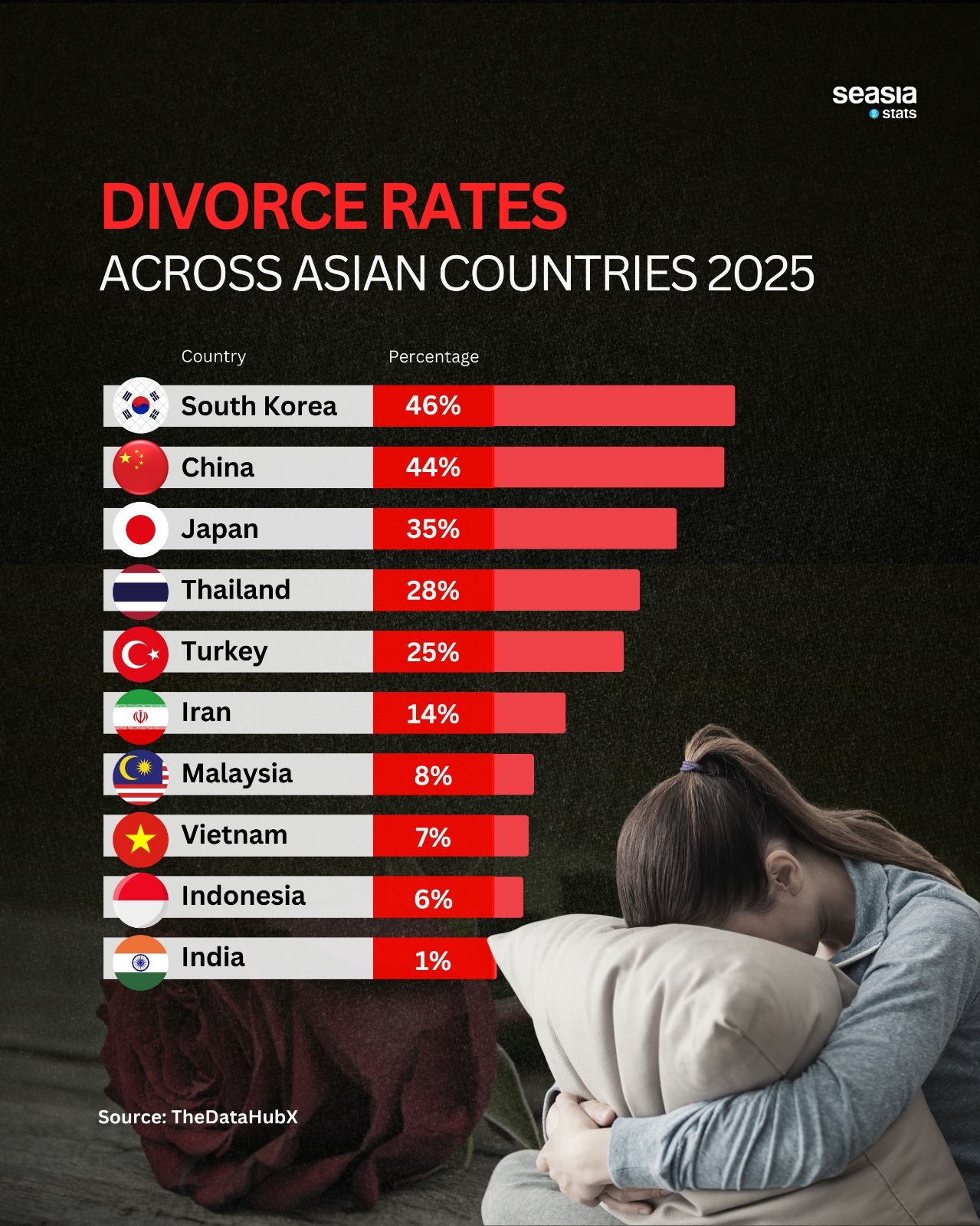
Marriage statistics rarely tell the full story of love, family, or modern life—but they do reveal how societies are changing. Across Asia, divorce rates are increasingly becoming a lens through which we can observe shifting expectations around gender roles, financial independence, urban stress, and what people now want from long-term relationships.
East Asia’s Changing Family Model
According to the data highlighted by Seasia Stats and TheDataHubX, South Korea records the highest divorce rate among the listed Asian countries in 2025 at 46%, followed closely by China at 44% and Japan at 35%. These are striking numbers, and they reflect more than just marital breakdown—they point to profound social transformation.
In much of East Asia, marriage is no longer seen as a lifelong obligation at all costs. Younger generations are increasingly prioritizing emotional compatibility, mental well-being, and personal freedom over the older ideal of endurance and sacrifice. In cities like Seoul, Shanghai, and Tokyo, where work pressure is intense and living costs are high, marriage itself has become more difficult to sustain.
As many social commentators have observed in recent years, modern relationships are being tested not only by romance, but by exhaustion, economic pressure, and changing gender expectations.
Why Urban Societies Tend to Divorce More
There is a clear pattern in many countries with higher divorce rates: they are also highly urbanized, fast-paced, and economically competitive. That matters. In urban societies, women tend to have greater financial independence, couples often delay marriage, and the stigma around divorce is lower than it was a generation ago.
In South Korea, for example, changing attitudes toward marriage have been widely discussed in local and international media. More women are choosing not to stay in unhappy marriages, while younger Koreans are also questioning traditional family structures altogether. China has seen similar shifts, particularly in large cities, where rapid modernization has altered expectations around romance, parenting, and domestic life.
The result is not necessarily that people value marriage less—but that they are less willing to remain in marriages that no longer work.
Southeast Asia: Between Tradition and Transition
Southeast Asia presents a more mixed and fascinating picture. Thailand posts the highest divorce rate in the region on this list at 28%, significantly above Malaysia (8%), Vietnam (7%), and Indonesia (6%).
Thailand’s relatively higher figure may reflect its more urbanized and tourism-driven economy, along with broader social openness compared to some of its neighbors. Meanwhile, countries like Indonesia and Malaysia still maintain strong family-centered norms, often reinforced by religion, community expectations, and the continued importance of extended family structures.
But low divorce rates do not automatically mean stronger marriages. In many Southeast Asian societies, legal, financial, and social barriers still make separation difficult—especially for women. In rural areas, marriage is often embedded in family networks and economic arrangements, making divorce not just a personal decision, but a communal one.
That is why these numbers should be read carefully: they measure formal divorce, not necessarily marital satisfaction.
India and the Power of Social Structure
At the bottom of the list is India, with a divorce rate of just 1%. On paper, it appears to be an extraordinary outlier. But India’s low rate is deeply tied to cultural and structural realities.
Marriage in India remains strongly influenced by family, religion, caste, and social expectation. Divorce, while growing in major cities, still carries a much heavier stigma than in many other Asian societies. In many communities, especially outside metropolitan areas, marriage is seen as a family institution rather than purely an individual one.
This helps explain why formal divorce remains rare, even as conversations around women’s rights, compatibility, and modern relationships continue to evolve.
More Than a Statistic
Ultimately, divorce rates are not simply a scoreboard of successful or failed marriages. They are indicators of how societies define commitment, autonomy, and dignity.
Across Asia, from Seoul to Jakarta, from Bangkok to Mumbai, marriage is being renegotiated in real time. And perhaps that is the deeper story behind the numbers: not that love is disappearing, but that people are redefining what a life partnership should look like in the 21st century.