

Does Driving an EV Appeal to You?
Electric vehicles are no longer a niche aspiration confined to wealthy, climate-conscious consumers in Northern Europe or California. According to the Ipsos Mob

Electric vehicles are no longer a niche aspiration confined to wealthy, climate-conscious consumers in Northern Europe or California. According to the Ipsos Mobility Report 2026, it is the emerging markets — particularly in Southeast Asia and Latin America — where enthusiasm for EVs runs hottest.
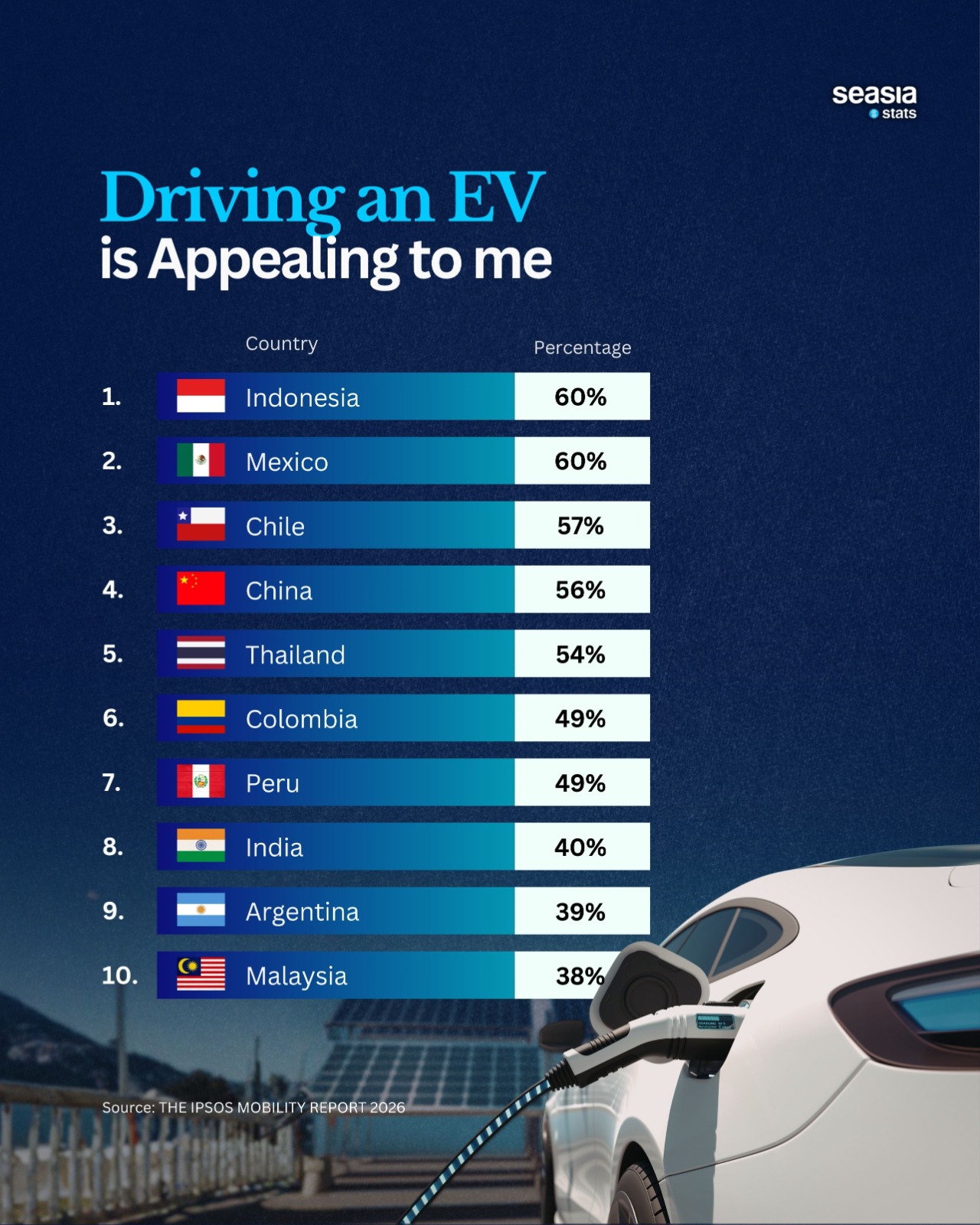
Indonesia leads the world, tied with Mexico at 60% of respondents agreeing that driving an electric vehicle is personally appealing. For Southeast Asia's largest economy — a nation still heavily reliant on coal power and dominated by Japanese automakers — the figure signals a dramatic shift in consumer sentiment that is already reshaping boardroom strategy across the region.
60% of Indonesians find EVs appealing — a figure that should alarm every legacy automaker still betting on combustion engines in Southeast Asia.
Countries where EVs are most appealing — % agreeing
- 1🇮🇩Indonesia60%
- 2🇲🇽Mexico60%
- 3🇨🇱Chile57%
- 4🇨🇳China56%
- 5🇹🇭Thailand54%
- 6🇨🇴Colombia49%
- 7🇵🇪Peru49%
- 8🇮🇳India40%
- 9🇦🇷Argentina39%
- 10🇲🇾Malaysia38%
Southeast Asia claims three spots in the top ten — Indonesia (1st), Thailand (5th), and Malaysia (10th). That breadth is striking for a region where EV penetration rates remain in the low single digits. High consumer desire is clearly running ahead of infrastructure and affordability, suggesting that the conversion from aspiration to purchase is the central challenge for both governments and manufacturers.
Thailand's position at 54% is particularly notable given Bangkok's aggressive push to become ASEAN's EV manufacturing hub, with Chinese brands like BYD, NETA, and MG making inroads against established Japanese players. Consumer appetite and industrial policy appear to be reinforcing each other.
The Latin America factor: Mexico, Chile, Colombia, and Peru all appear in the top ten, accounting for four of the ten most EV-enthusiastic nations. This pattern cuts against a narrative that decarbonisation enthusiasm is primarily a wealthy-country phenomenon — income levels alone do not predict EV appeal.
China's placement at fourth — despite being the world's largest EV market by volume — reflects that mass adoption has, to a degree, normalised the technology. The novelty factor that inflates enthusiasm in nascent markets may be less pronounced in a country where one in three new cars sold is already electric.
The data does not tell us why people find EVs appealing — whether it is fuel savings, environmental concern, the tech novelty, or government incentives. But the concentration of enthusiasm in markets where household incomes are rising rapidly suggests that EVs are increasingly perceived as aspirational goods, not just utilitarian or ideological ones. That is a powerful signal for where the next wave of global EV growth will come from.