

Driving Orientation in Southeast Asia
Which Southeast Asian countries drive on the left and right side of the road?

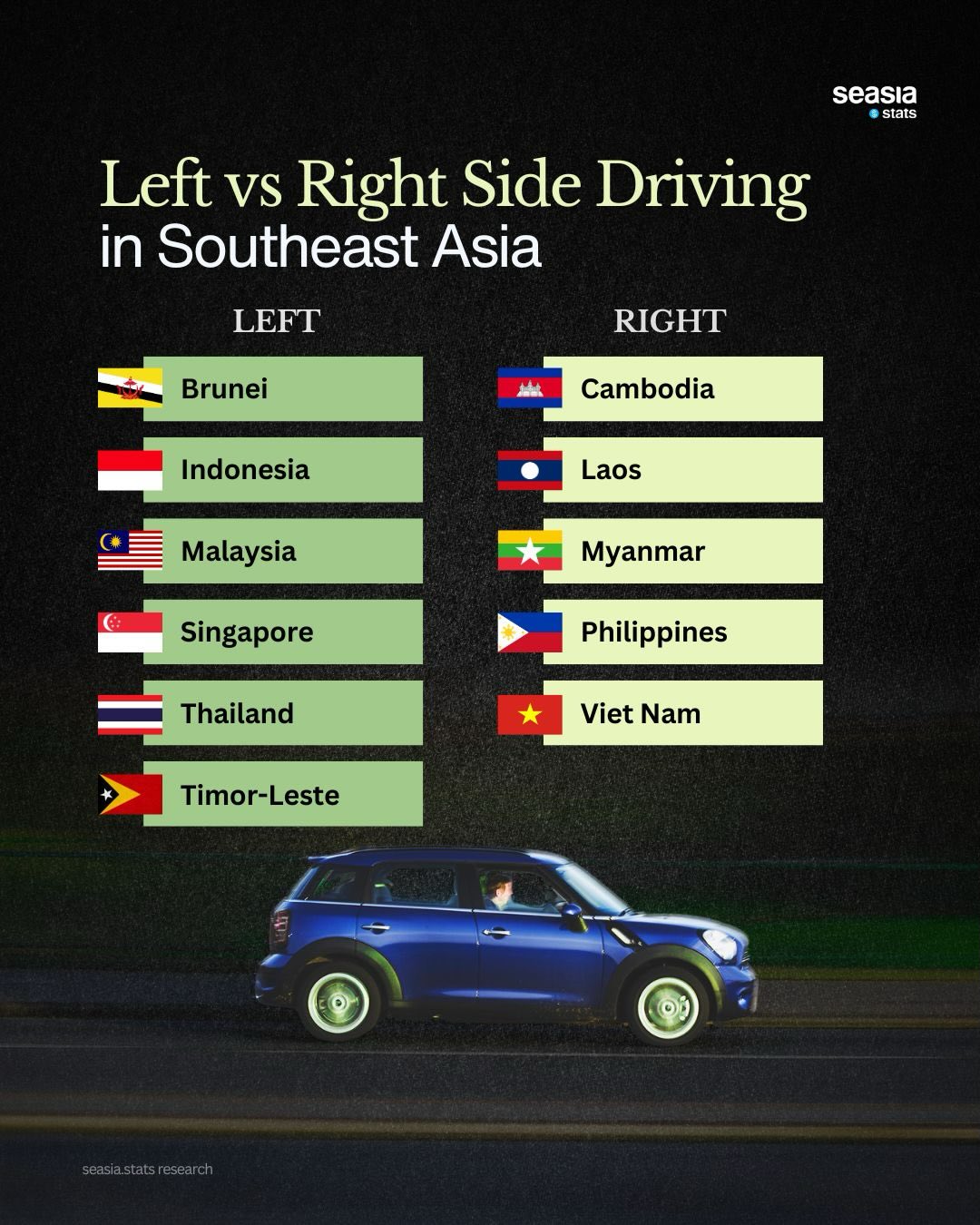
Driving orientation—whether a country uses the left or right side of the road—is an often-overlooked aspect of transportation systems, yet it reflects deep historical, political, and cultural influences.
In Southeast Asia, this divide is clearly visible. Countries such as Brunei, Indonesia, Malaysia, Singapore, Thailand, and Timor-Leste drive on the left, while Cambodia, Laos, Myanmar, the Philippines, and Viet Nam follow right-side driving.
The prevalence of left-side driving in Brunei, Malaysia, and Singapore can be traced back to British colonial rule. The British Empire standardized left-hand traffic across many of its territories, and this system remained even after independence due to the high cost and complexity of changing infrastructure, road design, and driver habits.
Thailand, although never colonized, adopted left-side driving partly due to early influence and alignment with neighboring British-influenced regions.
Indonesia’s case is slightly different. Although it was colonized by the Dutch—who drive on the right—the country retained left-side driving. This is believed to stem from earlier influences, including trade interactions and practical considerations during colonial transitions.
Similarly, Timor-Leste, a former Portuguese colony (Portugal drives on the right), uses left-side driving, largely because of its geographic and economic ties with Indonesia, which surrounds it.
On the other side, right-hand driving dominates in Cambodia, Laos, and Viet Nam, reflecting French colonial influence. France uses right-side driving, and its administrative systems extended this practice to its colonies in Indochina. After independence, these countries maintained the system for consistency and practicality.
Myanmar presents a unique case. Although it was a British colony and originally drove on the left, the country switched to right-side driving in 1970 under a government directive. Interestingly, many vehicles in Myanmar still have right-hand steering wheels, a legacy of imports from Japan and Thailand, which can make driving conditions more complex.
The Philippines also follows right-side driving, influenced by American colonial rule in the early 20th century. The United States standardized right-hand traffic, and this system remains in place today.
Overall, the division between left- and right-side driving in Southeast Asia highlights the region’s diverse colonial histories and regional influences. Despite the differences, each country has adapted its infrastructure and road culture to suit its system. For travelers and drivers, awareness of these variations is essential for safety and ease of navigation across borders.