

Eagle and Eagle-Like Birds on National Emblems of Asian Nations
Several Asian nations proudly show eagles or eagle-like birds on their national emblems.

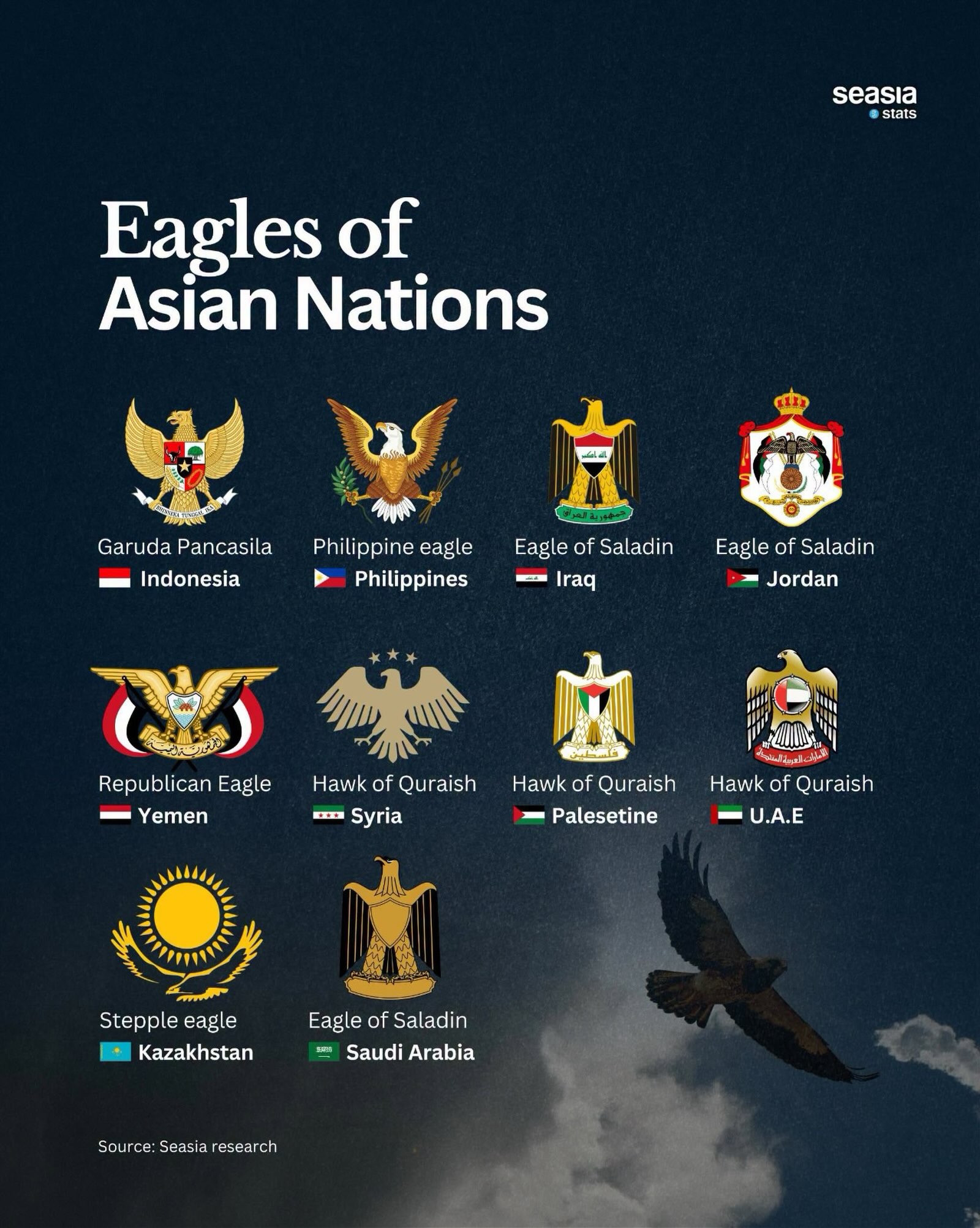
Throughout Asia, several nations feature eagles or eagle-like birds on their national emblems as powerful symbols of sovereignty, courage, and national identity. While these birds vary in species and historical origins, they all represent strength, independence, and the enduring spirit of their respective countries.
Indonesia's national emblem, Garuda Pancasila, is based on the mythical Garuda from Hindu and Buddhist traditions. Unlike a real eagle, Garuda is a legendary bird that symbolizes power, wisdom, and protection. The emblem holds a shield bearing the five principles of Pancasila, Indonesia's national philosophy, while a ribbon beneath displays the national motto, Bhinneka Tunggal Ika ("Unity in Diversity").
The Philippines features the Philippine Eagle, one of the world's largest and rarest eagles, on its coat of arms. Endemic to the country's forests, the Philippine Eagle represents bravery, resilience, and the nation's rich biodiversity. Its inclusion highlights both national pride and the importance of conserving this critically endangered species.
Several Arab nations employ heraldic eagles inspired by medieval Islamic history. Iraq, Jordan, and Saudi Arabia use the Eagle of Saladin, named after the renowned 12th-century Muslim leader Salah ad-Din (Saladin). This golden eagle symbolizes Arab unity, strength, and the historical legacy of Saladin's leadership.
Syria, Palestine, and the United Arab Emirates instead use the Hawk of Quraish, another historic Arab emblem associated with the Quraysh tribe of Mecca, to which the Prophet Muhammad belonged. Although technically a hawk rather than an eagle, it serves a similar heraldic role, representing honor, courage, and Arab heritage.
Yemen's national emblem features the Republican Eagle, a golden eagle derived from the same heraldic tradition as the Eagle of Saladin but adapted to reflect Yemen's republican identity following its political transformation. The eagle carries a scroll bearing the country's name and stands above symbols representing national unity and prosperity.
Kazakhstan's national emblem displays the Steppe Eagle, a majestic bird native to the vast Eurasian grasslands. Positioned beneath the central Shanyrak, the eagle signifies freedom, foresight, and the boundless horizons of the Kazakh steppe. It reflects the country's nomadic heritage and aspirations for progress.
Together, these magnificent birds—whether mythical, natural, or heraldic—serve as enduring national symbols. They embody the values, history, and cultural identity of their nations while reminding citizens of their shared heritage, resilience, and aspirations for a strong and prosperous future.