

Eagle National Emblems in Asia
These Asian nations proudly display an eagle on their national emblems.

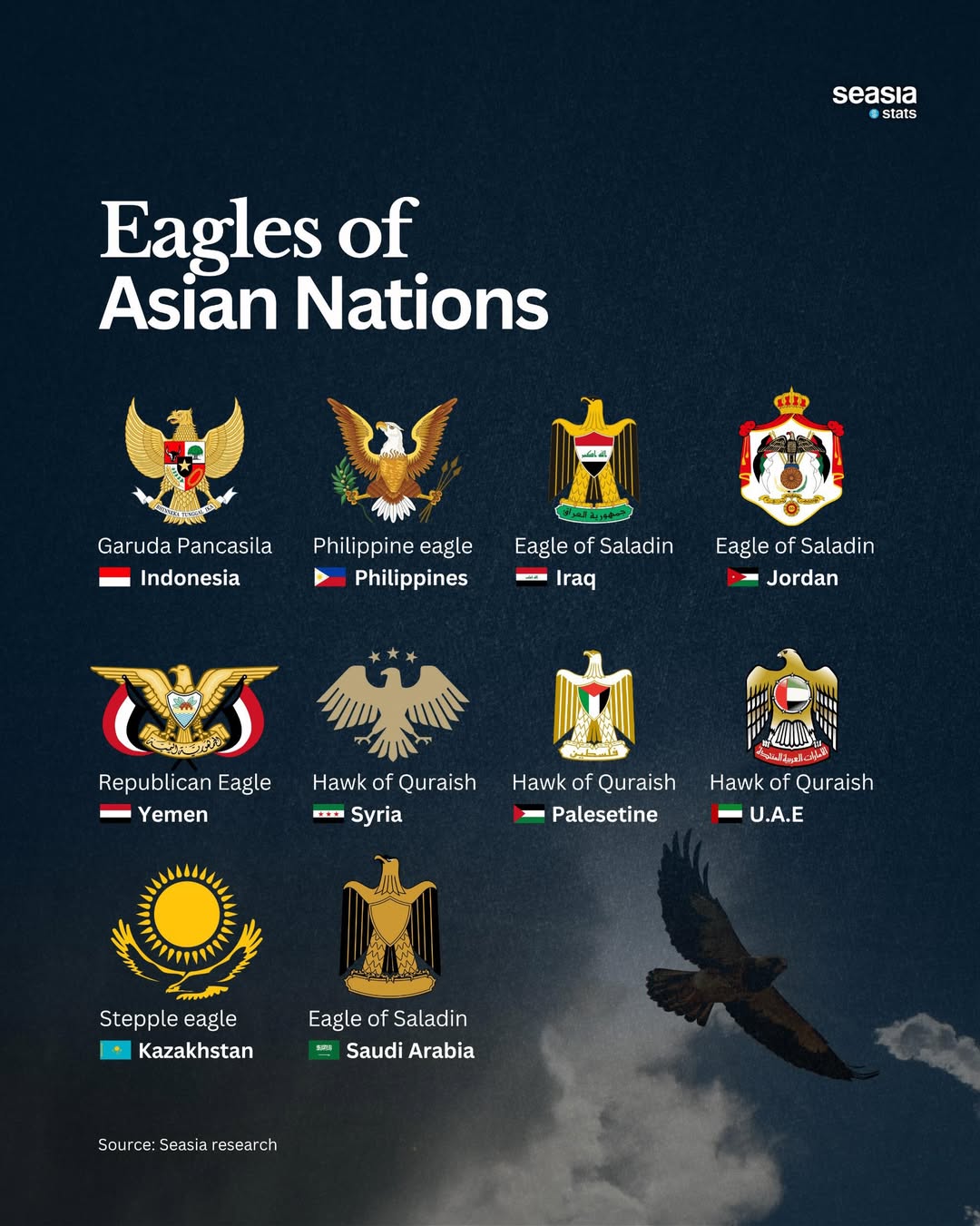
Throughout Asia, several nations have adopted eagles or eagle-like birds as national emblems, symbolizing strength, sovereignty, courage, and national identity. While these symbols differ in origin and artistic style, they share a common association with power and independence.
Indonesia's national emblem, the Garuda Pancasila, is based on Garuda, the legendary eagle-like creature from Hindu and Buddhist mythology. Adopted in 1950, the golden Garuda carries a shield displaying the five principles of Pancasila, Indonesia's state philosophy. The emblem represents national unity, wisdom, social justice, democracy, and belief in God.
The Philippines features the Philippine Eagle on its coat of arms. One of the world's largest and rarest eagles, the Philippine Eagle is endemic to the archipelago and serves as a symbol of the nation's natural heritage, strength, and resilience. It is also the country's national bird.
Several Middle Eastern nations use variations of the Eagle of Saladin, a symbol associated with the renowned 12th-century Muslim ruler Salah ad-Din (Saladin). Iraq, Jordan, and Saudi Arabia incorporate this emblem into their national insignia.
The Eagle of Saladin represents Arab unity, leadership, and historical pride. Although each country's version differs slightly in color and design, the symbol remains a powerful representation of Arab identity.
Yemen employs the Republican Eagle as its national emblem. Inspired by the Eagle of Saladin, it features a golden eagle carrying a scroll bearing the country's name. The emblem reflects Yemen's republican values, independence, and sovereignty.
Another important Arab symbol is the Hawk of Quraish, used by Syria, Palestine, and the United Arab Emirates. The hawk is linked to the Quraysh tribe of Mecca, from which the Prophet Muhammad descended.
The Hawk of Quraish symbolizes Arab heritage, dignity, and unity. Each nation adapts the emblem with unique national colors and shields while maintaining the distinctive hawk motif.
In Central Asia, Kazakhstan features the Steppe Eagle on its national emblem. The eagle appears beneath the shanyrak, the symbolic crown of a traditional yurt. The Steppe Eagle represents freedom, vigilance, and the vast open plains that characterize the Kazakh landscape. It also reflects the country's nomadic traditions and aspirations for progress.
Together, these eagle and eagle-like emblems demonstrate how nations across Asia use powerful avian symbols to express their history, culture, values, and aspirations. Despite their diverse origins, these majestic birds remain enduring icons of national pride and identity.