

East and Southeast Asian Countries in the 2026 Happy Planet Index
Filipinos are the happiest in East and Southeast Asia according to Happy Planet Index.

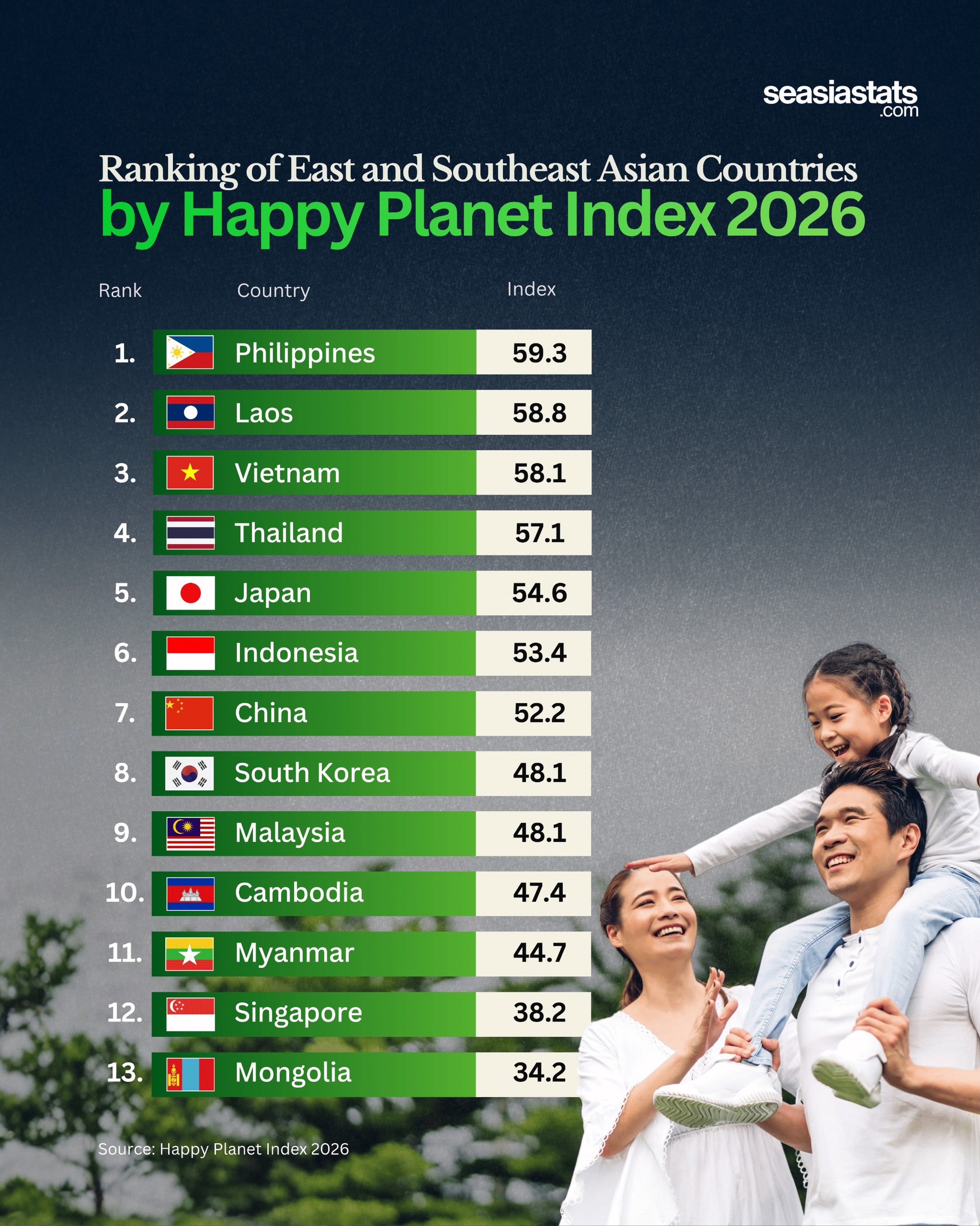
The 2026 Happy Planet Index (HPI) provides a different way of assessing national progress from conventional economic measures such as gross domestic product (GDP).
Rather than simply asking how wealthy or happy a country is, the HPI examines how efficiently countries provide their populations with long, happy lives while using the planet’s limited environmental resources. The 2026 index combines life expectancy, self-reported wellbeing, and ecological footprint.
Among the East and Southeast Asian countries listed, the Philippines ranks first regionally with a score of 59.3, followed closely by Laos at 58.8 and Vietnam at 58.1.
These results suggest that these countries perform relatively well at combining human wellbeing and longevity with comparatively moderate environmental impacts. Thailand, with 57.1, also records a strong result, placing it fourth among the countries considered.
The middle of the regional ranking includes Japan (54.6), Indonesia (53.4), China (52.2), South Korea (48.1), Malaysia (48.1), and Cambodia (47.4). Japan's position is notable because its high life expectancy contributes positively to its HPI performance, although the index also considers the environmental resources required to support consumption.
Indonesia's score of 53.4 is supported by a relatively low ecological footprint; the official 2026 data give Indonesia a life expectancy of 71.4 years, wellbeing of 5.6 out of 10, and an ecological footprint of 1.66 global hectares per person.
At the lower end are Myanmar (44.7), Singapore (38.2), and Mongolia (34.2). Singapore's relatively low position illustrates an important feature of the HPI: a country can have high levels of development and wellbeing while still receiving a lower score if achieving those outcomes requires a comparatively large environmental footprint.
The HPI explicitly states that it is not a ranking of happiness, quality of life, or economic development, but a measure of sustainable wellbeing.
Overall, the 2026 results reveal considerable differences across East and Southeast Asia. The rankings demonstrate that economic wealth alone does not determine sustainable wellbeing. Instead, countries can achieve stronger HPI outcomes by combining good health and life satisfaction with lower resource consumption.
The regional results therefore highlight an important policy challenge: how to improve people's lives while reducing pressure on the environment. As the HPI emphasizes, the ultimate goal is to create good lives that do not cost the Earth.