

Economic Performance from G20 Countries in Q1 2026
In the first quarter of 2026, Indonesia has the best economic performance among G20 countries.

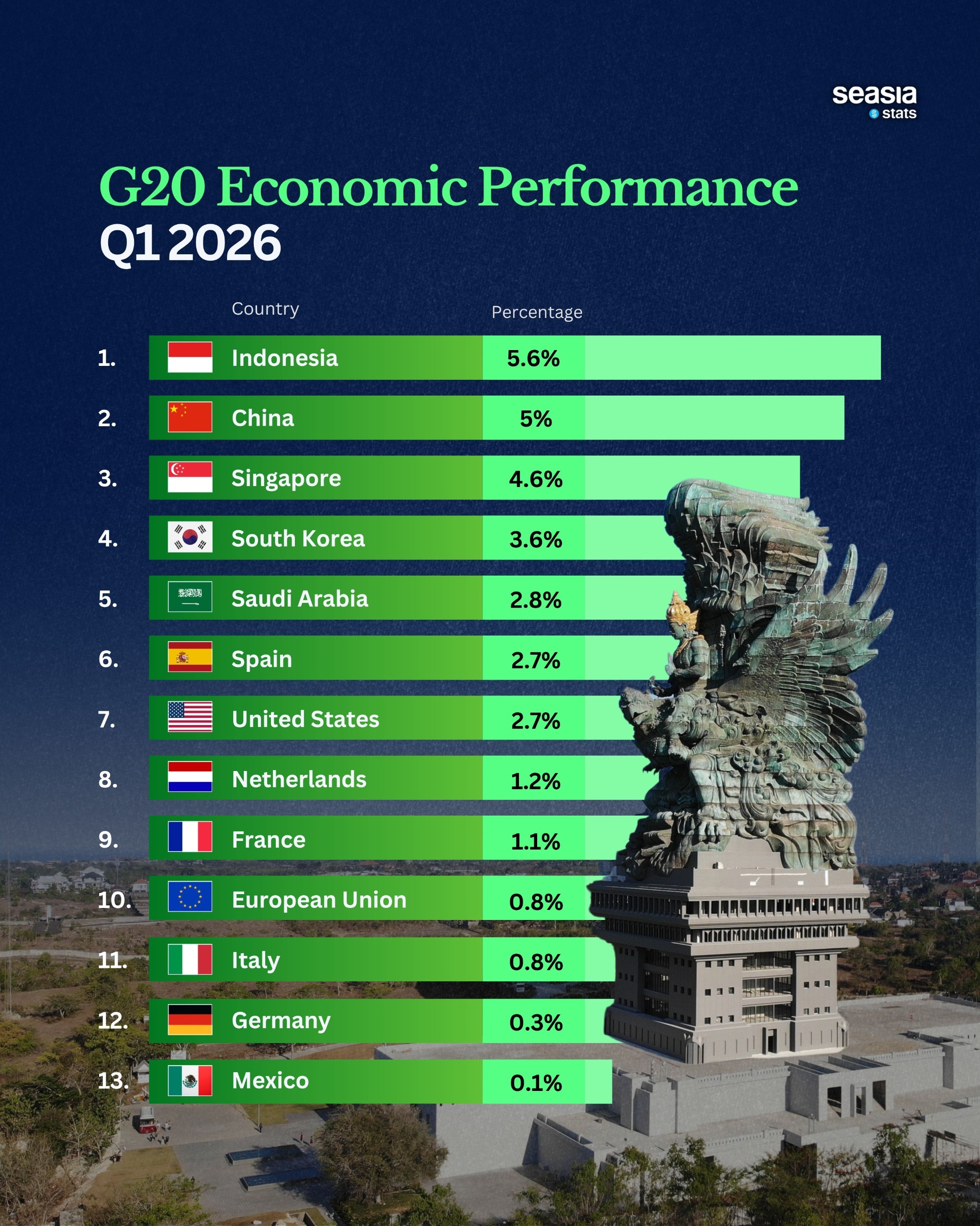
Economic performance across G20 economies in the first quarter of 2026 reveals a clear divergence between fast-growing emerging markets and slower-moving advanced economies.
While global uncertainty—particularly geopolitical tensions and energy price volatility—has influenced economic activity, several countries have demonstrated resilience through domestic demand, exports, and technological investment.
Among the strongest performers, Indonesia recorded growth of 5.6%, the highest among the listed G20 economies. This expansion was driven largely by household consumption, government spending, and investment, highlighting the strength of domestic demand.
Similarly, China posted a solid 5.0% growth rate, supported by strong industrial output and exports despite external pressures such as supply chain disruptions and rising energy costs. Singapore followed with 4.6%, reflecting its continued role as a trade and financial hub in Asia.
Mid-tier growth was observed in countries like South Korea (3.6%), Saudi Arabia (2.8%), Spain (2.7%), and the United States (2.7%). In the U.S., growth was fueled primarily by increased investment in artificial intelligence and a rebound in government spending, although consumer spending remained moderate.
Saudi Arabia and Spain benefited from energy and tourism sectors respectively, while South Korea’s recovery reflects improving trade conditions.
In contrast, several advanced European economies experienced modest growth. The Netherlands (1.2%) and France (1.1%) showed limited expansion, while the broader European Union and Italy both recorded 0.8% growth.
Germany, Europe’s largest economy, lagged significantly at 0.3%, reflecting ongoing industrial challenges and weak external demand. Mexico recorded the slowest growth among the group at 0.1%, indicating stagnation likely linked to weaker manufacturing output and external economic pressures.
Overall, the Q1 2026 data highlights a shifting global economic landscape within the G20. Emerging economies, particularly in Asia, are outperforming their developed counterparts due to stronger domestic consumption and more dynamic growth drivers.
Meanwhile, advanced economies are grappling with structural constraints, geopolitical risks, and slower productivity growth.
This divergence suggests that global economic momentum is increasingly being driven by emerging markets, while developed economies may require policy adjustments and innovation-led strategies to regain stronger growth trajectories.