

Emerging Markets Take the Lead in 2026’s Global Growth Race
As the global economy recalibrates after years of disruption, 2026 is shaping up to be a year led decisively by emerging markets.

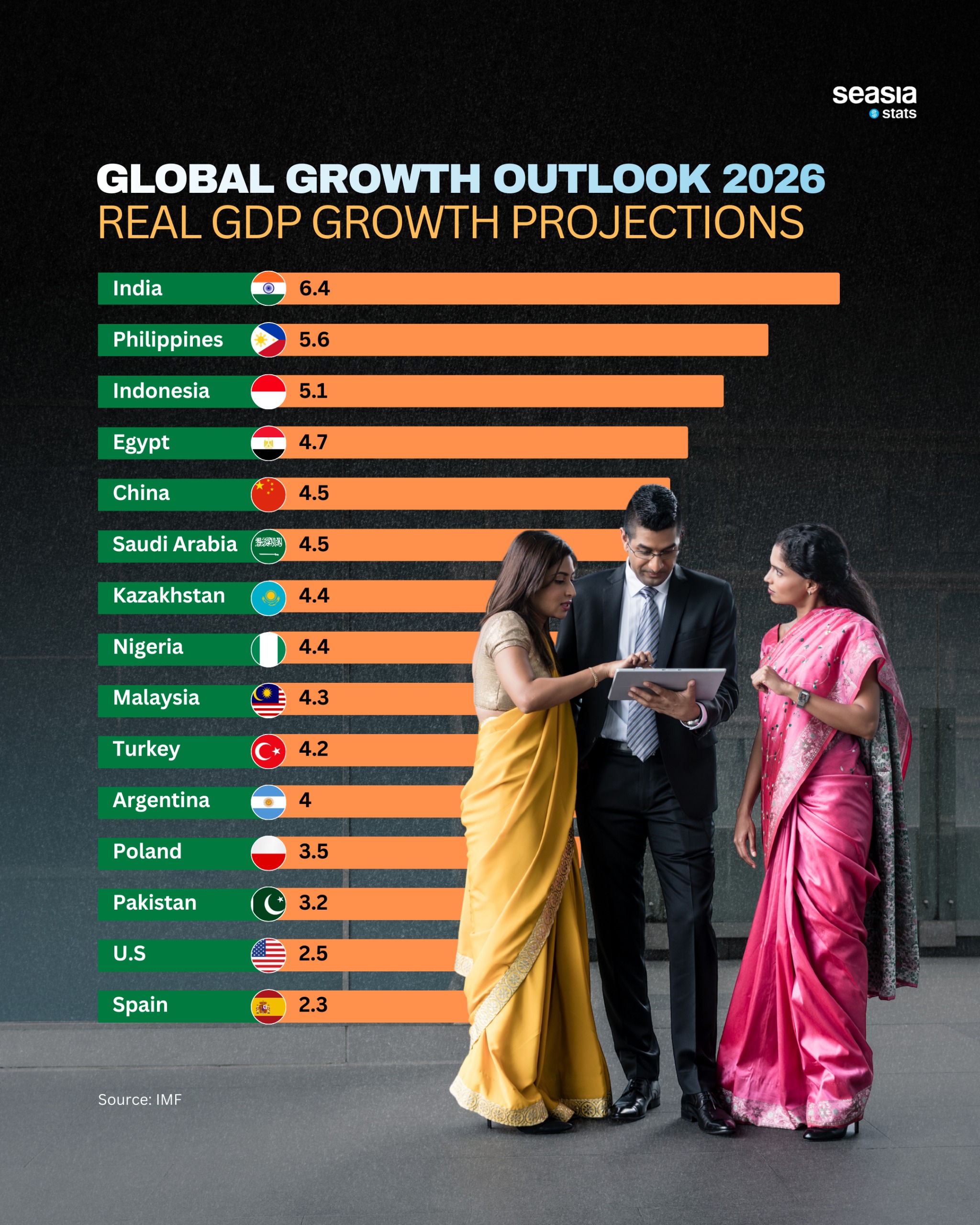
As the global economy recalibrates after years of disruption, 2026 is shaping up to be a year led decisively by emerging markets. According to IMF projections highlighted by Seasia Stats, faster-growing economies in Asia, the Middle East, and Africa are expected to significantly outperform many advanced nations. At the heart of this momentum lies Asia—particularly South and Southeast Asia—where demographic strength, domestic demand, and structural reforms continue to fuel expansion.
India at the Front of the Pack
Leading the global growth outlook is India, projected to grow by a robust 6.4% in real GDP terms in 2026. India’s performance reflects sustained investment in infrastructure, a rapidly expanding digital economy, and one of the world’s youngest labor forces. Manufacturing incentives, strong services exports, and resilient consumer spending continue to reinforce its position as the fastest-growing major economy.
Southeast Asia’s Growth Engines
Close behind India are two standout performers from Southeast Asia: the Philippines at 5.6% and Indonesia at 5.1%.
The Philippines’ growth is underpinned by domestic consumption, remittance inflows, and renewed public infrastructure spending. Its young population and expanding middle class remain key strengths. Indonesia, Southeast Asia’s largest economy, continues to benefit from strong commodity exports, electric vehicle supply-chain investments, and steady domestic demand, positioning it as a regional anchor.
The Strong Middle Tier
A cluster of economies is projected to grow between 4.0% and 4.7%, reflecting solid—but more moderate—momentum. This group includes Egypt (4.7%), China (4.5%), Saudi Arabia (4.5%), Kazakhstan (4.4%), and Nigeria (4.4%).
Within Southeast Asia, Malaysia stands out with projected growth of 4.3%. Malaysia’s outlook is supported by export recovery, electronics manufacturing, and regional trade integration, reinforcing its role as a stable mid-growth economy within ASEAN.
Slower Growth in Mature Economies
By contrast, several developed and reform-constrained economies are expected to post more modest growth. Poland is projected at 3.5%, while Pakistan comes in at 3.2%.
Advanced Western economies trail further behind. The United States is projected to grow by 2.5%, and Spain by 2.3%, reflecting tighter monetary conditions, aging populations, and slower productivity gains.
Asia’s Expanding Role in Global Growth
Taken together, the 2026 outlook highlights a clear shift in global economic gravity. Southeast Asian economies—alongside India—are no longer just “catch-up” markets but central drivers of global growth. As emerging Asia continues to combine scale, demographics, and reform momentum, its influence on global economic trajectories is set to deepen well beyond 2026.