

Emigrant Share of Population in Southeast Asia
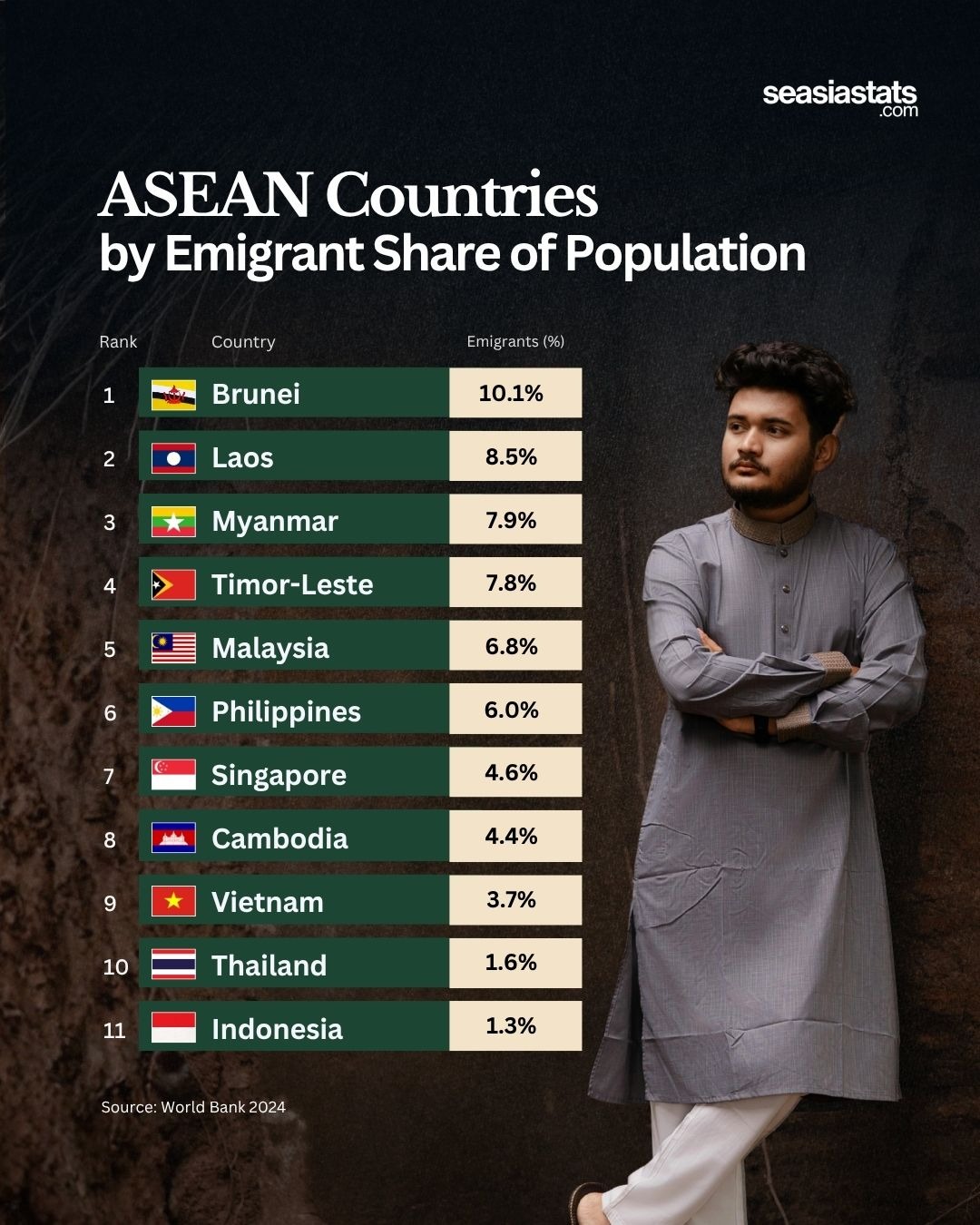
Despite its small size, Brunei has the largest emigrant share of population in Southeast Asia.

Migration has long played an important role in Southeast Asia, connecting countries through employment, family networks, education, and economic opportunities.
According to the figures provided from the World Bank, the share of emigrants varies considerably across the region, reflecting differences in population size, economic conditions, labor markets, and historical migration patterns.
The World Bank’s migration data are based on international migrant statistics, while its broader migration indicators draw on internationally comparable sources.
Brunei has the highest emigrant share among the Southeast Asian countries listed, at 10.1% of its population. Despite its small population and high income from energy resources, a notable proportion of its population lives abroad.
Laos follows with 8.5%, while Myanmar records 7.9%. These relatively high shares demonstrate the importance of migration as an economic and social strategy for households in countries where employment opportunities can be more limited.
Timor-Leste, with an emigrant share of 7.8%, also has a substantial proportion of its population living outside the country. Migration has historically provided opportunities for Timorese workers and families to seek employment and income abroad.
Malaysia ranks next at 6.8%, followed by the Philippines at 6.0%. The Philippines is particularly well known for international labor migration, with millions of Filipinos working and living overseas.
Interestingly, Singapore has an emigrant share of 4.6%. As a major international financial and business center, Singapore has strong connections with the global economy, and its citizens have opportunities to study, work, and settle abroad. Cambodia follows with 4.4%, while Vietnam records 3.7%.
At the lower end of the ranking are Thailand, with an emigrant share of 1.6%, and Indonesia, at just 1.3%. Indonesia's relatively low percentage is partly explained by its enormous population. Even though millions of Indonesians live overseas, they represent a relatively small proportion of the country's total population.
Overall, these figures highlight the diverse migration patterns across Southeast Asia. Countries with higher emigrant shares often have strong traditions of overseas employment or significant economic incentives for people to seek opportunities abroad.
Meanwhile, countries such as Indonesia and Thailand have much smaller emigrant shares relative to their large populations. Migration therefore remains an important feature of Southeast Asia's demographic and economic landscape, influencing labor markets, family incomes, and connections between countries.